


Two merging galaxy groups put on a spectacular display for Chandra telescope
The groups are located about 380 million light-years from Earth and will form a cluster after the merger.

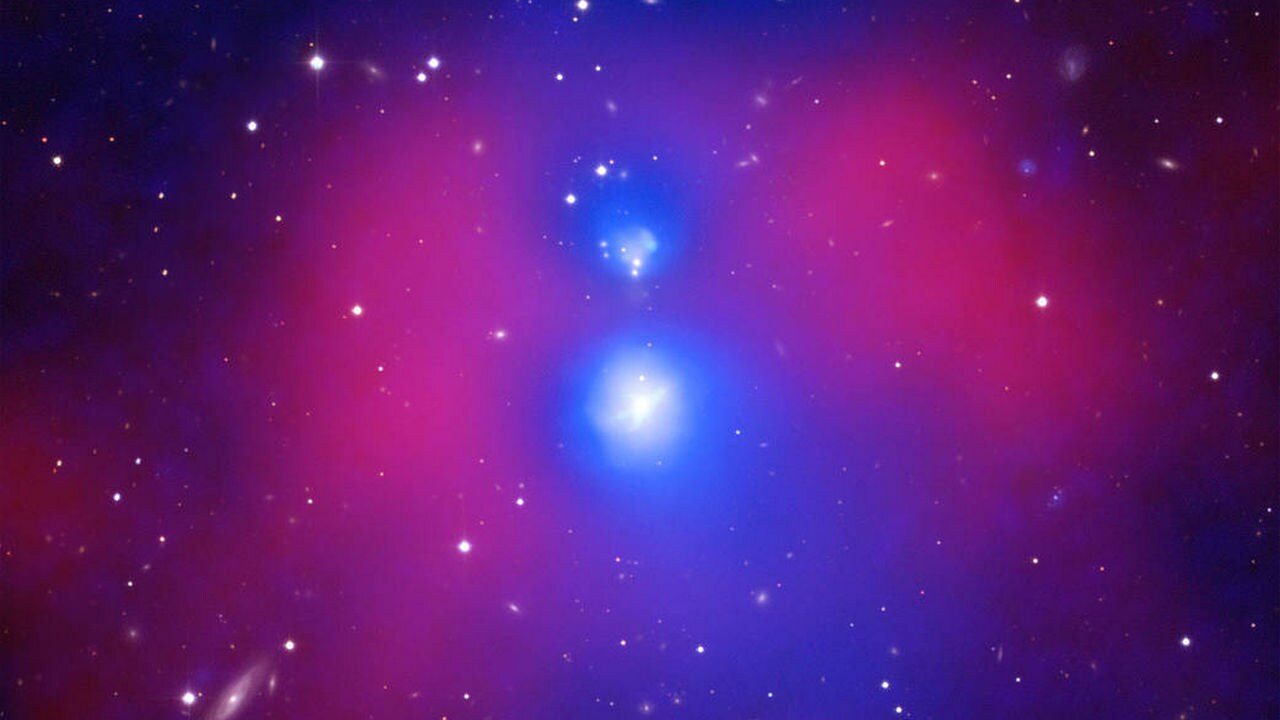
The two galaxy groups that are on the path to merging. The red hot gas is heated to around 20 million degrees Celsius and the blue cooler gas emits X-rays. Image credit: NASA[/caption]The galaxy groups merging together have been named NGC 6338 and they are located about 380 million light-years from Earth. After they merge the galaxy groups will become a galaxy cluster and continue to accumulate more galaxies through gravity.The total mass contained in NGC 6338 is about 100 trillion times the mass of the Sun. The mass can be broken down into being roughly 83 percent of dark matter, 16 percent is in the form of hot gas, and 1 percent is made up of stars.The Chandra X-ray Observatory, ESA’s XMM-Newton, the Giant Metrewave Radio Telescope (GMRT), and the Apache Point Observatory in New Mexico were used to make these observations. In the image, in red is hot gas that is heated to about 20 million degrees Celsius. Cooler gas has been detected by Chandra and XMM (shown in blue) emits x-rays. The data from the observatory has been combined with data from the Sloan Digital Sky Survey to show the stars and other galaxies in white.The findings from these Chandra telescope observations have been published in a journal the Monthly Notices of the Royal Astronomical Society.

Careless Whispers: Scientists discover that plants can 'talk' to each other using smells
Life on Mars? European Space Agency’s Orbiter discovers ice water deposits at equator
Microsoft briefly overtakes Apple as the most valuable company, Apple back on top again
Even NASA is facing a tough time, starts layoffs following major budget cuts
ISRO, NASA's NISAR satellite to get ready by Jan-end, will monitor Earth's snow-covered regions