
Advertisement


Sections
Travelling to Mars may not be the hardest part for humans, it will be communication says scientist on Twitter
As per the video, it takes three minutes and two seconds for a signal from Earth to travel to Mars at light speed.

Even as the National Aeronautics and Space Administration (NASA) and its commercial partners are working to develop methods to send humans to Mars, James O'Donoghue, a planetary scientist at the Japan Aerospace Exploration Agency (JAXA) showed that there may be a few difficulties. Through a simple animation, he highlighted the communications delay that future astronauts, travelling and staying on Mars, could face.[caption id="attachment_9002711" align="alignnone" width="1280"]![This artist's concept shows what Deep Space Station-23, a new antenna dish capable of supporting both radio wave and laser communications, will look like when completed at the Deep Space Network's Goldstone, California, complex. Image Credits: NASA/JPL-Caltech]()
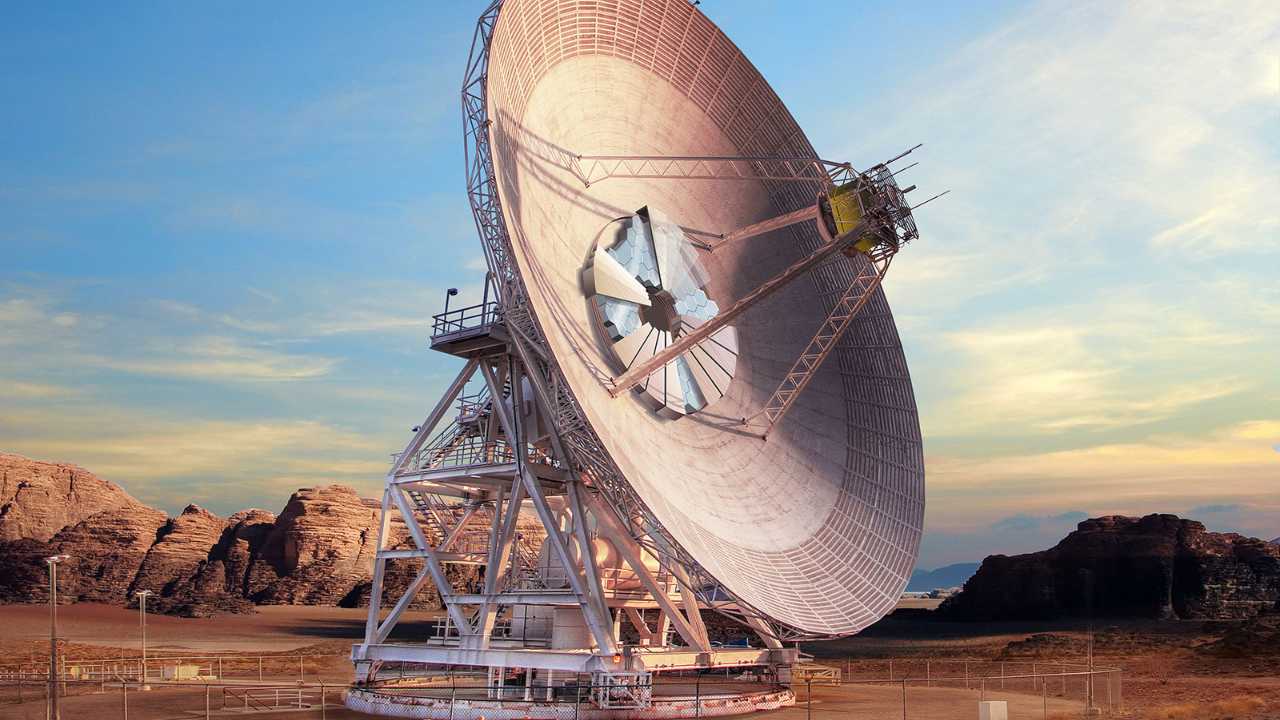
This artist's concept shows what Deep Space Station-23, a new antenna dish capable of supporting both radio wave and laser communications, will look like when completed at the Deep Space Network's Goldstone, California, complex.
Image Credits: NASA/JPL-Caltech[/caption]Taking to Twitter, O'Donoghue wrote, "Light speed radio communication between Earth and the Moon isn't so bad, but using it to video chat with Martian astronauts is going to be tough, even when Mars is closest to Earth. Here light is emitted as a pulse every 3.36 seconds, making the pulses separated by 1 million km."As per the video, it takes three minutes and two seconds for a signal from Earth to travel to Mars at light speed.Currently, the communication links between scientists and engineers on Earth and robots on Marsh is done through an international network of antennas called the NASA Deep Space Network (DSN).The DSN consists of three deep-space communications facilities placed approximately 120 degrees apart around the world, at Goldstone, California; near Madrid, Spain and near Canberra, Australia.According to a report in Business Insider, if mission controllers want to send a command to a robot on the marsh, the DNS antenna beams it across space to Marsh-orbiting satellites which direct it to the surface. However, the agency plans to upgrade the space-laser communication by the time it launches its first astronauts to Mars.NASA wants to make use of lasers which can transmit data at 10 to 100 times the rate of radio waves. The space agency is set to launch new satellites to try out space-laser communications in Earth's orbit in 2021.
Keywords:
Also Read
pic.twitter.com/AXI7piceLv
First Published:Nov 11, 2020, 10:55:22 IST
Advertisement
Advertisement

Careless Whispers: Scientists discover that plants can 'talk' to each other using smells
Japanese scientists have recorded a video that shows plants, in certain conditions, communicate with each other using mists that carry smells. The discovery, reveals that plants release a fine mist of airborne compounds, to warn nearby plants of potential dangers
Life on Mars? European Space Agency’s Orbiter discovers ice water deposits at equator
European Space Agency's Mars Express Orbiter has identified massive ice and ice water deposits beneath the surface of Mars. The Mars Express orbiter was also the first to confirmed the presence of ice on Mars in 2004
Microsoft briefly overtakes Apple as the most valuable company, Apple back on top again
At its peak during the session, Microsoft's value reached $2.903 trillion, with a 2% surge. As of writing this article, Apple closed at $2.89 trillion, whereas Microsoft closed at $2.86 trillion
Even NASA is facing a tough time, starts layoffs following major budget cuts
NASA is facing some massive budget cuts, because of which, it has been forced to postpone some upcoming missions. NASA's Jet Propulsion Laboratory has been hit hard by recent federal budget cuts, resulting in the layoff of 100 contractors last week
ISRO, NASA's NISAR satellite to get ready by Jan-end, will monitor Earth's snow-covered regions
The NISAR satellite which has been developed jointly ISRO and NASA, should be ready for launch by the end of January 2024. The collaboration between NASA and ISRO on NISAR is the first time the two agencies have cooperated on hardware development for an Earth-observing mission
Advertisement
Advertisement