
Advertisement


Sections
Touchdown! Japan's Hayabusa2 spacecraft lands on distant asteroid to grab sample
The complicated mission took less time than expected & seemed to complete with no trouble: JAXA.

A Japanese probe sent to collect samples from an asteroid 300 million kilometres away for clues about the origin of life and the solar system landed successfully on Friday, scientists said.Hayabusa2 touched down briefly on the Ryugu asteroid, fired a bullet into the surface to puff up dust for collection and blasted back to its holding position, said officials from the Japan Aerospace Exploration Agency (JAXA).A live webcast of the control room showed dozens of JAXA staff members nervously monitoring data ahead of the touchdown before exploding into applause after receiving a signal from Hayabusa2 that it had landed."We made a successful touchdown, including firing a bullet" into the Ryugu asteroid, Yuichi Tsuda, Hayabusa-2 project manager, told reporters."We made the ideal touchdown in the best conditions," he said.The complicated procedure took less time than expected and appeared to go without a hitch, said Hayabusa2 mission manager Makoto Yoshikawa."I'm really relieved now. It felt very long until the moment the touchdown happened," he said.He said the firing of the bullet — the first of three planned in this mission — "will lead to a leap, or new discoveries, in planetary science."The asteroid is thought to contain relatively large amounts of organic matter and water from some 4.6 billion years ago when the solar system was born.[caption id="attachment_5235041" align="alignnone" width="1280"]![Representational image of Hayabusa-2 attempting to touchdown on Ryugu. DLR]() Representational image of Hayabusa-2 attempting to touchdown on Ryugu. DLR[/caption]During a later mission, Hayabusa2 will eventually fire an "impactor" to blast out material from underneath Ryugu's surface, allowing the collection of "fresh" materials unexposed to millennia of wind and radiation.Scientists hope those samples may provide answers to some fundamental questions about life and the universe, including whether elements from space helped give rise to life on Earth.Former Queen rocker and space fan Brian May tweeted: "Hurrah. Brilliant success in touchdown on Ryugu."Spinning-top shapeCommunication with Hayabusa2 is cut off at times because its antennas are not always pointed towards Earth and it could take several more days to confirm the bullet was actually fired to allow the collection of samples.The mission has not been completely plain sailing and the probe's landing was originally scheduled for last year.[caption id="attachment_6133891" align="alignnone" width="1280"]
Representational image of Hayabusa-2 attempting to touchdown on Ryugu. DLR[/caption]During a later mission, Hayabusa2 will eventually fire an "impactor" to blast out material from underneath Ryugu's surface, allowing the collection of "fresh" materials unexposed to millennia of wind and radiation.Scientists hope those samples may provide answers to some fundamental questions about life and the universe, including whether elements from space helped give rise to life on Earth.Former Queen rocker and space fan Brian May tweeted: "Hurrah. Brilliant success in touchdown on Ryugu."Spinning-top shapeCommunication with Hayabusa2 is cut off at times because its antennas are not always pointed towards Earth and it could take several more days to confirm the bullet was actually fired to allow the collection of samples.The mission has not been completely plain sailing and the probe's landing was originally scheduled for last year.[caption id="attachment_6133891" align="alignnone" width="1280"]![An illustration of Hayabusa-2 heading for Ryugu. Image credit: German Aerospace Center]() An illustration of Hayabusa-2 heading for Ryugu. Image credit: German Aerospace Center[/caption]But it was pushed back after surveys found the asteroid's surface was more rugged than initially thought, forcing JAXA to take more time to find a suitable landing site.The Hayabusa-2 mission, with a price tag of around 30 billion yen ($270 million), was launched in December 2014 and is scheduled to return to Earth with its samples in 2020.Photos of Ryugu — which means "Dragon Palace" in Japanese and refers to a castle at the bottom of the ocean in an ancient Japanese tale — show an asteroid shaped a bit like a spinning top with a rough surface.Hayabusa-2 observes the surface of the asteroid with its camera and sensing equipment but has also dispatched two tiny MINERVA-II rover robots as well as the French-German robot MASCOT to help surface observation. Scientists have already received data from these probes deployed on the surface of the asteroid.At about the size of a large fridge, Hayabusa-2 is equipped with solar panels and is the successor to JAXA's first asteroid explorer, Hayabusa — Japanese for falcon.That probe returned from a smaller, potato-shaped, asteroid in 2010 with dust samples despite various setbacks during its epic seven-year Odyssey and was hailed as a scientific triumph.
An illustration of Hayabusa-2 heading for Ryugu. Image credit: German Aerospace Center[/caption]But it was pushed back after surveys found the asteroid's surface was more rugged than initially thought, forcing JAXA to take more time to find a suitable landing site.The Hayabusa-2 mission, with a price tag of around 30 billion yen ($270 million), was launched in December 2014 and is scheduled to return to Earth with its samples in 2020.Photos of Ryugu — which means "Dragon Palace" in Japanese and refers to a castle at the bottom of the ocean in an ancient Japanese tale — show an asteroid shaped a bit like a spinning top with a rough surface.Hayabusa-2 observes the surface of the asteroid with its camera and sensing equipment but has also dispatched two tiny MINERVA-II rover robots as well as the French-German robot MASCOT to help surface observation. Scientists have already received data from these probes deployed on the surface of the asteroid.At about the size of a large fridge, Hayabusa-2 is equipped with solar panels and is the successor to JAXA's first asteroid explorer, Hayabusa — Japanese for falcon.That probe returned from a smaller, potato-shaped, asteroid in 2010 with dust samples despite various setbacks during its epic seven-year Odyssey and was hailed as a scientific triumph.
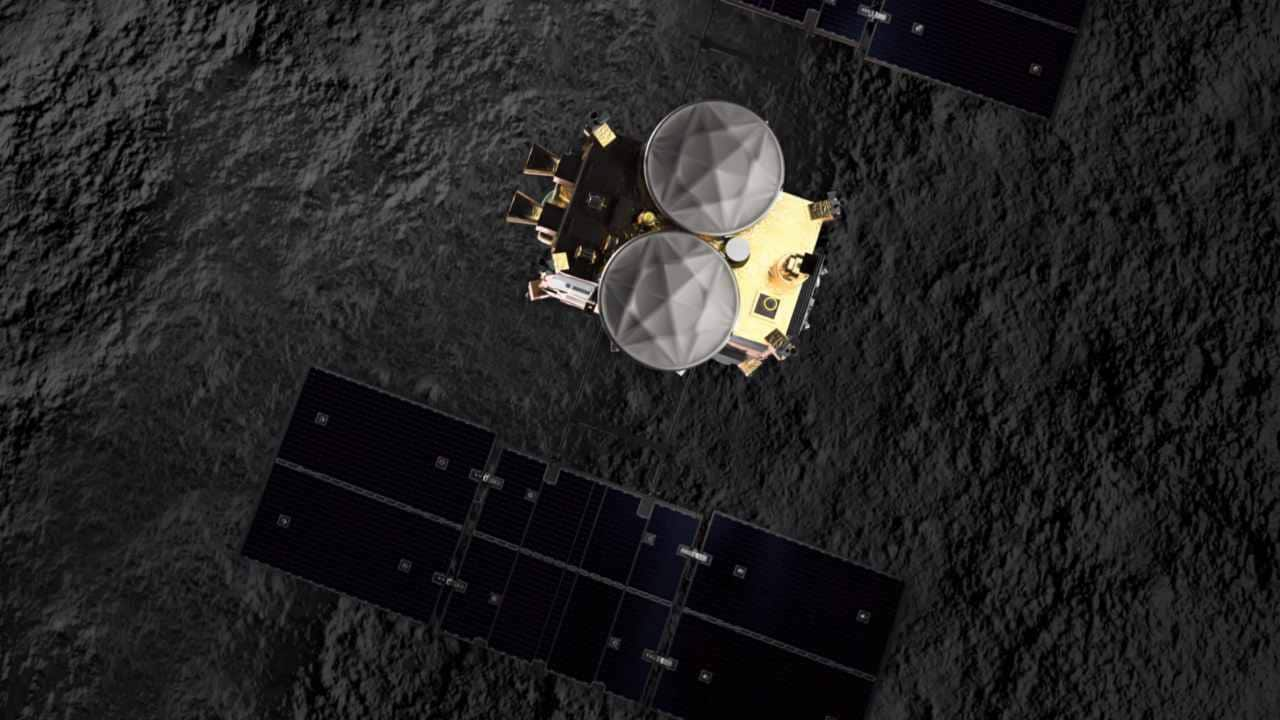 Representational image of Hayabusa-2 attempting to touchdown on Ryugu. DLR[/caption]During a later mission, Hayabusa2 will eventually fire an "impactor" to blast out material from underneath Ryugu's surface, allowing the collection of "fresh" materials unexposed to millennia of wind and radiation.Scientists hope those samples may provide answers to some fundamental questions about life and the universe, including whether elements from space helped give rise to life on Earth.Former Queen rocker and space fan Brian May tweeted: "Hurrah. Brilliant success in touchdown on Ryugu."Spinning-top shapeCommunication with Hayabusa2 is cut off at times because its antennas are not always pointed towards Earth and it could take several more days to confirm the bullet was actually fired to allow the collection of samples.The mission has not been completely plain sailing and the probe's landing was originally scheduled for last year.[caption id="attachment_6133891" align="alignnone" width="1280"]
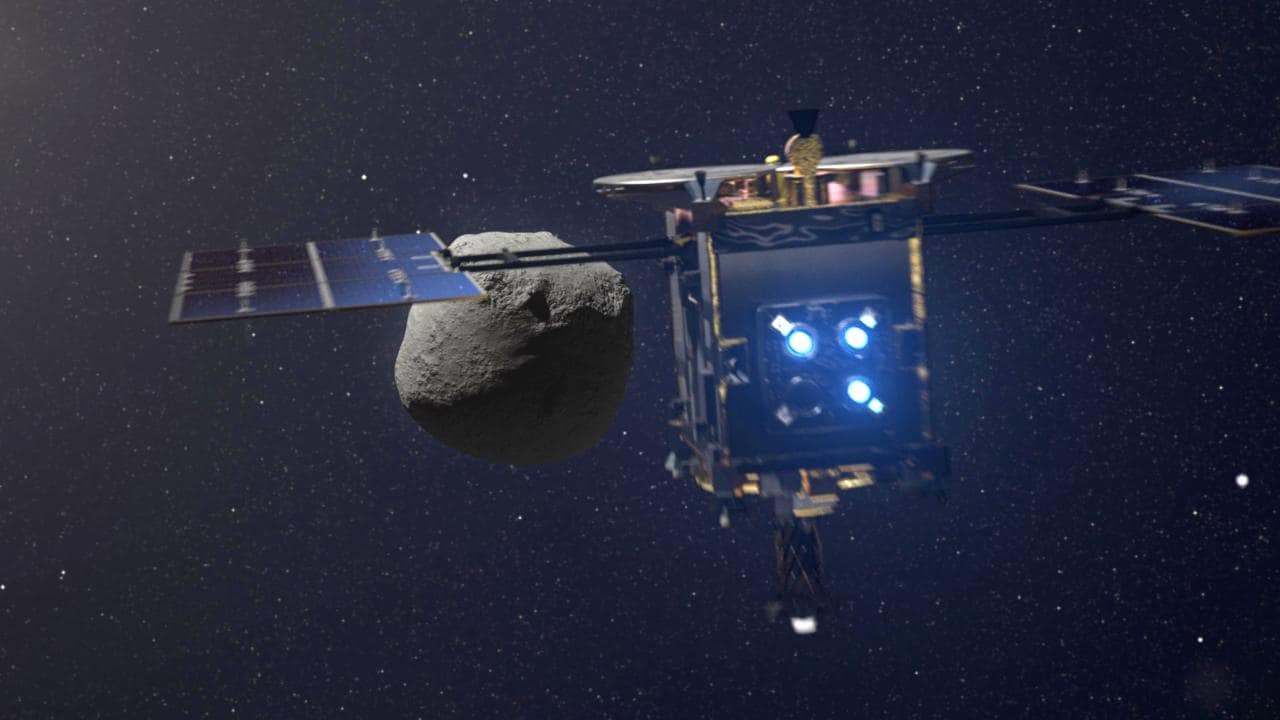 An illustration of Hayabusa-2 heading for Ryugu. Image credit: German Aerospace Center[/caption]But it was pushed back after surveys found the asteroid's surface was more rugged than initially thought, forcing JAXA to take more time to find a suitable landing site.The Hayabusa-2 mission, with a price tag of around 30 billion yen ($270 million), was launched in December 2014 and is scheduled to return to Earth with its samples in 2020.Photos of Ryugu — which means "Dragon Palace" in Japanese and refers to a castle at the bottom of the ocean in an ancient Japanese tale — show an asteroid shaped a bit like a spinning top with a rough surface.Hayabusa-2 observes the surface of the asteroid with its camera and sensing equipment but has also dispatched two tiny MINERVA-II rover robots as well as the French-German robot MASCOT to help surface observation. Scientists have already received data from these probes deployed on the surface of the asteroid.At about the size of a large fridge, Hayabusa-2 is equipped with solar panels and is the successor to JAXA's first asteroid explorer, Hayabusa — Japanese for falcon.That probe returned from a smaller, potato-shaped, asteroid in 2010 with dust samples despite various setbacks during its epic seven-year Odyssey and was hailed as a scientific triumph.
First Published:Feb 22, 2019, 11:07:39 IST
Advertisement
Advertisement

Careless Whispers: Scientists discover that plants can 'talk' to each other using smells
Japanese scientists have recorded a video that shows plants, in certain conditions, communicate with each other using mists that carry smells. The discovery, reveals that plants release a fine mist of airborne compounds, to warn nearby plants of potential dangers
Life on Mars? European Space Agency’s Orbiter discovers ice water deposits at equator
European Space Agency's Mars Express Orbiter has identified massive ice and ice water deposits beneath the surface of Mars. The Mars Express orbiter was also the first to confirmed the presence of ice on Mars in 2004
Microsoft briefly overtakes Apple as the most valuable company, Apple back on top again
At its peak during the session, Microsoft's value reached $2.903 trillion, with a 2% surge. As of writing this article, Apple closed at $2.89 trillion, whereas Microsoft closed at $2.86 trillion
Even NASA is facing a tough time, starts layoffs following major budget cuts
NASA is facing some massive budget cuts, because of which, it has been forced to postpone some upcoming missions. NASA's Jet Propulsion Laboratory has been hit hard by recent federal budget cuts, resulting in the layoff of 100 contractors last week
ISRO, NASA's NISAR satellite to get ready by Jan-end, will monitor Earth's snow-covered regions
The NISAR satellite which has been developed jointly ISRO and NASA, should be ready for launch by the end of January 2024. The collaboration between NASA and ISRO on NISAR is the first time the two agencies have cooperated on hardware development for an Earth-observing mission
Advertisement
Advertisement