
Advertisement


Sections
TIFR-NCRA Pune team's images of the Sun broaden understanding of solar flares
From a million high-contrast images, the team has helped understand flares, space weather better.

After the first-ever image of a black hole blew up online all last week, a team of astronomers based in Pune has captured 1,000x better images of the Sun from radio telescopes than previously possible.Radio data from observing the Sun was collected by a radio telescope called the Murchison Widefield Array (MWA) located in Murchison Radio-astronomy Observatory (MRO) in the Shire of Murchison in Western Australia. The team was led by Dr Divya Oberoi.[caption id="attachment_6458811" align="alignnone" width="1280"]![SolarFlare]() Solar Flare captured by The Extreme Ultraviolet Imager in the 195A emission line aboard the SOHO spacecraft captured the event. Image credit: NASA/SOHO[/caption]While the Sun is at the heart of our solar system, there's still a lot left to know about. Shrouded in mystery, this team has been researching the effects of the Sun on space weather and communication satellites. Solar flares can cause a lot of disruption all over the world. These can manifest as radio and GPS interference, electrical disturbances and blackouts, among others phenomena. Solar flares are intense bursts of radiation coming from strong magnetic field lines of the Sun crossing one another. These bursts can last for anywhere between a few minutes to a few hours.Studying solar flares is important because it can predict when they occur and help us be better prepared to deal with the fallout. An ingenious software package called 'Automated Imaging Routine for Compact Arrays for the Radio Sun' (AIRCARS) was developed to predict and understand space weather using data that was previously available.[caption id="attachment_6287911" align="aligncenter" width="1280"]
Solar Flare captured by The Extreme Ultraviolet Imager in the 195A emission line aboard the SOHO spacecraft captured the event. Image credit: NASA/SOHO[/caption]While the Sun is at the heart of our solar system, there's still a lot left to know about. Shrouded in mystery, this team has been researching the effects of the Sun on space weather and communication satellites. Solar flares can cause a lot of disruption all over the world. These can manifest as radio and GPS interference, electrical disturbances and blackouts, among others phenomena. Solar flares are intense bursts of radiation coming from strong magnetic field lines of the Sun crossing one another. These bursts can last for anywhere between a few minutes to a few hours.Studying solar flares is important because it can predict when they occur and help us be better prepared to deal with the fallout. An ingenious software package called 'Automated Imaging Routine for Compact Arrays for the Radio Sun' (AIRCARS) was developed to predict and understand space weather using data that was previously available.[caption id="attachment_6287911" align="aligncenter" width="1280"]![A solar flare erupts on the far right side of the sun, in this image captured by NASA's Solar Dynamics Observatory. Image: NASA Goddard]() A solar flare erupts on the far right side of the sun, in this image captured by NASA's Solar Dynamics Observatory. Image: NASA Goddard[/caption]"Previously, people could look at only the bright flares, which is the tip of the iceberg. For understanding the space weather what is needed is the details which are hidden in the faint end," Surajit Mondal, lead author of the AIRCARS project, told Indian Express. With the help of AIRCARS, the team generated almost a million high-contrast images of the Sun. These images showed that the activity does not take place only on the surface, but also deeper in the core.Over the last several years, Dr Oberoi and his PhD students Rohit Sharma, Atul Mohan, Surajit Mondal, along with several international collaborators have been searching for ways and means to uncover more of the Sun's mysteries using the MWA data. Both the team's papers will be featured in The Astrophysical Journal of the American Astronomical Society.
A solar flare erupts on the far right side of the sun, in this image captured by NASA's Solar Dynamics Observatory. Image: NASA Goddard[/caption]"Previously, people could look at only the bright flares, which is the tip of the iceberg. For understanding the space weather what is needed is the details which are hidden in the faint end," Surajit Mondal, lead author of the AIRCARS project, told Indian Express. With the help of AIRCARS, the team generated almost a million high-contrast images of the Sun. These images showed that the activity does not take place only on the surface, but also deeper in the core.Over the last several years, Dr Oberoi and his PhD students Rohit Sharma, Atul Mohan, Surajit Mondal, along with several international collaborators have been searching for ways and means to uncover more of the Sun's mysteries using the MWA data. Both the team's papers will be featured in The Astrophysical Journal of the American Astronomical Society.
 Solar Flare captured by The Extreme Ultraviolet Imager in the 195A emission line aboard the SOHO spacecraft captured the event. Image credit: NASA/SOHO[/caption]While the Sun is at the heart of our solar system, there's still a lot left to know about. Shrouded in mystery, this team has been researching the effects of the Sun on space weather and communication satellites. Solar flares can cause a lot of disruption all over the world. These can manifest as radio and GPS interference, electrical disturbances and blackouts, among others phenomena. Solar flares are intense bursts of radiation coming from strong magnetic field lines of the Sun crossing one another. These bursts can last for anywhere between a few minutes to a few hours.Studying solar flares is important because it can predict when they occur and help us be better prepared to deal with the fallout. An ingenious software package called 'Automated Imaging Routine for Compact Arrays for the Radio Sun' (AIRCARS) was developed to predict and understand space weather using data that was previously available.[caption id="attachment_6287911" align="aligncenter" width="1280"]
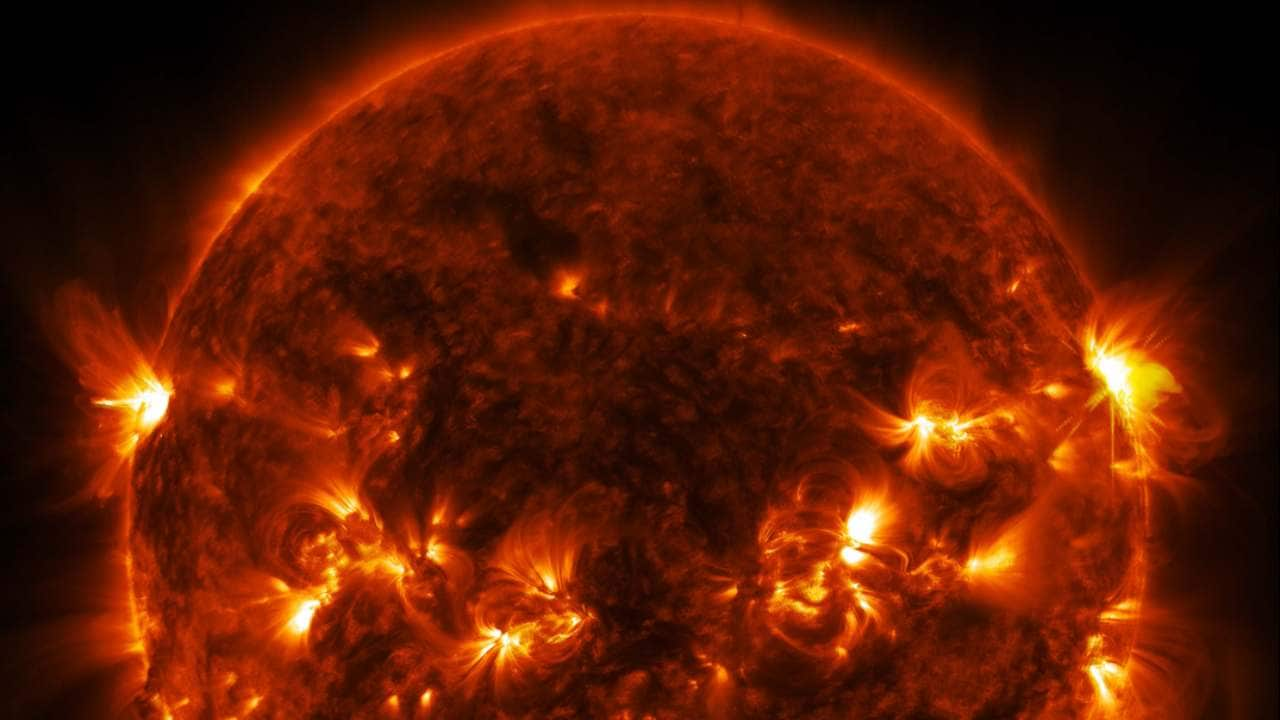 A solar flare erupts on the far right side of the sun, in this image captured by NASA's Solar Dynamics Observatory. Image: NASA Goddard[/caption]"Previously, people could look at only the bright flares, which is the tip of the iceberg. For understanding the space weather what is needed is the details which are hidden in the faint end," Surajit Mondal, lead author of the AIRCARS project, told Indian Express. With the help of AIRCARS, the team generated almost a million high-contrast images of the Sun. These images showed that the activity does not take place only on the surface, but also deeper in the core.Over the last several years, Dr Oberoi and his PhD students Rohit Sharma, Atul Mohan, Surajit Mondal, along with several international collaborators have been searching for ways and means to uncover more of the Sun's mysteries using the MWA data. Both the team's papers will be featured in The Astrophysical Journal of the American Astronomical Society.
First Published:Apr 16, 2019, 18:27:58 IST
Advertisement
Advertisement

Careless Whispers: Scientists discover that plants can 'talk' to each other using smells
Japanese scientists have recorded a video that shows plants, in certain conditions, communicate with each other using mists that carry smells. The discovery, reveals that plants release a fine mist of airborne compounds, to warn nearby plants of potential dangers
Life on Mars? European Space Agency’s Orbiter discovers ice water deposits at equator
European Space Agency's Mars Express Orbiter has identified massive ice and ice water deposits beneath the surface of Mars. The Mars Express orbiter was also the first to confirmed the presence of ice on Mars in 2004
Microsoft briefly overtakes Apple as the most valuable company, Apple back on top again
At its peak during the session, Microsoft's value reached $2.903 trillion, with a 2% surge. As of writing this article, Apple closed at $2.89 trillion, whereas Microsoft closed at $2.86 trillion
Even NASA is facing a tough time, starts layoffs following major budget cuts
NASA is facing some massive budget cuts, because of which, it has been forced to postpone some upcoming missions. NASA's Jet Propulsion Laboratory has been hit hard by recent federal budget cuts, resulting in the layoff of 100 contractors last week
ISRO, NASA's NISAR satellite to get ready by Jan-end, will monitor Earth's snow-covered regions
The NISAR satellite which has been developed jointly ISRO and NASA, should be ready for launch by the end of January 2024. The collaboration between NASA and ISRO on NISAR is the first time the two agencies have cooperated on hardware development for an Earth-observing mission
Advertisement
Advertisement