


Tidal heating explains why Jupiter’s moons are far hotter than researchers expect, study claims
Jupiter has nearly 80 moons, including Io, Europa, Ganymede and Callisto, which are the four largest.

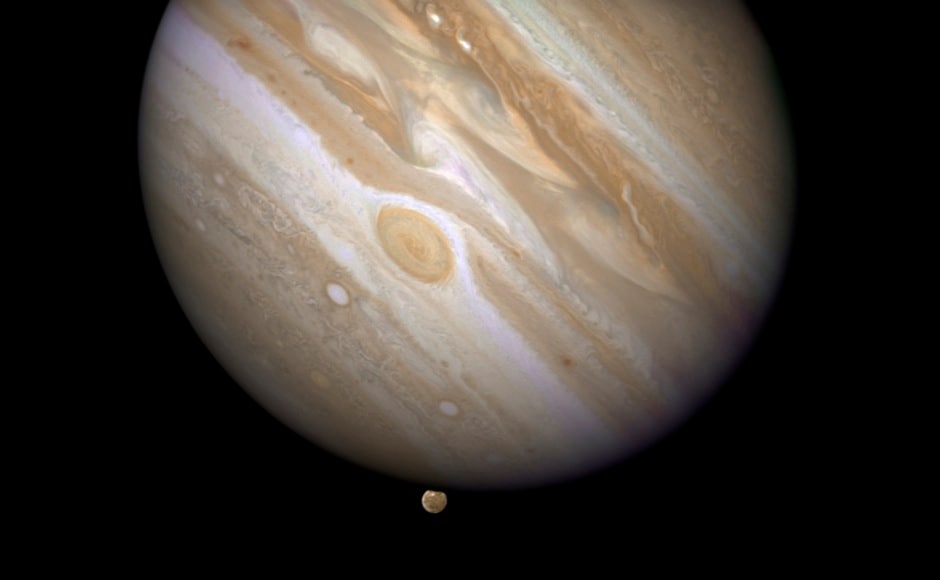
The planet Jupiter is shown with one of its moons, Ganymede (bottom), in this NASA image captured on 9 April 2007. Scientists using the Hubble Space Telescope have confirmed that the Jupiter-orbiting moon Ganymede has an ocean beneath its icy surface, raising the prospects for life, NASA said on Thursday. Image: NASA[/caption]Researchers are of the opinion that understanding how the moons influence each other could shed light on the evolution of the moon system as a whole.Co-author of the study Antony Trinh added that maintaining subsurface oceans against freezing over geological times require a fine balance between internal heating and heat loss, and yet researchers have several pieces of evidence that moons like Europa, Ganymede, Callisto and others should have ocean worlds. Io, which is closest to Jupiter, on its part, shows widespread volcanic activity which is another consequence of tidal heating."Ultimately, we want to understand the source of all this heat, both for its influence on the evolution and habitability of the many worlds across the solar system and beyond," Trinh added.According to study authors, tidal heating works through what's called tidal resonance, which means that the moons are essentially being vibrated at certain frequencies, and it's a phenomenon that happens everywhere there's water, including Earth.As per Hay, resonance creates more heating. According to him if a person pushes any object or system and let go, it wobbles at its own frequency. He added that if one keeps on pushing the system at right frequency, the oscillations get bigger and bigger. If one pushes at the right time, it goes higher but if the timing goes wrong then the motion gets dampened.While calculating these natural frequencies, researchers discovered that the tidal resonance of Jupiter alone don't match the sizes of the oceans through to be on these moons. According to study authors it is only when gravitational forces from the moons themselves are also added in that the tidal forces match current estimates of the moon oceans.According to the scientists, the overall tidal heating might be enough to melt ice and rock inside the moons.

Careless Whispers: Scientists discover that plants can 'talk' to each other using smells
Life on Mars? European Space Agency’s Orbiter discovers ice water deposits at equator
Microsoft briefly overtakes Apple as the most valuable company, Apple back on top again
Even NASA is facing a tough time, starts layoffs following major budget cuts
ISRO, NASA's NISAR satellite to get ready by Jan-end, will monitor Earth's snow-covered regions