


Thirteen dwarf galaxies found housing massive black holes — but not at their centers
These dwarf galaxies have black holes that are about 4,00,000 times the mass of our Sun.

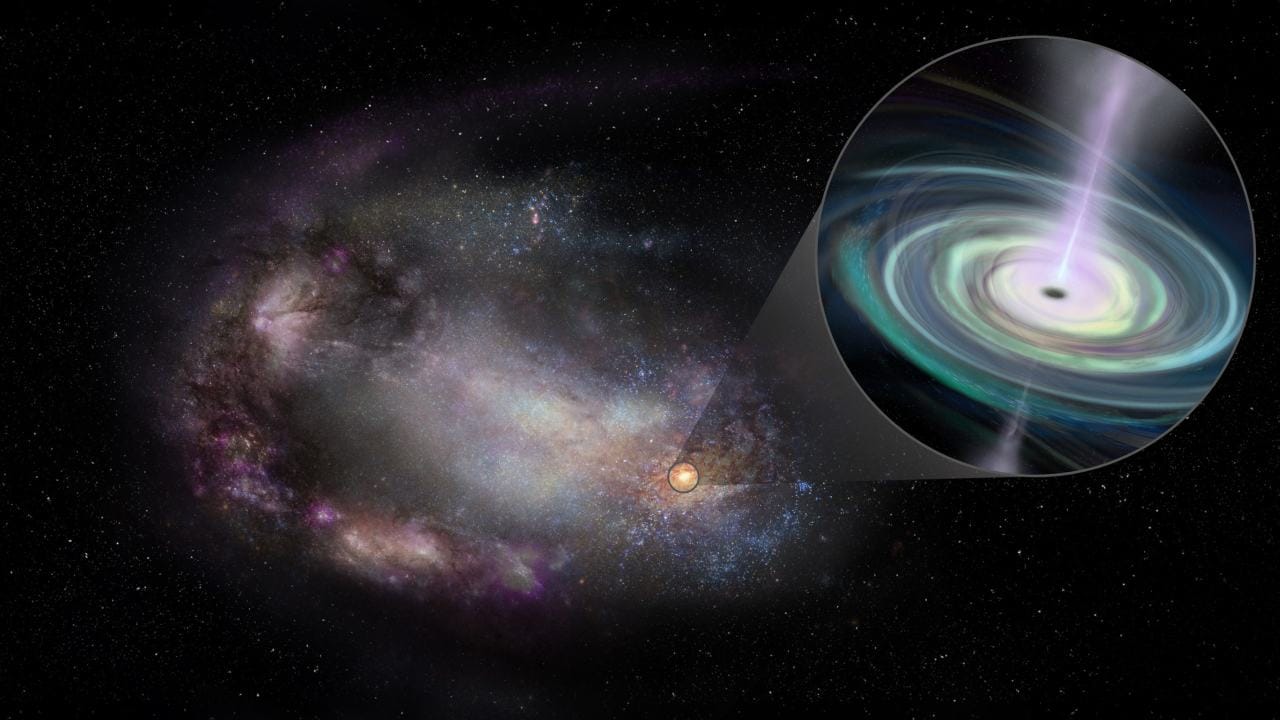
Artist's conception of a dwarf galaxy, its shape distorted, most likely by a past interaction with another galaxy, and a massive black hole in its outskirts (pullout). The black hole is drawing in material that forms a rotating disk and generates jets of material propelled outward. Image Credit: Sophia Dagnello/NRAO/AUI/NSF[/caption]In 2011, Montana State University scientist Amy Reines and her team found the first evidence of a massive black hole in a dwarf galaxy. This spurred their study on, leading them to explore galaxies from the NASA-Sloan Atlas — a catalog of images and parameters of local galaxies sourced from the Sloan Digital Sky Survey and Galaxy Evolution Explorer (GALEX) data to study objects in the ultraviolet spectrum. The team of astronomers chose a total of 111 galaxies, with all the stars collectively adding up to three billion times the sun's mass.The team also picked candidate dwarf galaxies from the National Radio Astronomy Observatory’s Faint Images of the Radio Sky at Twenty centimeters (FIRST) Survey, carried out between 1993 and 2011. The National Science Foundation's Very Large Array (VLA) telescope was used to take more sensitive, high-resolution images of some select galaxies.

Careless Whispers: Scientists discover that plants can 'talk' to each other using smells
Life on Mars? European Space Agency’s Orbiter discovers ice water deposits at equator
Microsoft briefly overtakes Apple as the most valuable company, Apple back on top again
Even NASA is facing a tough time, starts layoffs following major budget cuts
ISRO, NASA's NISAR satellite to get ready by Jan-end, will monitor Earth's snow-covered regions