


The closest black hole yet discovered is a mere 1,000 lightyears away, reveals ESO study
This is one of the very first stellar-mass black holes that does not interact violently with its environment and appear truly black.

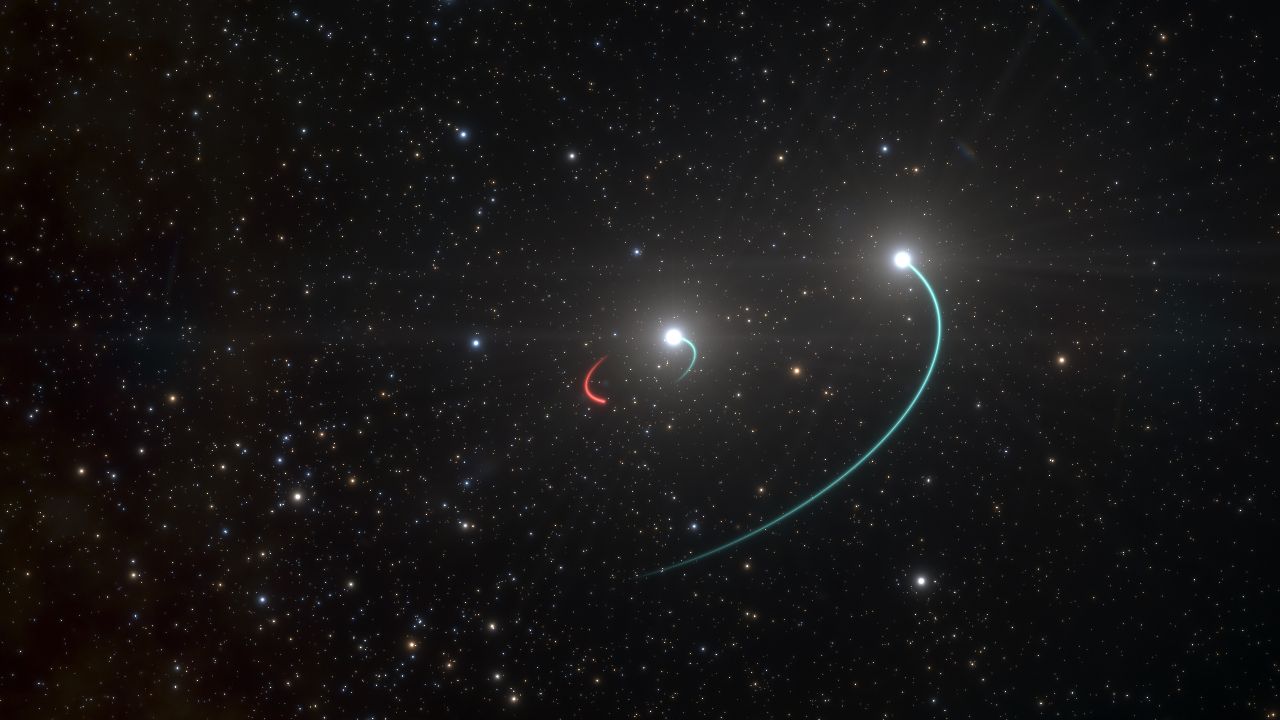
This artist’s impression shows the orbits of the objects in the HR 6819 triple system. This system is made up of an inner binary with one star (orbit in blue) and a newly discovered black hole (orbit in red), as well as a third object, another star, in a wider orbit (also in blue). Image credit: ESO/L. Calçada[/caption]Researchers say that one of the two visible stars orbits an unseen object every 40 days. They further discovered that the second star is at a larger distance from the inner pair. Study authors found that the unseen object had a mass that was four times that of the Sun, reaching the conclusion that it had to be a black hole.The black hole found in the star system HR 6819 is one of the very first stellar-mass black holes “which do not interact violently with their environment and, therefore, appear truly black.”Till date, only a couple of dozen black holes have been spotted in our galaxy. Most of them strongly interact with their environment and they release powerful X-rays during the interaction, making their presence felt.Scientists believe that many more black holes could be found in the future.“We realised that another system, called LB-1, may also be such a triple, though we'd need more observations to say for sure,” revealed Marianne Heida, another co-author of the study.In follow-up work to the study, Petr Hadrava aims to find out more about the light being given off by HR 6819 and in-process find out the identities of the two stars.

Careless Whispers: Scientists discover that plants can 'talk' to each other using smells
Life on Mars? European Space Agency’s Orbiter discovers ice water deposits at equator
Microsoft briefly overtakes Apple as the most valuable company, Apple back on top again
Even NASA is facing a tough time, starts layoffs following major budget cuts
ISRO, NASA's NISAR satellite to get ready by Jan-end, will monitor Earth's snow-covered regions