
Advertisement


Sections
Sweeping stretches of Arctic forests are burning, ‘unprecedented’ satellite images show
This, after the hottest June on global record, followed by a devastating heatwave in the US & forecast for the same in Europe.

Sweeping stretches of the Arctic are on going up in flames, suffering from "unprecedented" wildfires, according to satellite images of the region released by the World Meteorological Organisation's (WMO's) Global Atmosphere Watch Programme. The unusually hot and dry conditions in parts of the northern hemisphere above the Arctic Circle have been conducive to wildfires that begin as far as 5,000 kilometres away near the Mediterranean Sea. Climate change and dramatic changes in temperature and pattern of precipitation are increasing the risk of wildfires and the length of wildlife season, the WMO said in a release.The WMO has described the fires in the northern hemisphere as "unprecedented" and warned of the enormous impact they could have on CO2 levels and the already-severe climate crisis currently underway. The visuals shared by WMO are taken by the Copernicus Sentinel-2 operated by the European Space Agency (ESA).[caption id="attachment_7048181" align="alignnone" width="1280"]![]() Smoke from wildfires over Alaska, modified from Copernicus Sentinel data (2019) Image credit: Pierre Markuse (Click to see in high resolution)[/caption]Senior scientist at the European Centre for Medium-Range Weather Forecasting, Mark Parrington, tweeted about the amount of carbon dioxide emitted by the Arctic wildfires between 1 June and 21 July 2019, which, as per his research, is 100 megatonnes and fast-approaching the entirety of fossil fuel/carbon dioxide emissions of Belgium in the year 2017."I think it’s fair to say July Arctic Circle wildfires are now at unprecedented levels, having surpassed previous highest #Copernicus GFAS estimated July total CO2 emission (2004/2005), & last month’s 50 megatonnes … and still increasing," he said in a tweet.The visuals come days after data confirming the hottest June on the global record, a devastating heatwave in the US and similar heatwave-like conditions forecasted in Europe later this week. Over the month of June, the Copernicus Atmosphere Monitoring Service (CAMS) network of satellites alone has tracked over 100 intense, long-lived wildfires in the Arctic Circle. These fires in June alone released an estimated 50 megatonnes of carbon dioxide — the equivalent to Sweden's total annual emissions — into the atmosphere, the WMO statement added. These emissions are also higher than those released by wildfires in the Arctic in all the June months of 2010 to 2018 combined.[caption id="attachment_7048221" align="alignnone" width="1280"]
Smoke from wildfires over Alaska, modified from Copernicus Sentinel data (2019) Image credit: Pierre Markuse (Click to see in high resolution)[/caption]Senior scientist at the European Centre for Medium-Range Weather Forecasting, Mark Parrington, tweeted about the amount of carbon dioxide emitted by the Arctic wildfires between 1 June and 21 July 2019, which, as per his research, is 100 megatonnes and fast-approaching the entirety of fossil fuel/carbon dioxide emissions of Belgium in the year 2017."I think it’s fair to say July Arctic Circle wildfires are now at unprecedented levels, having surpassed previous highest #Copernicus GFAS estimated July total CO2 emission (2004/2005), & last month’s 50 megatonnes … and still increasing," he said in a tweet.The visuals come days after data confirming the hottest June on the global record, a devastating heatwave in the US and similar heatwave-like conditions forecasted in Europe later this week. Over the month of June, the Copernicus Atmosphere Monitoring Service (CAMS) network of satellites alone has tracked over 100 intense, long-lived wildfires in the Arctic Circle. These fires in June alone released an estimated 50 megatonnes of carbon dioxide — the equivalent to Sweden's total annual emissions — into the atmosphere, the WMO statement added. These emissions are also higher than those released by wildfires in the Arctic in all the June months of 2010 to 2018 combined.[caption id="attachment_7048221" align="alignnone" width="1280"]![Swan Lake just south of Anchorage, captured by the Copernicus Sentinel satellite. Image: Pierre Markuse]() Swan Lake just south of Anchorage, captured by the Copernicus Sentinel satellite. Image: Pierre Markuse (Click to see in high resolution)[/caption]Images show that the fires stretch across Greenland, Siberia and Alaska, with the warm and dry conditions leading to large volumes of melting ice in the enormous Greenland ice sheets. This melting, according to WMO's statement, has commenced a month sooner than average this year.[caption id="attachment_7048371" align="alignnone" width="1280"]
Swan Lake just south of Anchorage, captured by the Copernicus Sentinel satellite. Image: Pierre Markuse (Click to see in high resolution)[/caption]Images show that the fires stretch across Greenland, Siberia and Alaska, with the warm and dry conditions leading to large volumes of melting ice in the enormous Greenland ice sheets. This melting, according to WMO's statement, has commenced a month sooner than average this year.[caption id="attachment_7048371" align="alignnone" width="1280"]![Wildfires in Alaska on 16 June, modified from Copernicus Sentinel data. Image credit: Pierre Markuse (Click to see high resolution image)]() Wildfires in Alaska on 16 June, modified from Copernicus Sentinel data. Image credit: Pierre Markuse (Click to see in high resolution)[/caption]"The northern part of the world is warming faster than the planet as a whole. That heat is drying out forests and making them more susceptible to burn. A recent study found Earth’s boreal forests are now burning at a rate unseen in at least 10,000 years," WMO added.
Wildfires in Alaska on 16 June, modified from Copernicus Sentinel data. Image credit: Pierre Markuse (Click to see in high resolution)[/caption]"The northern part of the world is warming faster than the planet as a whole. That heat is drying out forests and making them more susceptible to burn. A recent study found Earth’s boreal forests are now burning at a rate unseen in at least 10,000 years," WMO added.
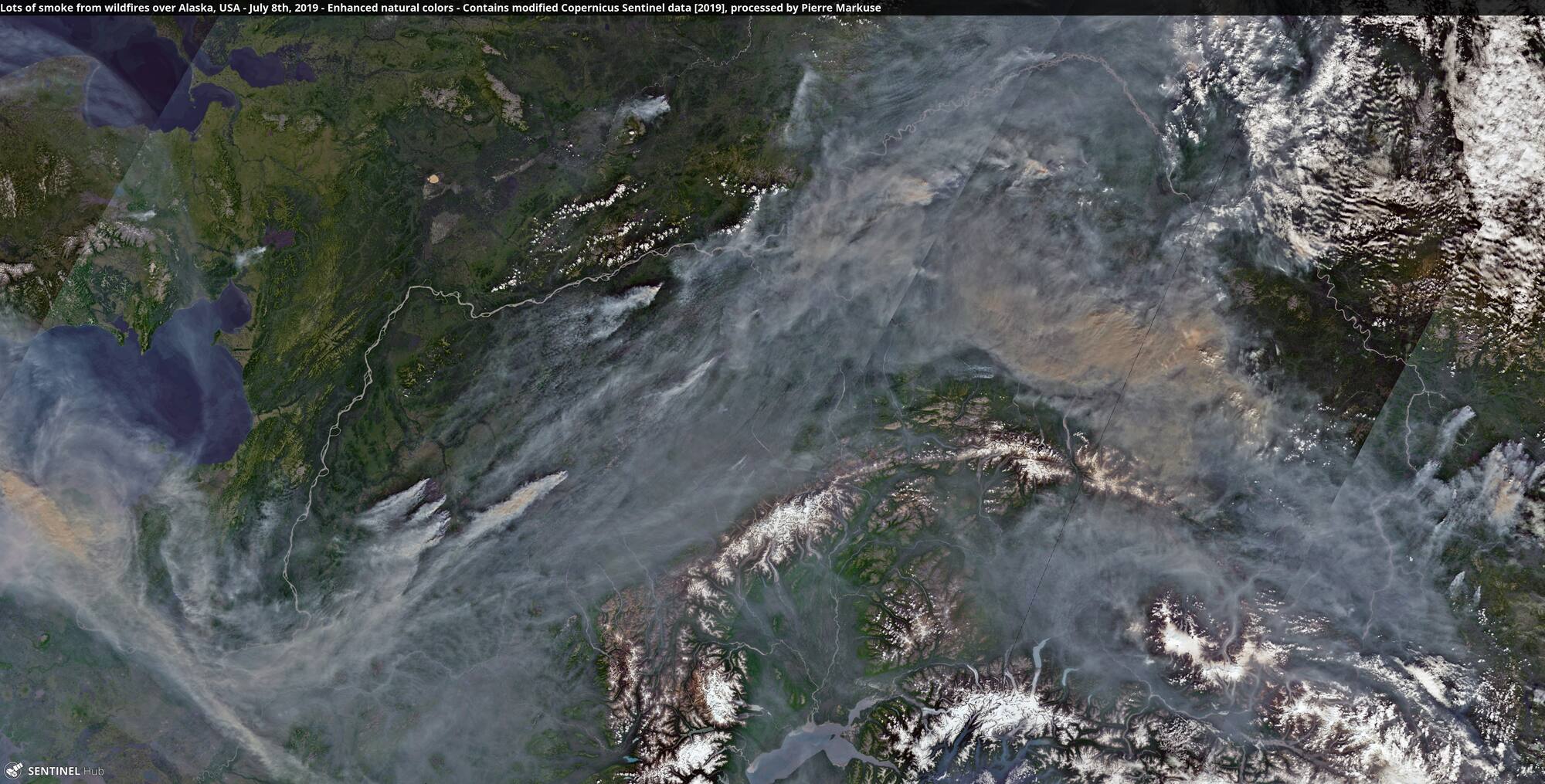 Smoke from wildfires over Alaska, modified from Copernicus Sentinel data (2019) Image credit: Pierre Markuse (Click to see in high resolution)[/caption]Senior scientist at the European Centre for Medium-Range Weather Forecasting, Mark Parrington, tweeted about the amount of carbon dioxide emitted by the Arctic wildfires between 1 June and 21 July 2019, which, as per his research, is 100 megatonnes and fast-approaching the entirety of fossil fuel/carbon dioxide emissions of Belgium in the year 2017."I think it’s fair to say July Arctic Circle wildfires are now at unprecedented levels, having surpassed previous highest #Copernicus GFAS estimated July total CO2 emission (2004/2005), & last month’s 50 megatonnes … and still increasing," he said in a tweet.The visuals come days after data confirming the hottest June on the global record, a devastating heatwave in the US and similar heatwave-like conditions forecasted in Europe later this week. Over the month of June, the Copernicus Atmosphere Monitoring Service (CAMS) network of satellites alone has tracked over 100 intense, long-lived wildfires in the Arctic Circle. These fires in June alone released an estimated 50 megatonnes of carbon dioxide — the equivalent to Sweden's total annual emissions — into the atmosphere, the WMO statement added. These emissions are also higher than those released by wildfires in the Arctic in all the June months of 2010 to 2018 combined.[caption id="attachment_7048221" align="alignnone" width="1280"]
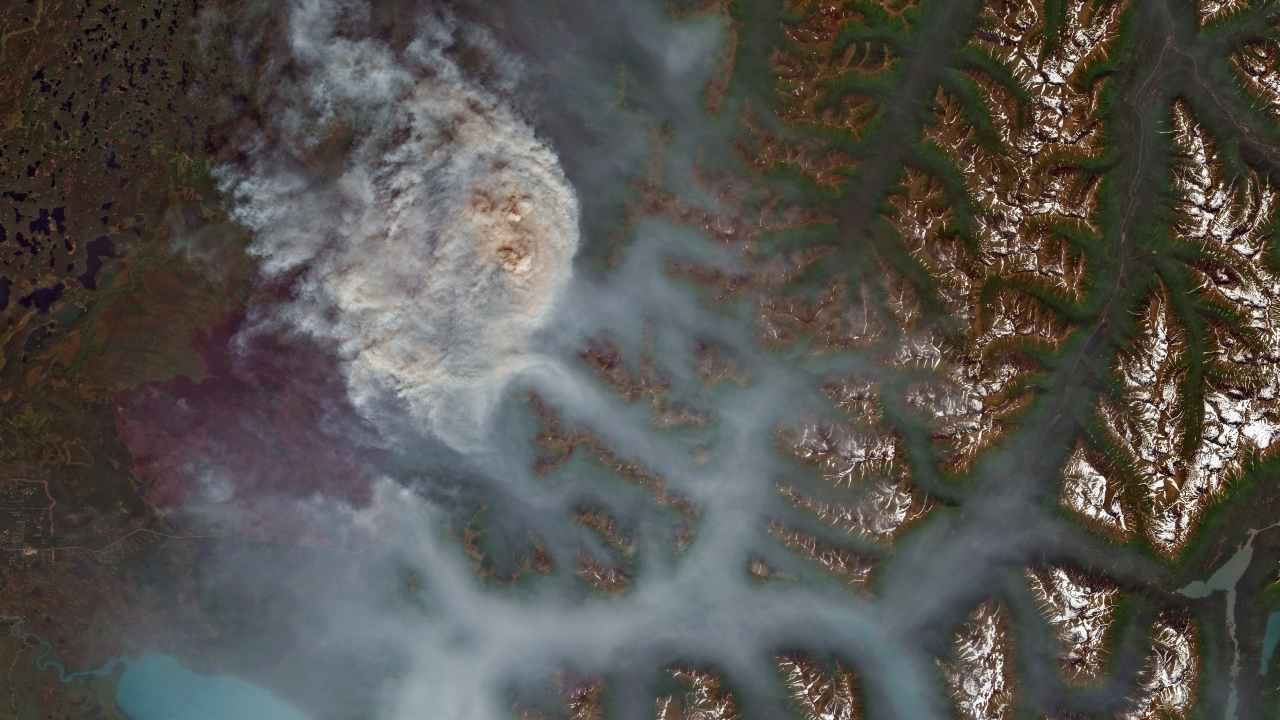 Swan Lake just south of Anchorage, captured by the Copernicus Sentinel satellite. Image: Pierre Markuse (Click to see in high resolution)[/caption]Images show that the fires stretch across Greenland, Siberia and Alaska, with the warm and dry conditions leading to large volumes of melting ice in the enormous Greenland ice sheets. This melting, according to WMO's statement, has commenced a month sooner than average this year.[caption id="attachment_7048371" align="alignnone" width="1280"]
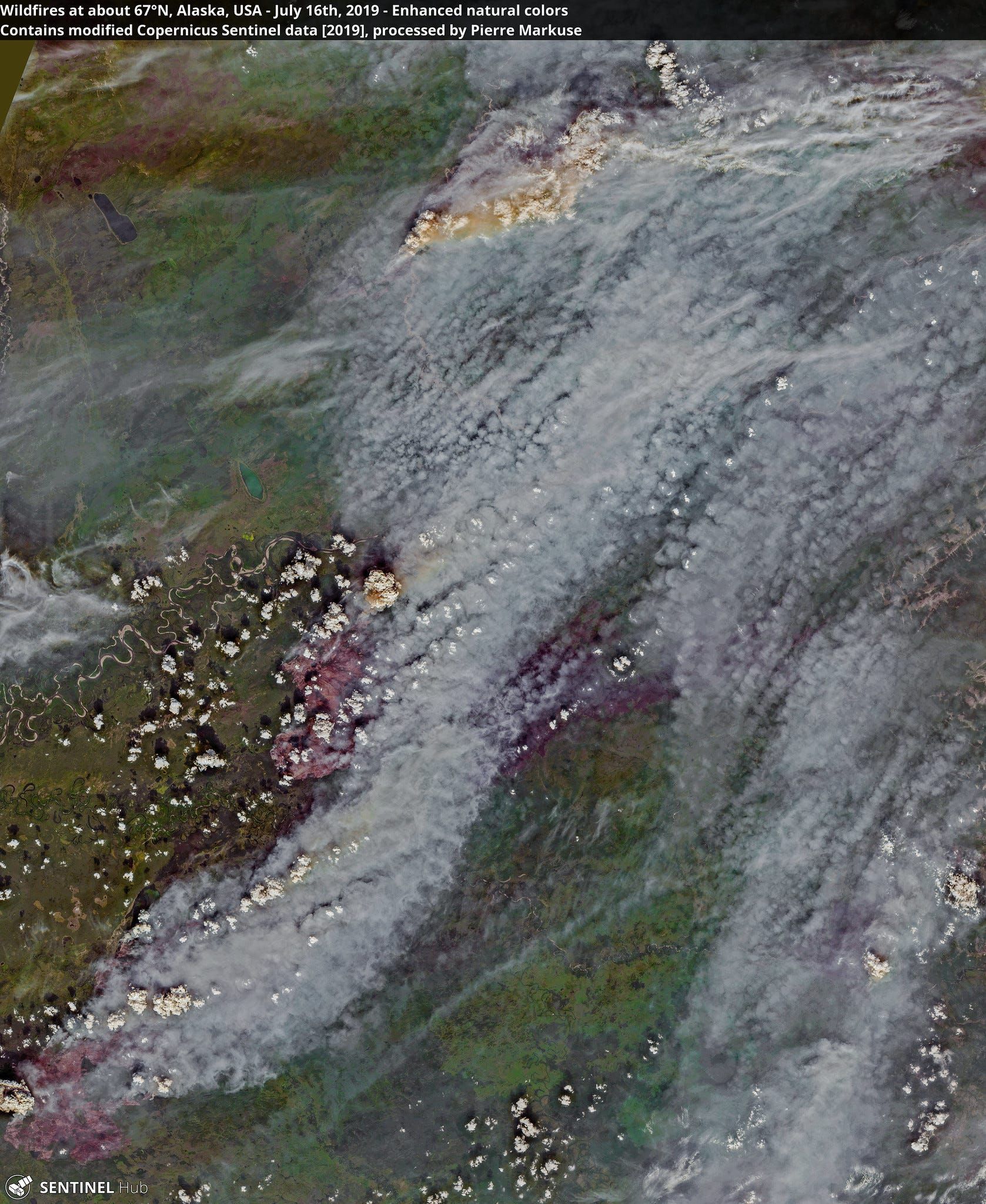 Wildfires in Alaska on 16 June, modified from Copernicus Sentinel data. Image credit: Pierre Markuse (Click to see in high resolution)[/caption]"The northern part of the world is warming faster than the planet as a whole. That heat is drying out forests and making them more susceptible to burn. A recent study found Earth’s boreal forests are now burning at a rate unseen in at least 10,000 years," WMO added.
First Published:Jul 24, 2019, 14:25:31 IST
Advertisement
Advertisement

Careless Whispers: Scientists discover that plants can 'talk' to each other using smells
Japanese scientists have recorded a video that shows plants, in certain conditions, communicate with each other using mists that carry smells. The discovery, reveals that plants release a fine mist of airborne compounds, to warn nearby plants of potential dangers
Life on Mars? European Space Agency’s Orbiter discovers ice water deposits at equator
European Space Agency's Mars Express Orbiter has identified massive ice and ice water deposits beneath the surface of Mars. The Mars Express orbiter was also the first to confirmed the presence of ice on Mars in 2004
Microsoft briefly overtakes Apple as the most valuable company, Apple back on top again
At its peak during the session, Microsoft's value reached $2.903 trillion, with a 2% surge. As of writing this article, Apple closed at $2.89 trillion, whereas Microsoft closed at $2.86 trillion
Even NASA is facing a tough time, starts layoffs following major budget cuts
NASA is facing some massive budget cuts, because of which, it has been forced to postpone some upcoming missions. NASA's Jet Propulsion Laboratory has been hit hard by recent federal budget cuts, resulting in the layoff of 100 contractors last week
ISRO, NASA's NISAR satellite to get ready by Jan-end, will monitor Earth's snow-covered regions
The NISAR satellite which has been developed jointly ISRO and NASA, should be ready for launch by the end of January 2024. The collaboration between NASA and ISRO on NISAR is the first time the two agencies have cooperated on hardware development for an Earth-observing mission
Advertisement
Advertisement