


Survivor of Ebola outbreak five years ago likely triggered the ongoing outbreak in Guinea
The outbreak first recognized in Guinea in January has reportedly infected at least 18 people and killed nine so far.

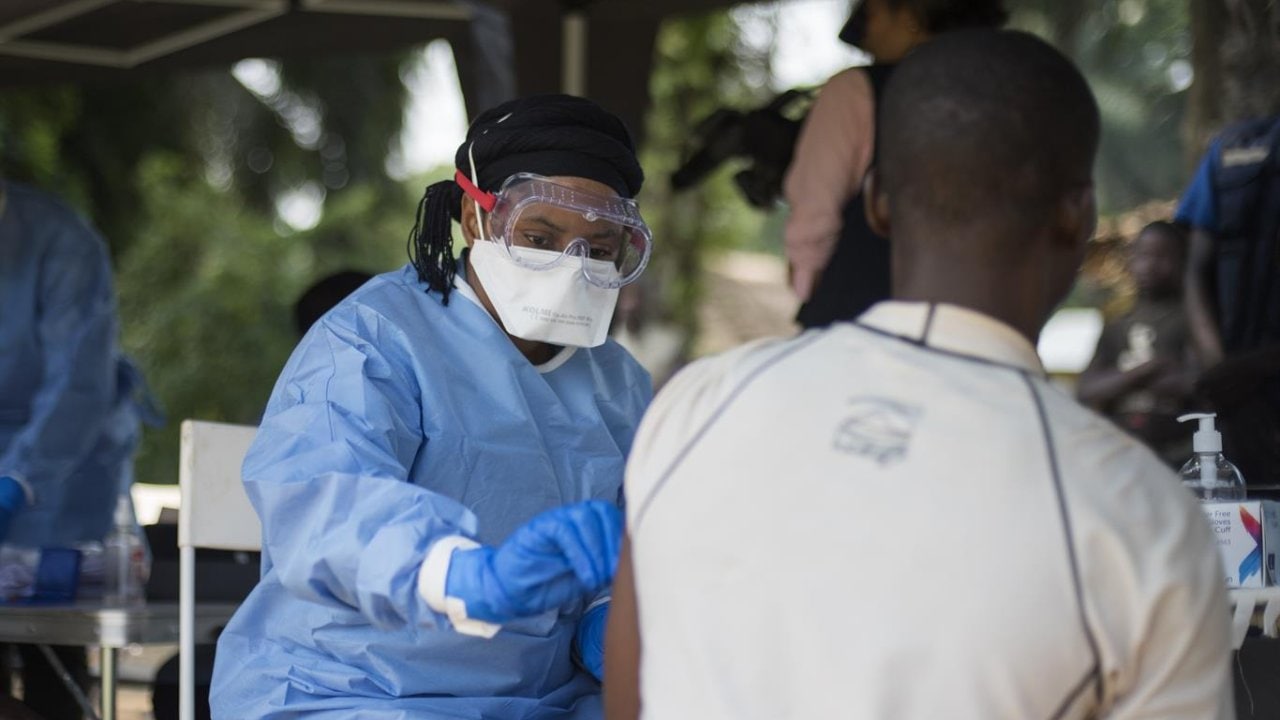
A member of the ring vaccination team vaccinates a man in Bosolo village. Image credit: WHO/L. Mackenzie[/caption]The findings were reported earlier Friday by Science and Stat.“There are very few genomic changes, and for those to occur, the virus has to multiply,” Schaffner said. “I think the virus is in hibernation for the most part.”“Among other things, it shows you what brilliant insights molecular whole-genome sequencing can provide,” he said. “Till this moment, all of us thought the current outbreak was a consequence of transmission from nature, from bats. But it likely came from a human reservoir.”Michael Wiley, a virologist at the University of Nebraska Medical Center and the chief executive of PraesensBio, which provided materials used to study the samples, described the current outbreak as a "continuation" of the previous one.He said persistent infections and sexual transmission had already been recognized during the West African outbreak and during one in the Democratic Republic of Congo. Each new milestone for viral persistence has come as a shock, he said: first 180 days, then 500 days, and now more than five years after the initial infection.The US Centers for Disease Control and Prevention said in a statement provided by its spokesman, Thomas Skinner: “CDC has reviewed the sequencing data from samples taken during the current outbreak in Guinea. While we can’t be 100% certain, CDC agrees that data supports the conclusion that cases in the current outbreak are likely linked to cases in the area during the 2014-2016 West Africa Ebola outbreak.”He added: “This suggests the outbreak was likely started from a persistent infection, a survivor, and not a new introduction of the virus from the animal reservoir. While we have seen outbreaks in the Democratic Republic of Congo linked to survivors, the length of time between the end of the 2014-2016 outbreak and the emergence of this outbreak is surprising and highlights the need for further research to better understand the complex epidemiology and ecology of Ebola.”Dr. Ian Lipkin, a virologist at Columbia University, said that after male patients had several semen samples that tested negative for Ebola, they were generally assumed to have cleared the virus, but that that was not always a correct assumption.“Somebody who had Ebola should probably be monitored on a regular basis to make sure they’re negative and remain negative,” he said.Denise Grady. c.2021 The New York Times Company

Careless Whispers: Scientists discover that plants can 'talk' to each other using smells
Life on Mars? European Space Agency’s Orbiter discovers ice water deposits at equator
Microsoft briefly overtakes Apple as the most valuable company, Apple back on top again
Even NASA is facing a tough time, starts layoffs following major budget cuts
ISRO, NASA's NISAR satellite to get ready by Jan-end, will monitor Earth's snow-covered regions