


Superflares from red dwarf stars likely to affect habitability of planets: Hubble
Hubble is observing such stars through a large programme called HAZMAT.

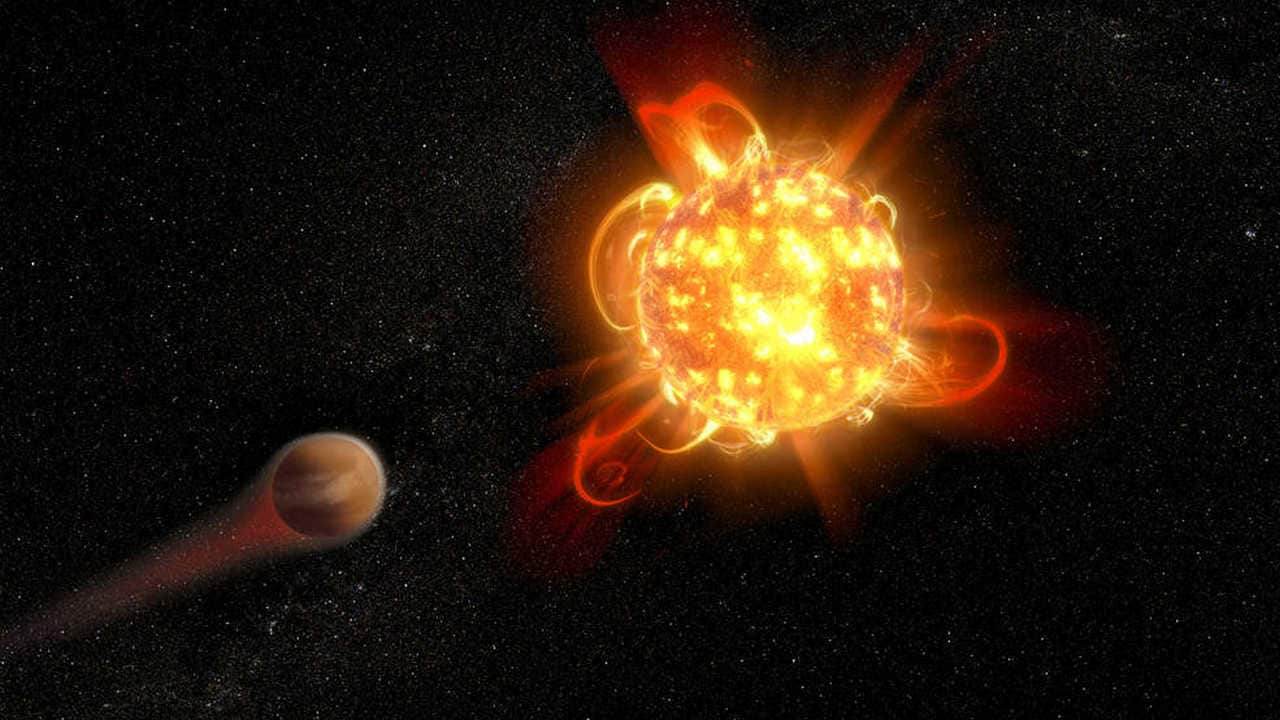
In this artist's rendering, an active, young red dwarf (right) is stripping the atmosphere from an orbiting planet (left). Image: NASA[/caption]Hubble is observing such stars through a large programme called HAZMAT — Habitable Zones and M dwarf Activity across Time."M dwarf" is the astronomical term for a red dwarf star — the smallest, most abundant and longest-living type of star in our galaxy.The HAZMAT programme is an ultraviolet survey of red dwarfs at three different ages — young, intermediate, and old."The goal of the HAZMAT programme is to help understand the habitability of planets around low-mass stars," explained the programme's principal investigator, Evgenya Shkolnik from Arizona State University."These low-mass stars are critically important in understanding planetary atmospheres," Shkolnik added.Stellar flares from red dwarfs are particularly bright in ultraviolet wavelengths, compared with Sun-like stars.Hubble's ultraviolet sensitivity makes the telescope very valuable for observing these flares.The flares are believed to be powered by intense magnetic fields that get tangled by the roiling motions of the stellar atmosphere.When the tangling gets too intense, the fields break and reconnect, unleashing tremendous amounts of energy.The team found that the flares from the youngest red dwarfs they surveyed — just about 40 million years old — are 100 to 1,000 times more energetic than when the stars are older.This younger age is when terrestrial planets are forming around their stars.About three-quarters of the stars in our Milky Way galaxy are red dwarfs. Most of the galaxy's "habitable zone" planets — planets orbiting their stars at a distance where temperatures are moderate enough for liquid water to exist on their surface — orbit red dwarfs.In fact, the nearest star to our Sun, a red dwarf named Proxima Centauri, has an Earth-size planet in its habitable zone.However, red dwarfs — especially young red dwarfs — are active stars, producing flares that could blast out so much energy that it disrupts and possibly strips off the atmospheres of these fledgeling planets.

Careless Whispers: Scientists discover that plants can 'talk' to each other using smells
Life on Mars? European Space Agency’s Orbiter discovers ice water deposits at equator
Microsoft briefly overtakes Apple as the most valuable company, Apple back on top again
Even NASA is facing a tough time, starts layoffs following major budget cuts
ISRO, NASA's NISAR satellite to get ready by Jan-end, will monitor Earth's snow-covered regions