


Super-Earth, three gas giants discovered by high school students using TESS data
The mentorship program the students were part of, connects high schoolers interested in research with real-world scientists at Harvard and MIT.

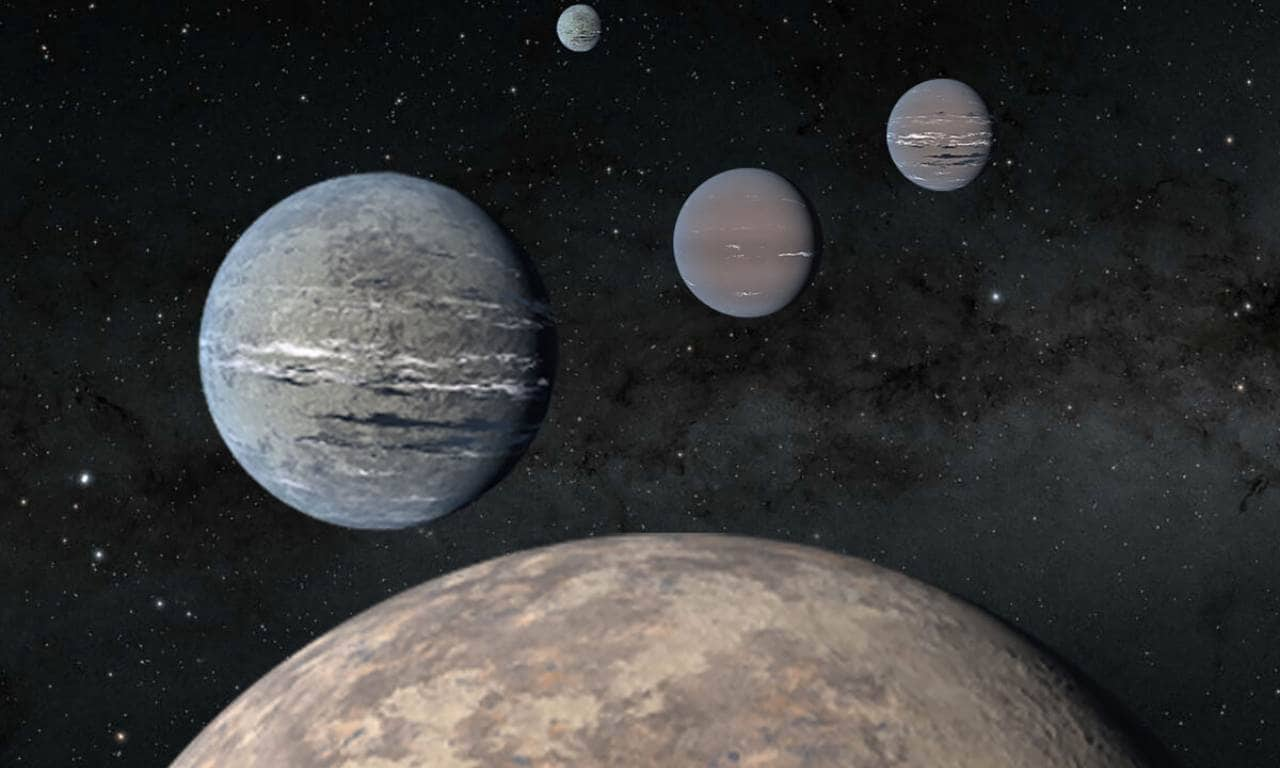
An artist rendering of the five-planet system around TOI-1233 includes a super-Earth (foreground) that could help solve mysteries of planet formation. Image Credit: NASA/JPL-Caltech[/caption]Sousa-Silva added that Pingle and Wright's achievement is rare as high-schoolers barely get to publish research.The two, under the guidance from mentor Tansu Daylan, a postdoc at the MIT Kavli Institute for Astrophysics and Space Research, studied and analysed data from TESS, focussing on TESS Object of Interest (TOI) 1233, a bright Sun-like star, narrowing it down to TOI-1233's light to see if any planets were rotating the star.Pingle explained that they were looking to see changes in light over time, with the idea being that if the planet transits the star, it would cover it up and decrease the sun's brightness.The team ended up discovering four planets rotating around TOI-1233.Wright added that she was excited and shocked, adding that while they knew it was the goal of the research, but fining a multiplanetary system was actually very cool.According to the release, three of the planets are 'sub-Neptunes', or gaseous planets, smaller but similar to Milky Way's Neptune. They take between six and 19.5 days to orbit around the star. The fourth is a 'super-Earth', which is large and rocky, and orbits in just under 4 days.

Careless Whispers: Scientists discover that plants can 'talk' to each other using smells
Life on Mars? European Space Agency’s Orbiter discovers ice water deposits at equator
Microsoft briefly overtakes Apple as the most valuable company, Apple back on top again
Even NASA is facing a tough time, starts layoffs following major budget cuts
ISRO, NASA's NISAR satellite to get ready by Jan-end, will monitor Earth's snow-covered regions