
Advertisement

Stunning image of Milky Way-like galaxy's X-shaped magnetic field captured in new radio study

Radio astronomy tools used by researchers found previously unknown magnetic field structures in the NGC 4217 galaxy.

Advertisement
FP Trending|Jul 27, 2020, 14:24:19 IST

A recent experiment saw researchers observe the magnetic fields of a galaxy in the Ursa Major constellation, which was found to be similar to the Milky Way's.Using radio astronomy instruments, researchers found previously unknown magnetic field structures in the NGC 4217 galaxy, suggesting that star formation and star explosions – so-called supernovae – are responsible for these visible structures. The researchers proposed that the new map could be applied to the Milky Way, giving scientists a greater insight into the home galaxy.In a statement by Max Planck Institute for Radio Astronomy, Yelena Stein, who began the study at the Chair of Astronomy at Ruhr-Universität Bochum under Professor Ralf-Jürgen Dettmar, said, "The analysed data had been compiled in the project 'Continuum Halos in Nearby Galaxies', where radio waves were utilised to measure 35 galaxies. Galaxy NGC 4217 is of particular interest to us.”
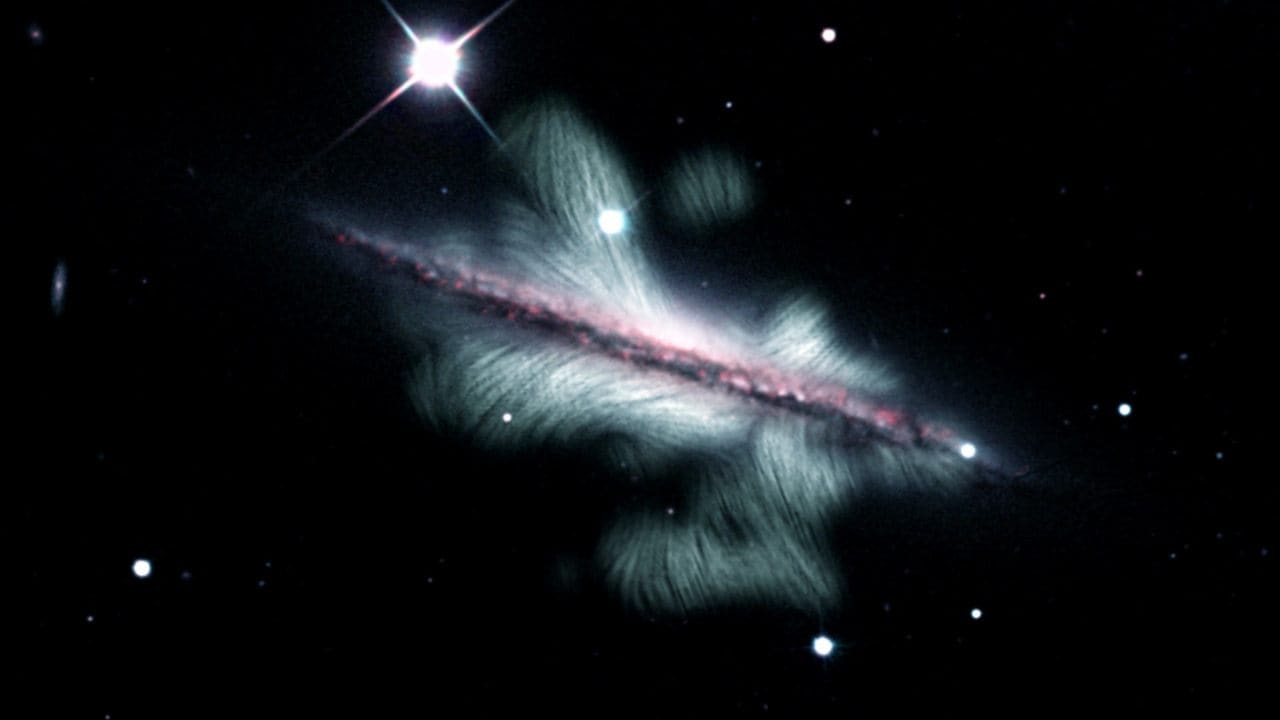

This composite image shows the edge-on spiral galaxy NGC 4217. Magnetic field lines (green), revealed by the VLA, extend far above and below the plane of the galaxy. Image: Y Stein/NRAO/SDSS/ KPNO /J English, University of Manitoba/R J Dettmar & A Miskolczi, Ruhr-Universität Bochum/R J Rand, UNM/J Irwin, Queen’s University
Evaluating the data from NGC 4217, researchers found that the galaxy has an X-shaped magnetic field structure, similar to what has been found in other galaxies including the Milky Way. They also found a helix structure and two large bubble structures, called "superbubbles".These superbubbles originate in places where massive stars explode (supernovae), as well as regions where star formation emits stellar winds in the process. The study's authors suspect a connection between the two phenomena.Stein said that the analysis revealed large loop structures in the magnetic fields along with the entire galaxy, something that has never been observed before. Researchers suspect this is because the structures are caused by star formation since at these points matter is thrown outward."Visualising the data was important to me. Because when you think about galaxies, magnetic fields are not the first thing that comes to mind, although they can be gigantic and display unique structures. The image is supposed to shift the magnetic fields more into focus," Stein added.The results of the study have been published in the scientific journal Astronomy & Astrophysics.

Handpicked stories, in your inbox
Global stories. Indian perspective. Zero noise.
No Spam. Unsubscribe Any Time.
First Published:Jul 27, 2020, 14:24:19 IST
Advertisement
Advertisement
Trending Stories

Microsoft briefly overtakes Apple as the most valuable company, Apple back on top again

At its peak during the session, Microsoft's value reached $2.903 trillion, with a 2% surge. As of writing this article, Apple closed at $2.89 trillion, whereas Microsoft closed at $2.86 trillion
Advertisement
Advertisement
Up Next