


Stone tools show humans in India survived the cataclysmic Toba eruption 74,000 years ago
The plume of the eruption punched more than 30 km into the sky and blanketed much of India and Africa in a layer of ash.


New evidence suggests that humans in India survived the Toba eruption and continued to flourish after it. Image credit: Christina Neudorf, Author provided[/caption]It is still unclear how intense the fallout from the Toba eruption really was, and how it affected humans. The debate has been running for decades, drawing on evidence from climate science, geology, archaeology and genetics.We have found new evidence that humans in India survived the Toba eruption and continued to flourish after it. The study – by researchers from the University of Queensland, the University of Wollongong, the Max Planck Institute for the Science of Human History, the University of Allahabad and others – is published in Nature Communications today.
Living through the eruption
We studied a unique archaeological record that covers 80,000 years at the Dhaba site in the middle Son valley of northern India. Ash from the Toba eruption was found in the Son valley back in the 1980s, but until now there was no archaeological evidence to go with it.The Dhaba site fills a major time gap in our understanding of how ancient humans survived and migrated out of Africa and across the world. The stone tools we found at Dhaba are similar to the ones people were using in Africa at the same time.[caption id="attachment_8091991" align="alignnone" width="1000"]
Some of the stone tools found at Dhaba. Image credit: Chris Clarkson[/caption]These toolkits were present at Dhaba before and after the Toba super-eruption, indicating that populations survived the event. It is likely that humans made the same kinds of tools all along the dispersal route from Africa through India, reaching Australia by at least 65,000 years ago.Dhaba, therefore, provides a crucial cultural link between Africa, Asia and Australia. Although fossil and genetic evidence indicate modern humans have lived outside Africa for the past 200,000 years (at sites such as Apedima, Misliya,Qafzeh, Skhul, Al Wusta and Fuyan cave) only human fossil evidence can prove beyond doubt they were in India 80,000 years ago.Nevertheless, the stone tools at Dhaba go a long way toward demonstrating human presence.
Putting together the puzzle
Our findings at Dhaba fit with archaeological evidence from Africa, Asia, and elsewhere in India to support the idea that the Toba super-eruption had minimal effects on humans and did not cause a population bottleneck. Archaeological sites in southern Africa show human populations thrived following the Toba super-eruption.Climate and vegetation records from Lake Malawi in East Africa likewise show no evidence for a volcanic winter at the time of the eruption. Genetic studies similarly have not detected a clear population bottleneck around 74,000 years ago.[caption id="attachment_8092001" align="alignnone" width="1280"]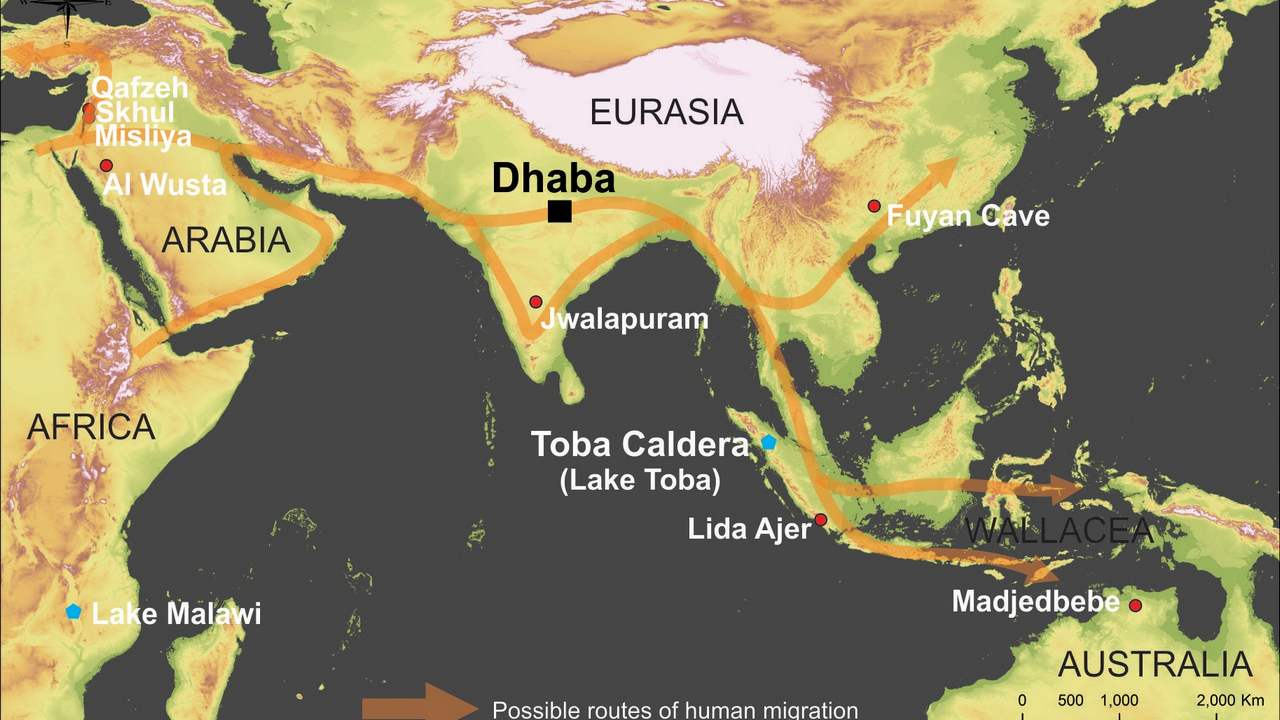
Possible routes of ancient human migration. Image credit: Chris Clarkson, Author provided[/caption]At Jwalapuram, in southern India, Michael Petraglia and colleagues found similar Middle Palaeolithic stone tools above and below a thick layer of Toba ash. At the Lida Ajer site in Sumatra, close to the eruption itself, Kira Westaway and colleagues found human teeth dated to 73,000-63,000 years ago. This indicates humans were living in Sumatra, in a closed-canopy rainforest environment not long after the eruption.Our new findings contribute to a revised understanding of the global impact of the Toba super-eruption. While the Toba super-eruption was certainly a colossal event, global cooling may have been less significant than previously thought.In any case, archaeological evidence suggests that humans survived and coped with one of the largest volcanic events in human history. Small bands of hunter-gatherers turned out to be highly adaptable in the face of climate change.Chris Clarkson, Professor in Archaeology, The University of Queensland and Michael Petraglia, Professor of Archaeology, Max Planck Institute for the Science of Human HistoryThis article is republished from The Conversation under a Creative Commons license. Read the original article.

Careless Whispers: Scientists discover that plants can 'talk' to each other using smells
Life on Mars? European Space Agency’s Orbiter discovers ice water deposits at equator
Microsoft briefly overtakes Apple as the most valuable company, Apple back on top again
Even NASA is facing a tough time, starts layoffs following major budget cuts
ISRO, NASA's NISAR satellite to get ready by Jan-end, will monitor Earth's snow-covered regions