
Advertisement


Sections
STEVE is the new kid on the block now that the Aurora Borealis is making its way out
Purple and green might not be an accepted combination but when it is blazing in the sky, it is beautiful!

Steve Rogers has left the building and STEVE has entered.The Aurora Borealis or the Northern lights has always captured the attention of people and photographers all over the world. With recent reports of the Borealis dying off, STEVE might take over.Bonus: it does not only occur in the auroral zones. They usually occur in populated/residential areas.
What is Aurora Borealis?
Aurorae are caused by charged particles hitting atoms and molecules in Earth’s atmosphere, causing them to glow. Traditional aurorae are often green because oxygen atoms present in Earth’s atmosphere emit that colour when they’re bombarded by charged particles trapped in Earth’s magnetic field. They also appear in a diffused glow — rather than a distinct line — on the northern or southern horizon according to the report in Science.[caption id="attachment_6581031" align="alignnone" width="1280"]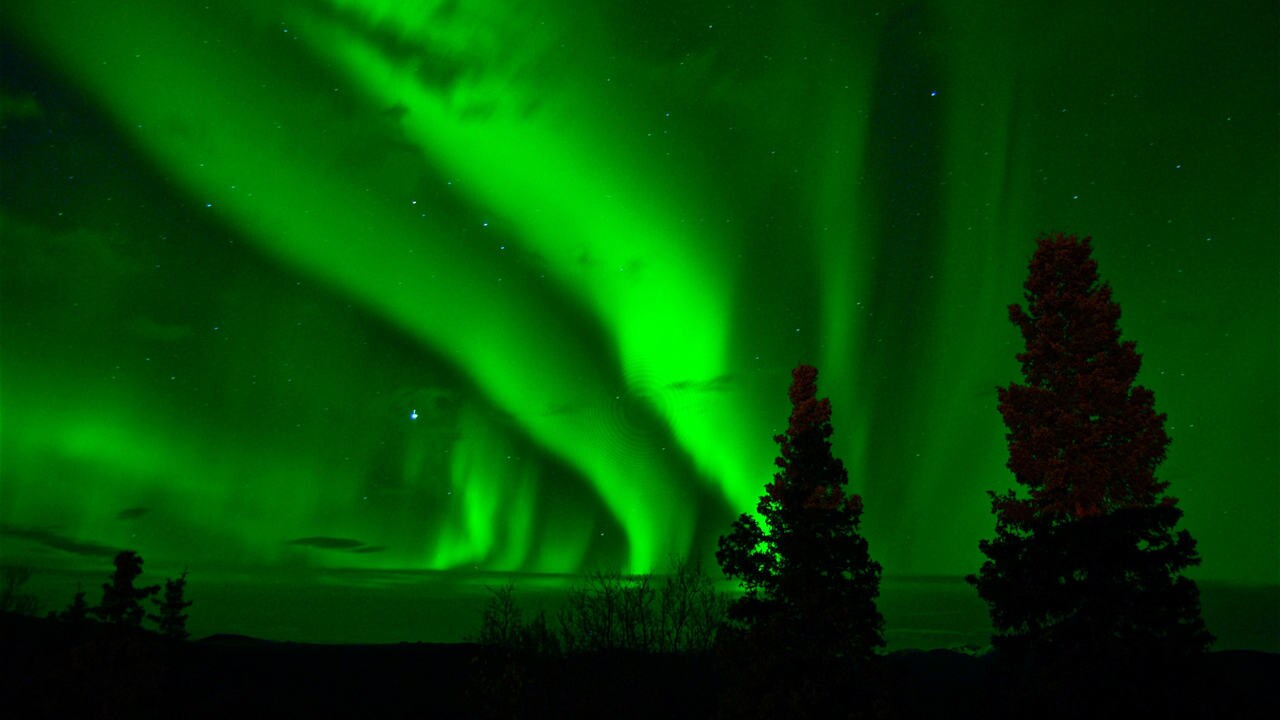 The Aurora Borealis. image credit: Good Free Picture[/caption]
What is STEVE?
STEVE stands for Strong Thermal Emission Velocity Enhancement. It is similar to the Aurora Borealis but unlike the Aurora, it is mostly mauve and purple. It is a band of light, stretching east to west that appears across the sky. It sometimes also has a second arc of green which is also known as a picket fence. It appears in much lower latitudes.How did it get its name?
A group of citizen-scientists led by Chris Ratzlaff from Alberta, Canada named it STEVE, after a line in the 2006 children’s movie Over the Hedge.[caption id="attachment_6581061" align="alignnone" width="1280"]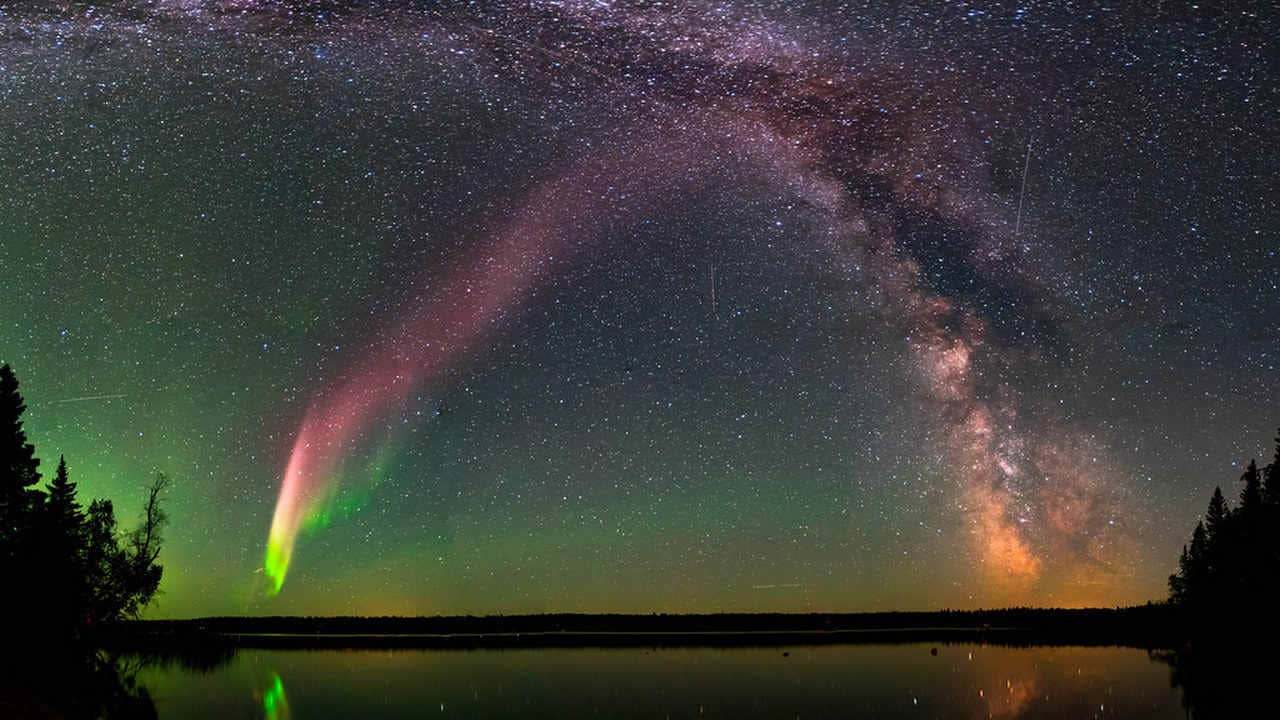 STEVE (Strong Thermal Emission Velocity Enhancement) and the Milky Way at Childs Lake, Manitoba, Canada. The picture is a composite of 11 images stitched together. Image Courtesy: Krista Trinder/Flickr [/caption]
How does it occur?
Elizabeth MacDonald, a space physicist at the NASA Goddard Space Flight Center in Greenbelt, Maryland, and her team have used data from a European satellite called Swarm-A to study STEVE and has published the findings in the journal Science Advances.Appearing about 200 kilometres up in the atmosphere the satellite revealed that the charged particles had a temperature of 6,000 degree Celsius. These ions flow east to west at nearly six kilometres per second, propelled by electric and magnetic fields in the atmosphere. The heat and motion contribute to the purple hue. What causes the purple hue is still unknown.What is the picket fence?
The picket fence is the secondary light arc that appears along with STEVE. It is caused by a similar process to what causes auroras, although it is closer to the equator than where the auroras are seen. They are caused by energetic electrons streaming into Earth's atmosphere from thousands of kilometres away and occur in both Northern and Southern hemispheres simultaneously.These arcs have been occurring and have been observed by aurora chasers before scientists got the wind of it. Hence, it is only now that scientists are studying it.First Published:May 06, 2019, 18:44:21 IST
Advertisement
Advertisement

Careless Whispers: Scientists discover that plants can 'talk' to each other using smells
Japanese scientists have recorded a video that shows plants, in certain conditions, communicate with each other using mists that carry smells. The discovery, reveals that plants release a fine mist of airborne compounds, to warn nearby plants of potential dangers
Life on Mars? European Space Agency’s Orbiter discovers ice water deposits at equator
European Space Agency's Mars Express Orbiter has identified massive ice and ice water deposits beneath the surface of Mars. The Mars Express orbiter was also the first to confirmed the presence of ice on Mars in 2004
Microsoft briefly overtakes Apple as the most valuable company, Apple back on top again
At its peak during the session, Microsoft's value reached $2.903 trillion, with a 2% surge. As of writing this article, Apple closed at $2.89 trillion, whereas Microsoft closed at $2.86 trillion
Even NASA is facing a tough time, starts layoffs following major budget cuts
NASA is facing some massive budget cuts, because of which, it has been forced to postpone some upcoming missions. NASA's Jet Propulsion Laboratory has been hit hard by recent federal budget cuts, resulting in the layoff of 100 contractors last week
ISRO, NASA's NISAR satellite to get ready by Jan-end, will monitor Earth's snow-covered regions
The NISAR satellite which has been developed jointly ISRO and NASA, should be ready for launch by the end of January 2024. The collaboration between NASA and ISRO on NISAR is the first time the two agencies have cooperated on hardware development for an Earth-observing mission
Advertisement
Advertisement