
Advertisement


Sections
Spinal implant helps man walk again after five years of living with paralysis
The remotely operated implant creates pulses that stimulate permanently disconnected nerves.

Five years after he was paralysed in a snowmobile accident, a man in the US has learned to walk again aided by an electrical implant, in a potential breakthrough for spinal injury sufferers.A team of doctors at the Mayo Clinic in Minnesota say the man, using a front-wheeled walker, was able to cover the equivalent of the length of a football pitch, issuing commands from his brain to transfer weight and maintain balance – all previously thought impossible for paralysed patients.The man, now 29, severed his spinal cord in the middle of his back when he crashed his snowmobile in 2013.He is completely paralysed from the waist down, and cannot move or feel anything below the middle of his torso.In the study, the results of which were published on Monday, 24 September, in the journal Nature Medicine, doctors in 2016 implanted a small electronic device in the man's spine.The wirelessly operated implant, about the size of a AA battery, generates electrical pulses to stimulate nerves that – due to the injury – had been permanently disconnected from the brain.[caption id="attachment_5254761" align="alignnone" width="1280"]![Jered Chinnock, the subject of the implant, stands with the assistance of his therapy team at the Mayo Clinic in Rochester, Minnesota. AP]() Jered Chinnock, who received the spinal implant, stands with the assistance of his therapy team at the Mayo Clinic in Rochester, Minnesota. AP[/caption]"What this is teaching us is that those networks of neurons below a spinal cord injury can still function after paralysis," said Kendall Lee, neurosurgeon at the Mayo Clinic and lead study author.Within weeks of the device being switched on, the man began to take his first steps since the accident – but was still suspended in a harness.Astonishingly, after several more sessions of rehab and physiotherapy, he was able to support most of his own body weight and take steps on a treadmill."We didn't limit our expectations and continued to safely advance his performance as he gained function," Kristin Zhao, director of the Mayo Clinic's Assistive and Restorative Technology Laboratory, told AFP."This is important because the patient's own mind was able to drive the movement in the legs," she said.Although the device was able to help generate power and control in the patient's lower body, it did nothing to restore sensation in his legs.This initially proved challenging. Without the physical feeling of walking registering in his brain, it was hard for him to make the instantaneous balance adjustments most of us make without thinking.The team overcame the problem by installing mirrors at knee height so the patient could see what position his legs were in while walking.Long road aheadEventually the man was able to walk on the treadmill with only periodic glances down at his legs.Footage of the experiment shows him walking jerkily on a slow-moving treadmill, using a metal rail for balance.While the device's effect is remarkable, the man is still paralysed once it is turned off."It is important to understand that even with the success that this individual had in stepping ability during the research, he still performs his daily activities from a wheelchair," Lee told AFP.In 2011, electrodes implanted on the lower spine of a paraplegic man allowed him to stand and regain some movement in his legs, but the team believes this is the first instance an implant has been used to get a paralysed person to walk.For safety reasons, the patient currently only uses the device under supervision, but the implications of the study – that paralysis may not be permanent after severe spinal injury – could be massive."Our results, combined with prior evidence, emphasise the need to reassess our current understandings of spinal cord injury in order to realise the potential of emerging technologies for functional recovery once thought to be permanently lost," Lee said.The study was conducted in conjunction with the University of California Los Angeles and was partly funded by the Christopher and Dana Reeve Foundation.Christopher Reeve, best known for starring role in the "Superman" film, was left paraplegic after a horse-riding accident in 1995.
Jered Chinnock, who received the spinal implant, stands with the assistance of his therapy team at the Mayo Clinic in Rochester, Minnesota. AP[/caption]"What this is teaching us is that those networks of neurons below a spinal cord injury can still function after paralysis," said Kendall Lee, neurosurgeon at the Mayo Clinic and lead study author.Within weeks of the device being switched on, the man began to take his first steps since the accident – but was still suspended in a harness.Astonishingly, after several more sessions of rehab and physiotherapy, he was able to support most of his own body weight and take steps on a treadmill."We didn't limit our expectations and continued to safely advance his performance as he gained function," Kristin Zhao, director of the Mayo Clinic's Assistive and Restorative Technology Laboratory, told AFP."This is important because the patient's own mind was able to drive the movement in the legs," she said.Although the device was able to help generate power and control in the patient's lower body, it did nothing to restore sensation in his legs.This initially proved challenging. Without the physical feeling of walking registering in his brain, it was hard for him to make the instantaneous balance adjustments most of us make without thinking.The team overcame the problem by installing mirrors at knee height so the patient could see what position his legs were in while walking.Long road aheadEventually the man was able to walk on the treadmill with only periodic glances down at his legs.Footage of the experiment shows him walking jerkily on a slow-moving treadmill, using a metal rail for balance.While the device's effect is remarkable, the man is still paralysed once it is turned off."It is important to understand that even with the success that this individual had in stepping ability during the research, he still performs his daily activities from a wheelchair," Lee told AFP.In 2011, electrodes implanted on the lower spine of a paraplegic man allowed him to stand and regain some movement in his legs, but the team believes this is the first instance an implant has been used to get a paralysed person to walk.For safety reasons, the patient currently only uses the device under supervision, but the implications of the study – that paralysis may not be permanent after severe spinal injury – could be massive."Our results, combined with prior evidence, emphasise the need to reassess our current understandings of spinal cord injury in order to realise the potential of emerging technologies for functional recovery once thought to be permanently lost," Lee said.The study was conducted in conjunction with the University of California Los Angeles and was partly funded by the Christopher and Dana Reeve Foundation.Christopher Reeve, best known for starring role in the "Superman" film, was left paraplegic after a horse-riding accident in 1995.
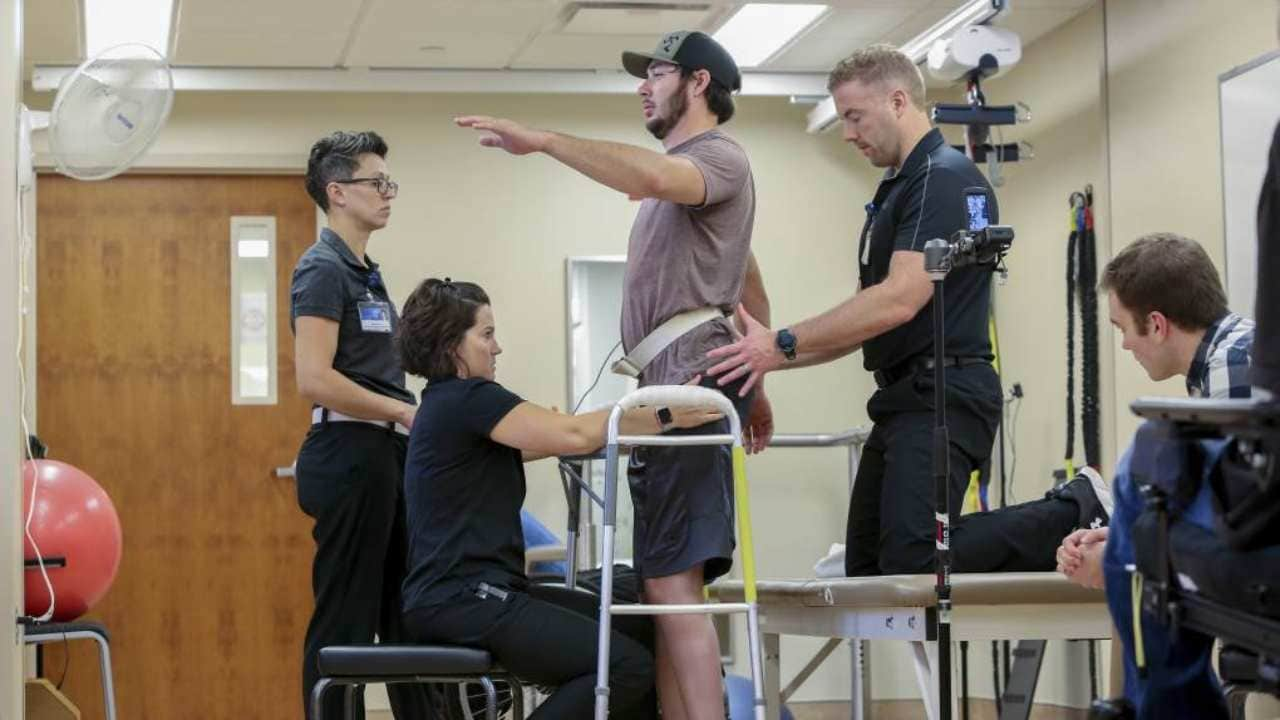 Jered Chinnock, who received the spinal implant, stands with the assistance of his therapy team at the Mayo Clinic in Rochester, Minnesota. AP[/caption]"What this is teaching us is that those networks of neurons below a spinal cord injury can still function after paralysis," said Kendall Lee, neurosurgeon at the Mayo Clinic and lead study author.Within weeks of the device being switched on, the man began to take his first steps since the accident – but was still suspended in a harness.Astonishingly, after several more sessions of rehab and physiotherapy, he was able to support most of his own body weight and take steps on a treadmill."We didn't limit our expectations and continued to safely advance his performance as he gained function," Kristin Zhao, director of the Mayo Clinic's Assistive and Restorative Technology Laboratory, told AFP."This is important because the patient's own mind was able to drive the movement in the legs," she said.Although the device was able to help generate power and control in the patient's lower body, it did nothing to restore sensation in his legs.This initially proved challenging. Without the physical feeling of walking registering in his brain, it was hard for him to make the instantaneous balance adjustments most of us make without thinking.The team overcame the problem by installing mirrors at knee height so the patient could see what position his legs were in while walking.
First Published:Sep 25, 2018, 08:43:44 IST
Advertisement
Advertisement

Careless Whispers: Scientists discover that plants can 'talk' to each other using smells
Japanese scientists have recorded a video that shows plants, in certain conditions, communicate with each other using mists that carry smells. The discovery, reveals that plants release a fine mist of airborne compounds, to warn nearby plants of potential dangers
Life on Mars? European Space Agency’s Orbiter discovers ice water deposits at equator
European Space Agency's Mars Express Orbiter has identified massive ice and ice water deposits beneath the surface of Mars. The Mars Express orbiter was also the first to confirmed the presence of ice on Mars in 2004
Microsoft briefly overtakes Apple as the most valuable company, Apple back on top again
At its peak during the session, Microsoft's value reached $2.903 trillion, with a 2% surge. As of writing this article, Apple closed at $2.89 trillion, whereas Microsoft closed at $2.86 trillion
Even NASA is facing a tough time, starts layoffs following major budget cuts
NASA is facing some massive budget cuts, because of which, it has been forced to postpone some upcoming missions. NASA's Jet Propulsion Laboratory has been hit hard by recent federal budget cuts, resulting in the layoff of 100 contractors last week
ISRO, NASA's NISAR satellite to get ready by Jan-end, will monitor Earth's snow-covered regions
The NISAR satellite which has been developed jointly ISRO and NASA, should be ready for launch by the end of January 2024. The collaboration between NASA and ISRO on NISAR is the first time the two agencies have cooperated on hardware development for an Earth-observing mission
Advertisement
Advertisement