


SpaceX's Falcon 9 pre-dawn launch leaves behind rainbow coloured sky, images go viral on social media
SpaceX launched its Falcon 9 rocket on Saturday 13 June, 2.46 pm IST (5.21 am EDT) from Cape Canaveral, Florida.

SpaceX on Saturday launched a Falcon 9 rocket carrying 58 StarLink satellites and three Planet Labs’ SkySat Earth-observing spacecraft. The Starlink-8 mission was SpaceX’s eighth batch of its latest Starlink satellites and the 540th placed into orbit. Along with the internet-providing satellites, SpaceX also launched three Planet Labs' high-resolution Earth-observing spacecraft.
SpaceX launched its Falcon 9 rocket on Saturday 13 June, 2.46 pm IST (5.21 am EDT) from Cape Canaveral, Florida.
According to a report in Business Insider, as the rocket started its journey from Cape Canaveral, Florida and traversed over the Atlantic Ocean, it created a glowing-cloud phenomenon which multiple people documented and shared on social media. The cloud was created due to the rocket's exhaust fumes catching the morning's sunlight.[caption id="" align="alignnone" width="1280"]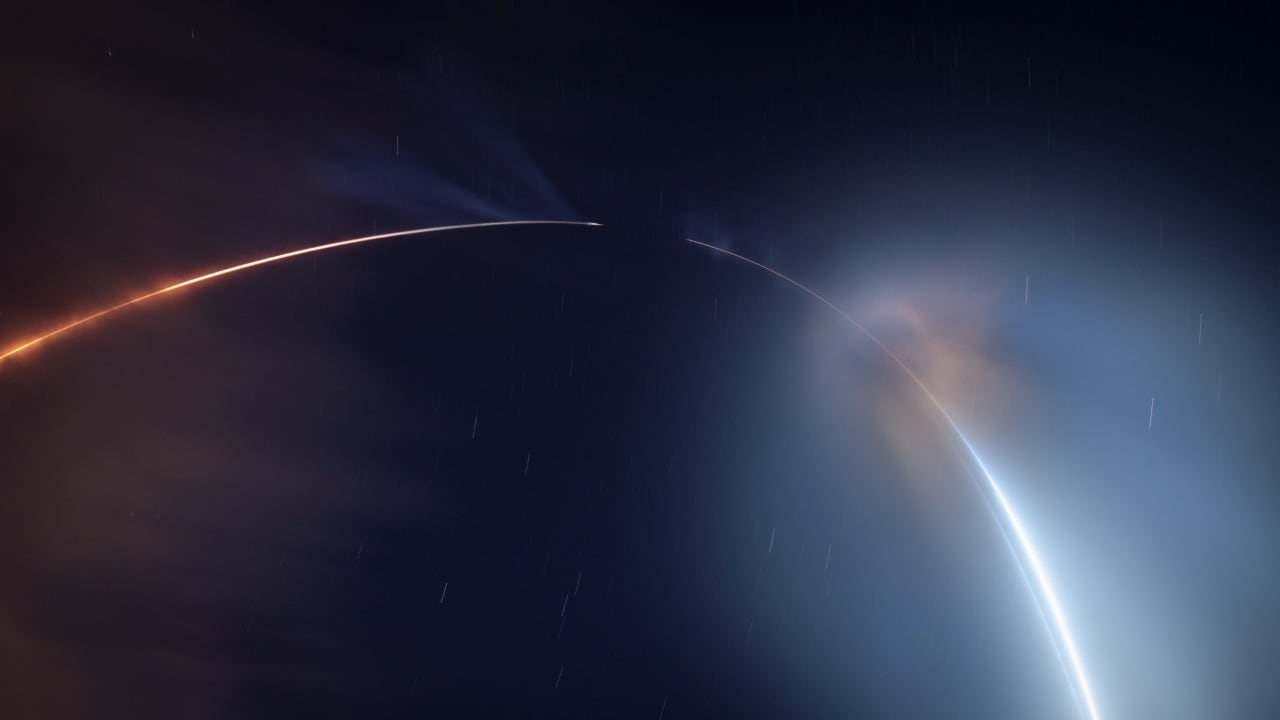
The blue rainbow that took place because of the Starlink launch. Image credit: Twitter/@johnpisaniphoto[/caption]Minutes after the launch, photographer John Pisani tweeted two mesmerising long-exposure photographs that he had captured of the rocket ascending to orbit. "An epic display on Florida's Space Coast this morning,” Pisani captioned.
The entire time-lapse of entire pre-dawn Falcon 9 launch was shared on Twitter by John Kraus, the house photographer for the space media company SuperCluster.SuperCluster also shared a still image captured by Kraus showing how the expanding exhaust plume brightened the predawn twilight with a rainbow of colours.A picture captured and shared by photographer Greg Diesel Walck highlighted how the high-altitude winds blew around the exhaust trail, creating a snake-like pattern in the sky.Teacher and part-time reporter Jamie Groh also tweeted a picture of the predawn Falcon 9 launch. The image that Groh captured was captured 140 miles away from the rocket's launch site.With the launch of the SkySats, SpaceX plans to begin offering space-based internet service across the northern United States and Canada later in 2020 with an initial fleet of more than 700 satellites, the report added.
 More from Science
Careless Whispers: Scientists discover that plants can 'talk' to each other using smells
Life on Mars? European Space Agency’s Orbiter discovers ice water deposits at equator
Microsoft briefly overtakes Apple as the most valuable company, Apple back on top again
Even NASA is facing a tough time, starts layoffs following major budget cuts
ISRO, NASA's NISAR satellite to get ready by Jan-end, will monitor Earth's snow-covered regions