
Advertisement


Sections
SpaceX successfully launches 'most complicated' Falcon Heavy rocket with 24 payloads

SpaceX’s Falcon Heavy has finally launched a 12.00 pm IST after a few delays. The rocket was launched from NASA’s Kennedy Space Center in Florida. This is the first time that a SpaceX launch has taken place at night.It was scheduled to be launched on 24 June 11.35 pm EDT (25 June 9.00 am IST) but was delayed due to 'additional system checkouts' tweeted SpaceX.There are 24 payloads that will be launched at three different orbits and the rocket is expected to undergo four separate upper stage engine burns. Twelve minutes into the liftoff, deployment of the payloads will begin and it is expected to end almost four hours after the liftoff. The total mission is expected to last six hours.[caption id="attachment_6876821" align="alignnone" width="1280"]![Falcon Heavy has a successful launch. Image credit: SpaceX/Twitter]() Falcon Heavy has a successful launch. Image credit: SpaceX/Twitter[/caption]The mission is part of the US Department of Defense’s (DOD) Space Test Program-2 (STP-2). NASA and the National Oceanic and Atmospheric Administration (NOAA) will also be sending their experiments as a part of this mission. NASA has a Deep Space Atomic Clock, a new kind of green fuel that is part of this mission.University experiments and payloads form private organizations are also being sent up along with 152 metal capsules of human ashes as a part of a private company.The mission is reusing the side boosters from the Arabsat-6A mission from April. It made a successful landing on SpaceX's landing zones 1 and 2 at Cape Canaveral Air Force Station in Florida. This is the first time that the boosters have been reused in a Falcon Heavy mission.The core centre was supposed to land on the 'Of Course I Love You' drone ship that is stationed in the Atlantic Ocean 768 miles away from shore, which is the furthest it has ever been. The core centre missed its mark on the landing pad and plunged into the ocean. The last time they tried to capture the core centre was not successful as well. The core landed on the pad but they lost it to the rough seas.[caption id="attachment_6876781" align="alignnone" width="1280"]
Falcon Heavy has a successful launch. Image credit: SpaceX/Twitter[/caption]The mission is part of the US Department of Defense’s (DOD) Space Test Program-2 (STP-2). NASA and the National Oceanic and Atmospheric Administration (NOAA) will also be sending their experiments as a part of this mission. NASA has a Deep Space Atomic Clock, a new kind of green fuel that is part of this mission.University experiments and payloads form private organizations are also being sent up along with 152 metal capsules of human ashes as a part of a private company.The mission is reusing the side boosters from the Arabsat-6A mission from April. It made a successful landing on SpaceX's landing zones 1 and 2 at Cape Canaveral Air Force Station in Florida. This is the first time that the boosters have been reused in a Falcon Heavy mission.The core centre was supposed to land on the 'Of Course I Love You' drone ship that is stationed in the Atlantic Ocean 768 miles away from shore, which is the furthest it has ever been. The core centre missed its mark on the landing pad and plunged into the ocean. The last time they tried to capture the core centre was not successful as well. The core landed on the pad but they lost it to the rough seas.[caption id="attachment_6876781" align="alignnone" width="1280"]![The side boosters seperates and is heading back to Cape Caneraal. image credit: SpaceX]() The side boosters separate and is heading back to Cape Canaveral. image credit: SpaceX[/caption]While the core stage is identical to the side stages, it separates from the payload at a much higher altitude, which means it's returning to the Earth at a much higher speed than the boosters.
The side boosters separate and is heading back to Cape Canaveral. image credit: SpaceX[/caption]While the core stage is identical to the side stages, it separates from the payload at a much higher altitude, which means it's returning to the Earth at a much higher speed than the boosters.
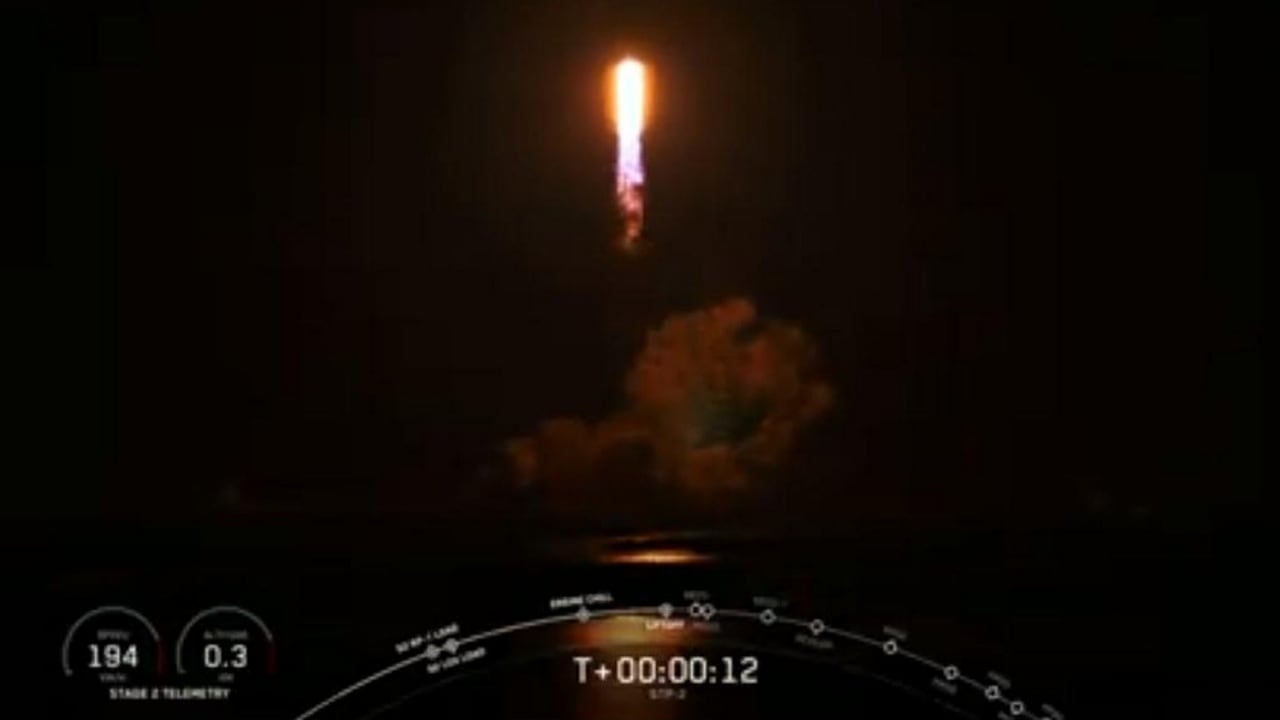 Falcon Heavy has a successful launch. Image credit: SpaceX/Twitter[/caption]The mission is part of the US Department of Defense’s (DOD) Space Test Program-2 (STP-2). NASA and the National Oceanic and Atmospheric Administration (NOAA) will also be sending their experiments as a part of this mission. NASA has a Deep Space Atomic Clock, a new kind of green fuel that is part of this mission.University experiments and payloads form private organizations are also being sent up along with 152 metal capsules of human ashes as a part of a private company.The mission is reusing the side boosters from the Arabsat-6A mission from April. It made a successful landing on SpaceX's landing zones 1 and 2 at Cape Canaveral Air Force Station in Florida. This is the first time that the boosters have been reused in a Falcon Heavy mission.The core centre was supposed to land on the 'Of Course I Love You' drone ship that is stationed in the Atlantic Ocean 768 miles away from shore, which is the furthest it has ever been. The core centre missed its mark on the landing pad and plunged into the ocean. The last time they tried to capture the core centre was not successful as well. The core landed on the pad but they lost it to the rough seas.[caption id="attachment_6876781" align="alignnone" width="1280"]
 The side boosters separate and is heading back to Cape Canaveral. image credit: SpaceX[/caption]While the core stage is identical to the side stages, it separates from the payload at a much higher altitude, which means it's returning to the Earth at a much higher speed than the boosters.
First Published:Jun 25, 2019, 12:10:21 IST
Advertisement
Advertisement

Careless Whispers: Scientists discover that plants can 'talk' to each other using smells
Japanese scientists have recorded a video that shows plants, in certain conditions, communicate with each other using mists that carry smells. The discovery, reveals that plants release a fine mist of airborne compounds, to warn nearby plants of potential dangers
Life on Mars? European Space Agency’s Orbiter discovers ice water deposits at equator
European Space Agency's Mars Express Orbiter has identified massive ice and ice water deposits beneath the surface of Mars. The Mars Express orbiter was also the first to confirmed the presence of ice on Mars in 2004
Microsoft briefly overtakes Apple as the most valuable company, Apple back on top again
At its peak during the session, Microsoft's value reached $2.903 trillion, with a 2% surge. As of writing this article, Apple closed at $2.89 trillion, whereas Microsoft closed at $2.86 trillion
Even NASA is facing a tough time, starts layoffs following major budget cuts
NASA is facing some massive budget cuts, because of which, it has been forced to postpone some upcoming missions. NASA's Jet Propulsion Laboratory has been hit hard by recent federal budget cuts, resulting in the layoff of 100 contractors last week
ISRO, NASA's NISAR satellite to get ready by Jan-end, will monitor Earth's snow-covered regions
The NISAR satellite which has been developed jointly ISRO and NASA, should be ready for launch by the end of January 2024. The collaboration between NASA and ISRO on NISAR is the first time the two agencies have cooperated on hardware development for an Earth-observing mission
Advertisement
Advertisement