
Advertisement


Sections
SpaceX Falcon 9 rocket carrying AI robot Cimon finally reaches space station
The SpaceX Falcon 9 rocket lifted on June 29 from Cape Canaveral Air Force Station in Florida.

A SpaceX Dragon spacecraft loaded with about 2,600 kg of research materials and supplies, including an Artificial Intelligence (AI) robot named Cimon, reached the International Space Station on 2 July, NASA said.The spacecraft lifted off on a Falcon 9 rocket on June 29 from Cape Canaveral Air Force Station in Florida."Capture confirmed! Dragon now attached to the Space Station robotic arm," SpaceX tweeted on Monday.NASA astronauts Ricky Arnold and Drew Feustel captured the Dragon spacecraft using the space station's Canadarm2 robotic arm, the US space agency wrote in a blog post.[caption id="attachment_4649871" align="alignnone" width="1280"]![The SpaceX Dragon is pictured about 30 meters from the International Space Station. Credit: NASA TV]() The SpaceX Dragon is pictured about 30 meters from the International Space Station. Credit: NASA TV[/caption]Among the research arriving on Dragon is a cellular biology investigation (Micro-12) to understand how microgravity affects the growth, gene expression and ability of a model bacterium to transfer electrons through its cell membrane along the bacterial nanowires it produces.Such bacteria could be used in microbial fuel cells to make electricity from waste organic material.[caption id="attachment_4632891" align="alignnone" width="1280"]
The SpaceX Dragon is pictured about 30 meters from the International Space Station. Credit: NASA TV[/caption]Among the research arriving on Dragon is a cellular biology investigation (Micro-12) to understand how microgravity affects the growth, gene expression and ability of a model bacterium to transfer electrons through its cell membrane along the bacterial nanowires it produces.Such bacteria could be used in microbial fuel cells to make electricity from waste organic material.[caption id="attachment_4632891" align="alignnone" width="1280"]![SpaceX Raocket. Image: Kennedy Space Center, NASA]() SpaceX Rocket. Image: Kennedy Space Center, NASA[/caption]An Earth science instrument called the ECOsystem Spaceborne Thermal Radiometer Experiment on Space Station (ECOSTRESS) will provide a new space-based measurement of how plants respond to changes in water availability. This data can help society better manage agricultural water use.The spacecraft's occupant also included a robot named Cimon, short for Crew Interactive Mobile Companion.The pilot study with Cimon is a technology demonstration project, and an observational study that aims to obtain the first insights into the effects on crew support by AI, in terms of efficiency and acceptance during long-term missions in space.
SpaceX Rocket. Image: Kennedy Space Center, NASA[/caption]An Earth science instrument called the ECOsystem Spaceborne Thermal Radiometer Experiment on Space Station (ECOSTRESS) will provide a new space-based measurement of how plants respond to changes in water availability. This data can help society better manage agricultural water use.The spacecraft's occupant also included a robot named Cimon, short for Crew Interactive Mobile Companion.The pilot study with Cimon is a technology demonstration project, and an observational study that aims to obtain the first insights into the effects on crew support by AI, in terms of efficiency and acceptance during long-term missions in space.
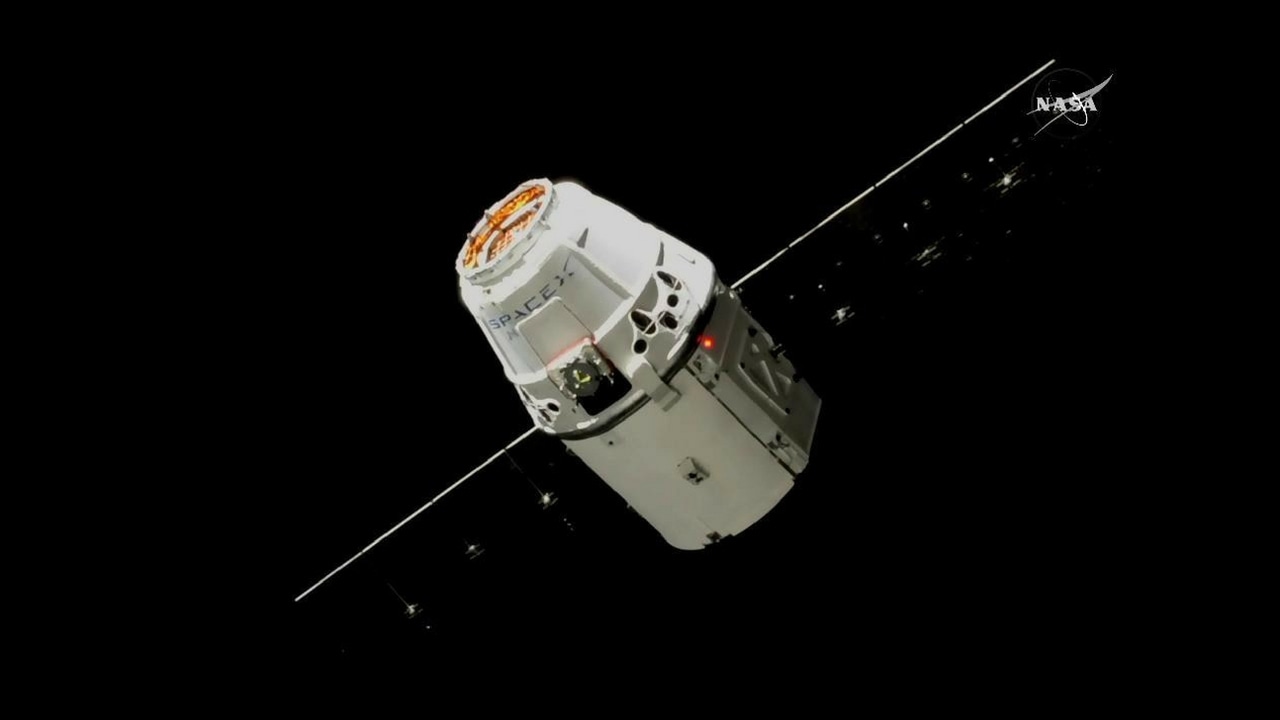 The SpaceX Dragon is pictured about 30 meters from the International Space Station. Credit: NASA TV[/caption]Among the research arriving on Dragon is a cellular biology investigation (Micro-12) to understand how microgravity affects the growth, gene expression and ability of a model bacterium to transfer electrons through its cell membrane along the bacterial nanowires it produces.Such bacteria could be used in microbial fuel cells to make electricity from waste organic material.[caption id="attachment_4632891" align="alignnone" width="1280"]
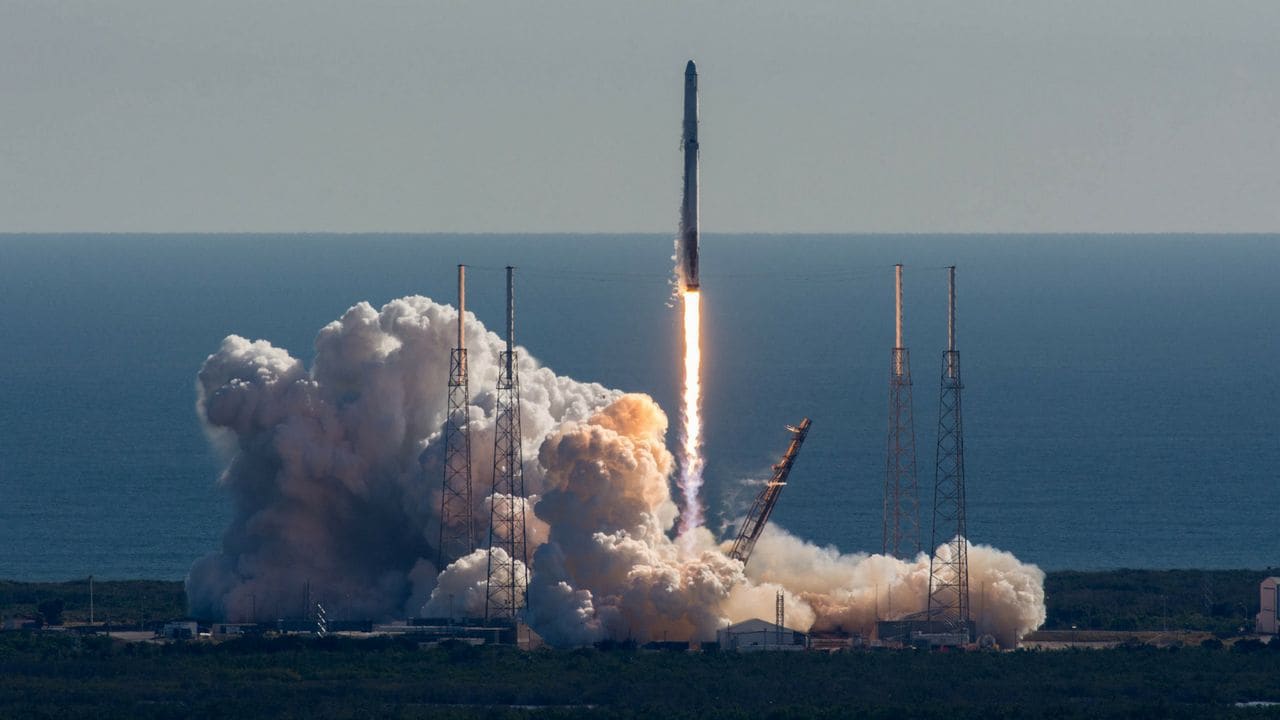 SpaceX Rocket. Image: Kennedy Space Center, NASA[/caption]An Earth science instrument called the ECOsystem Spaceborne Thermal Radiometer Experiment on Space Station (ECOSTRESS) will provide a new space-based measurement of how plants respond to changes in water availability. This data can help society better manage agricultural water use.
First Published:Jul 02, 2018, 18:54:19 IST
Advertisement
Advertisement

Careless Whispers: Scientists discover that plants can 'talk' to each other using smells
Japanese scientists have recorded a video that shows plants, in certain conditions, communicate with each other using mists that carry smells. The discovery, reveals that plants release a fine mist of airborne compounds, to warn nearby plants of potential dangers
Life on Mars? European Space Agency’s Orbiter discovers ice water deposits at equator
European Space Agency's Mars Express Orbiter has identified massive ice and ice water deposits beneath the surface of Mars. The Mars Express orbiter was also the first to confirmed the presence of ice on Mars in 2004
Microsoft briefly overtakes Apple as the most valuable company, Apple back on top again
At its peak during the session, Microsoft's value reached $2.903 trillion, with a 2% surge. As of writing this article, Apple closed at $2.89 trillion, whereas Microsoft closed at $2.86 trillion
Even NASA is facing a tough time, starts layoffs following major budget cuts
NASA is facing some massive budget cuts, because of which, it has been forced to postpone some upcoming missions. NASA's Jet Propulsion Laboratory has been hit hard by recent federal budget cuts, resulting in the layoff of 100 contractors last week
ISRO, NASA's NISAR satellite to get ready by Jan-end, will monitor Earth's snow-covered regions
The NISAR satellite which has been developed jointly ISRO and NASA, should be ready for launch by the end of January 2024. The collaboration between NASA and ISRO on NISAR is the first time the two agencies have cooperated on hardware development for an Earth-observing mission
Advertisement
Advertisement