
Advertisement


Sections
Solar sail made by Bill Nye's Planetary Society takes wing in space after 2-week delay
On 2 July, Prox 1 deployed the Lightsail 2 in a nearly perfect circular orbit, 720 km, in low Earth orbit.

On 25 June, SpaceX acted as a courier and launched 24 satellites into space. Among them was a small, loaf sized spacecraft called 'Prox 1', built by students. It contained a solar sail Lightsail 2, a passion project of the non-profit organization The Planetary Society, which is headed by Bill Nye who is well known for his science program Bill Nye the Science Guy.On 2 July, Prox 1 deployed the Lightsail 2 in a nearly perfect circular orbit, 720 km, in low Earth orbit. The deployment of the sail was delayed for two weeks due to irregularities in the readings. After plenty of checks and test of the cameras and solar panels, on 23 July, the solar sail was finally launched.Lightsail 2, a crowdsourced satellite that uses sunlight to power its movement, is now in space. Like boats have sails that use the wind to move through water; this sail will use photons from the Sun to move through space. A representative from Planetary Science told Space.com, "While light has no mass, it has momentum that can be transferred to other objects. A solar sail harnesses this momentum for propulsion."The photons will bounce off the shiny panels on the kite-like body and push the sail. During the deployment, four booms extended from its body and unfurled four triangular Mylar sails. This whole process took around three minutes.[caption id="attachment_7046671" align="alignnone" width="1280"]![The solar sail deployment. Image credit: The Planetary Society]() If the test sail is successful in its mission, it can lead to more ambitious solar sail missions beyond just the Earth’s orbit, to other planets and solar systems. This sail has a mission life of a year because of 'atmospheric drag' and it will burn up on re-entry into the Earth’s atmosphere.
If the test sail is successful in its mission, it can lead to more ambitious solar sail missions beyond just the Earth’s orbit, to other planets and solar systems. This sail has a mission life of a year because of 'atmospheric drag' and it will burn up on re-entry into the Earth’s atmosphere.
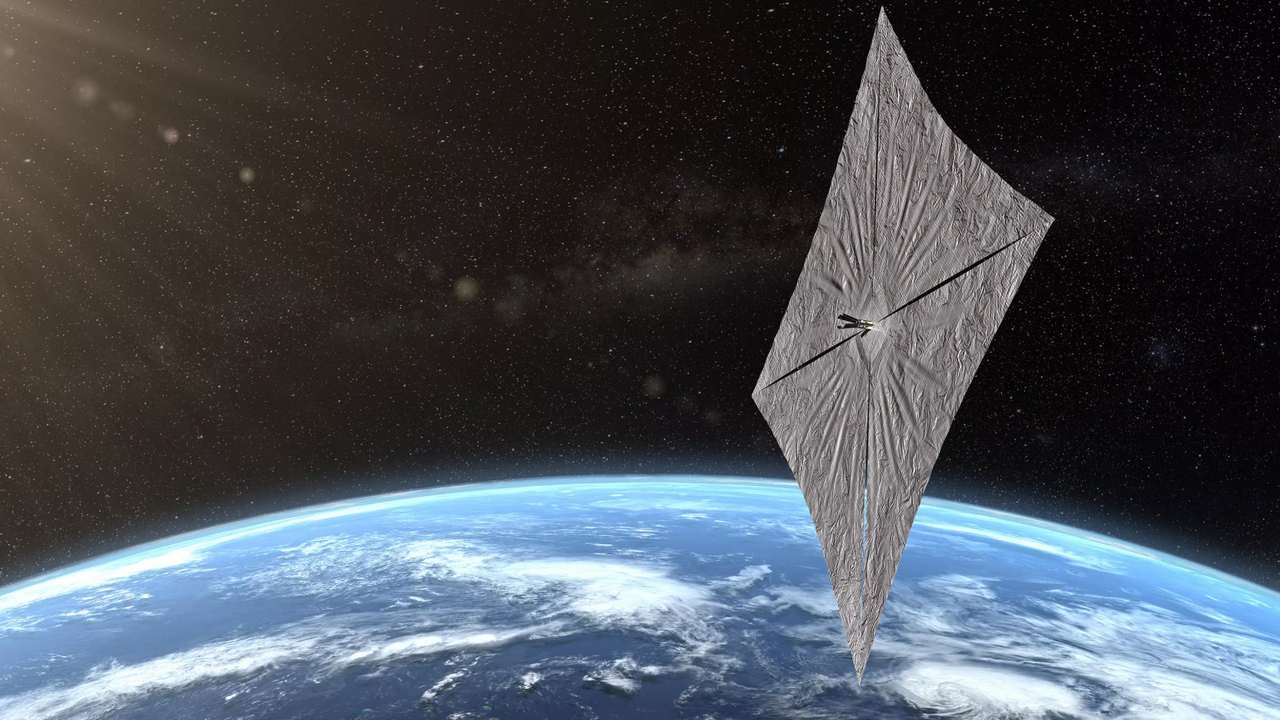
The solar sail deployment. Image credit: The Planetary Society[/caption]"We use the term boom just like on a sailboat, to hold the sails out because we’re twisting relatively fast in Earth orbit," Bill Nye, Planetary Society CEO, said at a press launch. He then went on to explain how the sail will move. "We go edge-on toward the sun, twist 90 degrees, go face on and get a full push like a sailboat going downwind, building orbital energy. [We] then twist again on the night side of the Earth and twist on the dayside, over and over."
What can this sail be used for?
Solar sailing is a revolutionary, simple mechanism to propel a spacecraft through space. It captures the momentum of light from the Sun and using that momentum to push the spacecraft forward."LightSail 2 will demonstrate the application of solar sailing for CubeSats, [which are] small, standardized spacecraft that have made spaceflight more affordable for academics, government organizations and private institutions," The Society’s representative explains.Lightsail: Not a pioneer
The Lightsail 2 is not the first solar sail to be launched in space. There was a Lightsail 1 that did not take off. Japan’s space agency, JAXA, launched IKAROS (interplanetary Kite-craft Accelerated by Radiation Of the Sun) on May 2010. In August 2010, NASA launched the NanoSail-D, however, the satellite was lost soon after the launch. A replacement, NanoSail-D2 was launched to complete its mission.The Planetary Society's LightSail 2 mission is just one of many examples of this technology in action.First Published:Jul 29, 2019, 12:55:56 IST
Advertisement
Advertisement

Careless Whispers: Scientists discover that plants can 'talk' to each other using smells
Japanese scientists have recorded a video that shows plants, in certain conditions, communicate with each other using mists that carry smells. The discovery, reveals that plants release a fine mist of airborne compounds, to warn nearby plants of potential dangers
Life on Mars? European Space Agency’s Orbiter discovers ice water deposits at equator
European Space Agency's Mars Express Orbiter has identified massive ice and ice water deposits beneath the surface of Mars. The Mars Express orbiter was also the first to confirmed the presence of ice on Mars in 2004
Microsoft briefly overtakes Apple as the most valuable company, Apple back on top again
At its peak during the session, Microsoft's value reached $2.903 trillion, with a 2% surge. As of writing this article, Apple closed at $2.89 trillion, whereas Microsoft closed at $2.86 trillion
Even NASA is facing a tough time, starts layoffs following major budget cuts
NASA is facing some massive budget cuts, because of which, it has been forced to postpone some upcoming missions. NASA's Jet Propulsion Laboratory has been hit hard by recent federal budget cuts, resulting in the layoff of 100 contractors last week
ISRO, NASA's NISAR satellite to get ready by Jan-end, will monitor Earth's snow-covered regions
The NISAR satellite which has been developed jointly ISRO and NASA, should be ready for launch by the end of January 2024. The collaboration between NASA and ISRO on NISAR is the first time the two agencies have cooperated on hardware development for an Earth-observing mission
Advertisement
Advertisement