
Advertisement


Sections
Sitting in the space station, ESA astronaut remotely drives lunar rover collecting rock samples
This method will help future astronauts to stay in the safety of the spacecraft while controlling the rover.

An astronaut in space took control of ESA's lunar rover, Interact, on Earth and drove it around successfully. It even picked up a rock sample as a test. These preliminary tests were conducted to ascertain that the space agency could replicate this method on the moon or Mars.This was the first test in a series of tests to check if the technology developed by the European Space Agency (ESA) actually worked. The entire series of tests are called Analog-1.In this test, astronaut Luca Parmitano took control of the prototype lunar rover, which was situated in the Netherlands, from the International Space Station where he is currently working. He then drove it around an obstacle course in the testing facility and picked up a rock sample from a sampling site.[caption id="attachment_7698141" align="alignnone" width="1280"]![The ESA prototype of the lunar rover in the Netherlands. Image credit: ESA]() The ESA prototype of the lunar rover in the Netherlands. Image credit: ESA[/caption]The astronaut used two laptops and a Sigma7 ‘force-feedback’ joystick with six degrees of motion to operate the rover. The joystick allows the astronaut to feel what the robot feels and adjust his grip accordingly. The test was supposed to last one hour but the Italian astronaut completed it in half an hour.ESA wants to build a rover that can work hand-in-hand with human beings. The agency believes that robots can go to places and do things that human beings are not able to. However, they are not as adaptive and quick like human beings.ESA project manager Kjetil Wormnes said in a statement, “A rover on Mars would have taken weeks to do the same work Luca and the Analog-1 rover did in half an hour.”If all goes well with this rover, ESA will be able to send astronauts into orbit around other planets without taking the risk of landing them. They will be able to control the rover while orbiting around the planet.[caption id="attachment_7698031" align="alignnone" width="1280"]
The ESA prototype of the lunar rover in the Netherlands. Image credit: ESA[/caption]The astronaut used two laptops and a Sigma7 ‘force-feedback’ joystick with six degrees of motion to operate the rover. The joystick allows the astronaut to feel what the robot feels and adjust his grip accordingly. The test was supposed to last one hour but the Italian astronaut completed it in half an hour.ESA wants to build a rover that can work hand-in-hand with human beings. The agency believes that robots can go to places and do things that human beings are not able to. However, they are not as adaptive and quick like human beings.ESA project manager Kjetil Wormnes said in a statement, “A rover on Mars would have taken weeks to do the same work Luca and the Analog-1 rover did in half an hour.”If all goes well with this rover, ESA will be able to send astronauts into orbit around other planets without taking the risk of landing them. They will be able to control the rover while orbiting around the planet.[caption id="attachment_7698031" align="alignnone" width="1280"]![Italian astronaut Luca Parmitano that took control of the rover from the Space station. Image credit : ESA]() Italian astronaut Luca Parmitano that took control of the rover from the Space station. Image credit : ESA[/caption]Jessica Grenouilleau, Meteron project lead at ESA’s Exploration Systems Group said in a press release, “Even on the Moon preparing an astronaut for a sortie takes hours just to get into a suit and prepare the airlock. By giving astronauts the possibility to control the robots nearby in the safety and comfort of their base or orbital spacecraft, much more can be achieved. This first test indicates an excellent adaptation between the crew and the robotic system, making this combination better at a wide range of tasks.”Since this test was a success, Parmitano will go ahead with other tests. In the next test, he will drive the rover around the test facility to three different sites to collect rock samples.
Italian astronaut Luca Parmitano that took control of the rover from the Space station. Image credit : ESA[/caption]Jessica Grenouilleau, Meteron project lead at ESA’s Exploration Systems Group said in a press release, “Even on the Moon preparing an astronaut for a sortie takes hours just to get into a suit and prepare the airlock. By giving astronauts the possibility to control the robots nearby in the safety and comfort of their base or orbital spacecraft, much more can be achieved. This first test indicates an excellent adaptation between the crew and the robotic system, making this combination better at a wide range of tasks.”Since this test was a success, Parmitano will go ahead with other tests. In the next test, he will drive the rover around the test facility to three different sites to collect rock samples.
 The ESA prototype of the lunar rover in the Netherlands. Image credit: ESA[/caption]The astronaut used two laptops and a Sigma7 ‘force-feedback’ joystick with six degrees of motion to operate the rover. The joystick allows the astronaut to feel what the robot feels and adjust his grip accordingly. The test was supposed to last one hour but the Italian astronaut completed it in half an hour.ESA wants to build a rover that can work hand-in-hand with human beings. The agency believes that robots can go to places and do things that human beings are not able to. However, they are not as adaptive and quick like human beings.
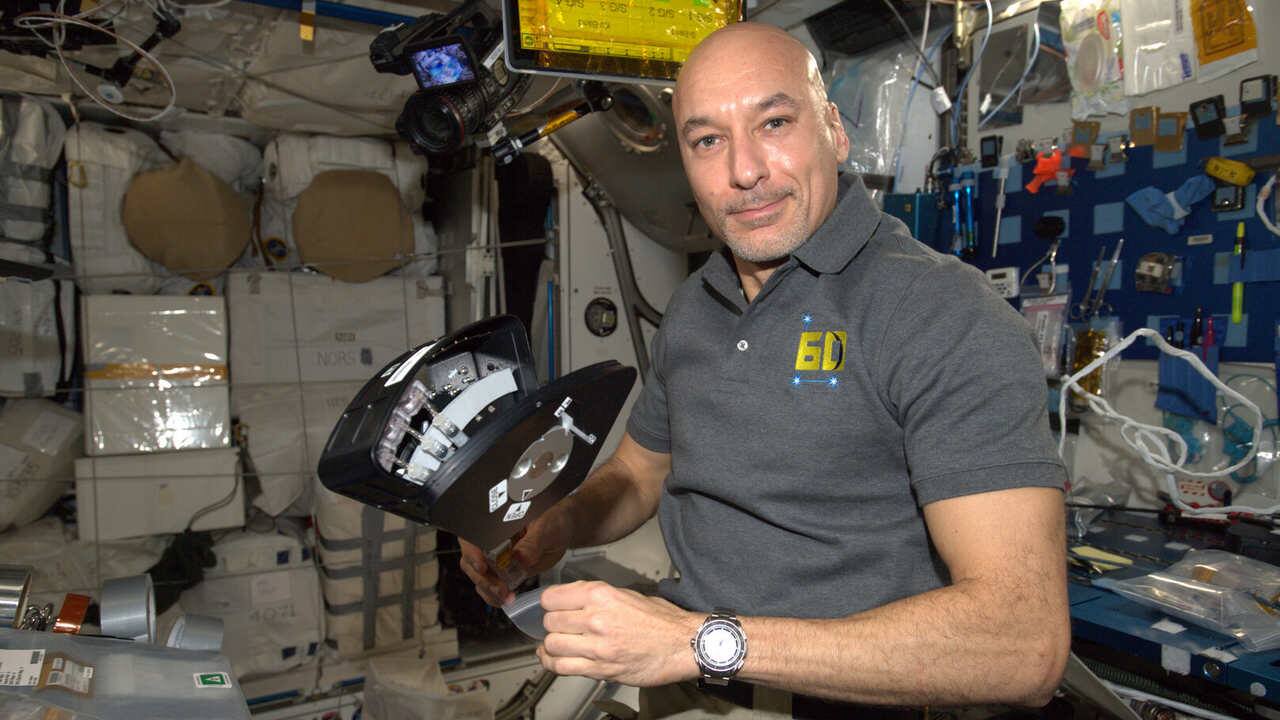 Italian astronaut Luca Parmitano that took control of the rover from the Space station. Image credit : ESA[/caption]Jessica Grenouilleau, Meteron project lead at ESA’s Exploration Systems Group said in a press release, “Even on the Moon preparing an astronaut for a sortie takes hours just to get into a suit and prepare the airlock. By giving astronauts the possibility to control the robots nearby in the safety and comfort of their base or orbital spacecraft, much more can be achieved. This first test indicates an excellent adaptation between the crew and the robotic system, making this combination better at a wide range of tasks.”Since this test was a success, Parmitano will go ahead with other tests. In the next test, he will drive the rover around the test facility to three different sites to collect rock samples.
First Published:Nov 25, 2019, 16:50:10 IST
Advertisement
Advertisement

Careless Whispers: Scientists discover that plants can 'talk' to each other using smells
Japanese scientists have recorded a video that shows plants, in certain conditions, communicate with each other using mists that carry smells. The discovery, reveals that plants release a fine mist of airborne compounds, to warn nearby plants of potential dangers
Life on Mars? European Space Agency’s Orbiter discovers ice water deposits at equator
European Space Agency's Mars Express Orbiter has identified massive ice and ice water deposits beneath the surface of Mars. The Mars Express orbiter was also the first to confirmed the presence of ice on Mars in 2004
Microsoft briefly overtakes Apple as the most valuable company, Apple back on top again
At its peak during the session, Microsoft's value reached $2.903 trillion, with a 2% surge. As of writing this article, Apple closed at $2.89 trillion, whereas Microsoft closed at $2.86 trillion
Even NASA is facing a tough time, starts layoffs following major budget cuts
NASA is facing some massive budget cuts, because of which, it has been forced to postpone some upcoming missions. NASA's Jet Propulsion Laboratory has been hit hard by recent federal budget cuts, resulting in the layoff of 100 contractors last week
ISRO, NASA's NISAR satellite to get ready by Jan-end, will monitor Earth's snow-covered regions
The NISAR satellite which has been developed jointly ISRO and NASA, should be ready for launch by the end of January 2024. The collaboration between NASA and ISRO on NISAR is the first time the two agencies have cooperated on hardware development for an Earth-observing mission
Advertisement
Advertisement