


Scientists witness the death of a galaxy 9 million light-years away unfold, in a remarkable first
The rare and recent discovery also shows that galaxies could shut down as a result of mergers.

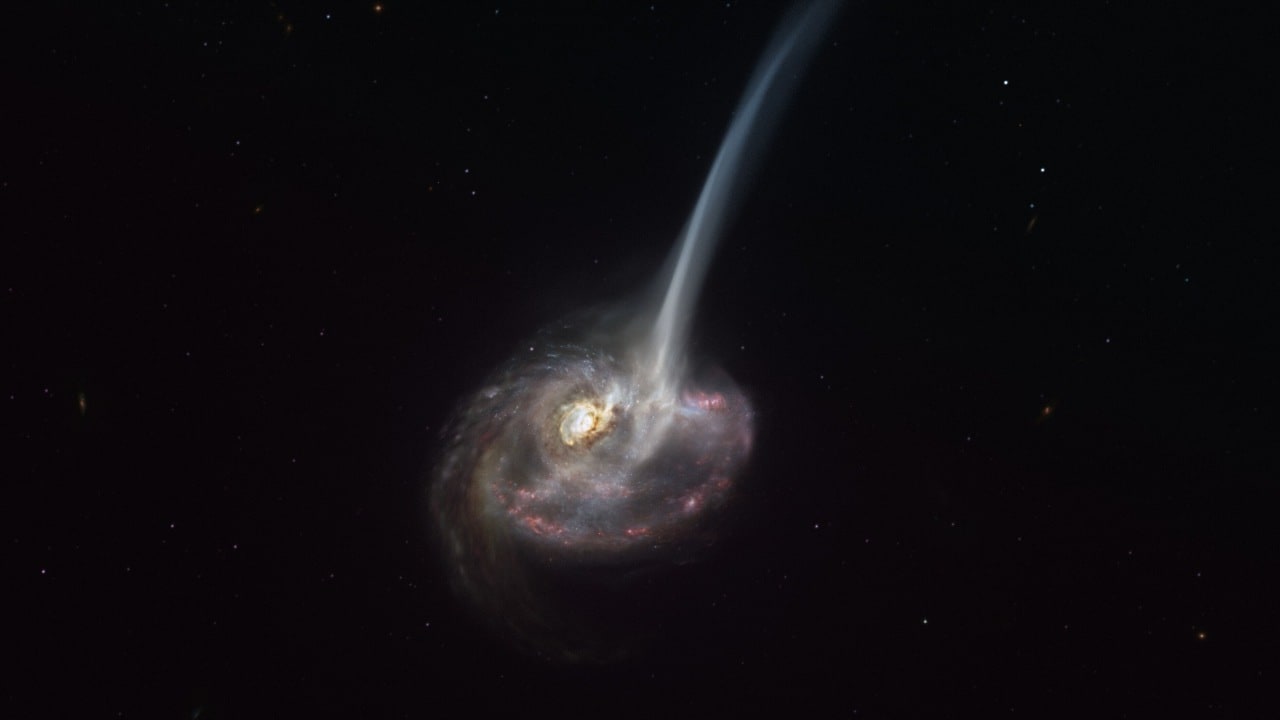
Galaxy mergers could inhibit star formation. This artist's impression of ID2299 shows the galaxy, the product of a galactic collision, and some of its gas being ejected by a "tidal tail" as a result of the merger. Image credit: ESO/M Kornmesser[/caption]Apart from ejecting out material, the galaxy is also forming stars. The rate of creating stars is very rapid, almost hundreds of times faster than our galaxy, the Milky Way. The result of this fast creation will be that the remaining gas in ID2299 will be consumed gradually, over a few tens of millions of years.Earlier, it was believed that winds caused by star formation and the activity of black holes at the centres of giant galaxies caused the ejection of star-forming material into space. But the recent case shows that mergers of galaxies can also lead to the shutting down of a galaxy.“ALMA has shed new light on the mechanisms that can halt the formation of stars in distant galaxies. Witnessing such a massive disruption event adds an important piece to the complex puzzle of galaxy evolution," said Chiara Circosta, a researcher at the University College London who was part of the research. The study has been published in the journal Nature Astronomy.

Careless Whispers: Scientists discover that plants can 'talk' to each other using smells
Life on Mars? European Space Agency’s Orbiter discovers ice water deposits at equator
Microsoft briefly overtakes Apple as the most valuable company, Apple back on top again
Even NASA is facing a tough time, starts layoffs following major budget cuts
ISRO, NASA's NISAR satellite to get ready by Jan-end, will monitor Earth's snow-covered regions