
Advertisement


Sections
Russia sends its first humanoid robot — Fedor to the ISS on its Soyuz rocket
Fedor has Instagram and Twitter accounts that describe it as learning new skills such as opening a bottle of water.

Russia was set to launch on Thursday an unmanned rocket carrying a life-size humanoid robot that will spend 10 days learning to assist astronauts on the International Space Station. Named Fedor, for Final Experimental Demonstration Object Research with identification number Skybot F850, the robot is the first-ever sent up by Russia.Fedor was to blast off in a Soyuz rocket at 6:38 am Moscow time from Russia's Baikonur cosmodrome in Kazakhstan, dock with the space station on Saturday and stay till 7 September.The Soyuz spacecraft is normally manned on such trips, but on Thursday no humans will be travelling in order to test a new emergency rescue system. Instead of cosmonauts, Fedor will sit in a specially adapted pilot's seat.The silvery anthropomorphic robot stands one metre 80 centimetres tall and weighs 160 kilograms.Fedor has Instagram and Twitter accounts that describe it as learning new skills such as opening a bottle of water. In the station, it will try those manual skills in very low gravity."That's connecting and disconnecting electric cables, using standard items from a screwdriver and a spanner to a fire extinguisher," the Russian space agency's director for prospective programmes and science, Alexander Bloshenko, said in televised comments.Fedor copies human movements, a key skill that allows it to remotely help astronauts or even people on Earth carry out tasks while they are strapped into an exoskeleton.Such robots will eventually carry out dangerous operations such as spacewalks, Bloshenko told RIA Novosti state news agency.On the website of one of the state backers of the project, the Foundation of Advanced Research Projects, Fedor is described as potentially useful on Earth for working in high radiation environments, de-mining and tricky rescue missions.[caption id="attachment_7205341" align="alignnone" width="1280"]![Russian humanoid robot]()
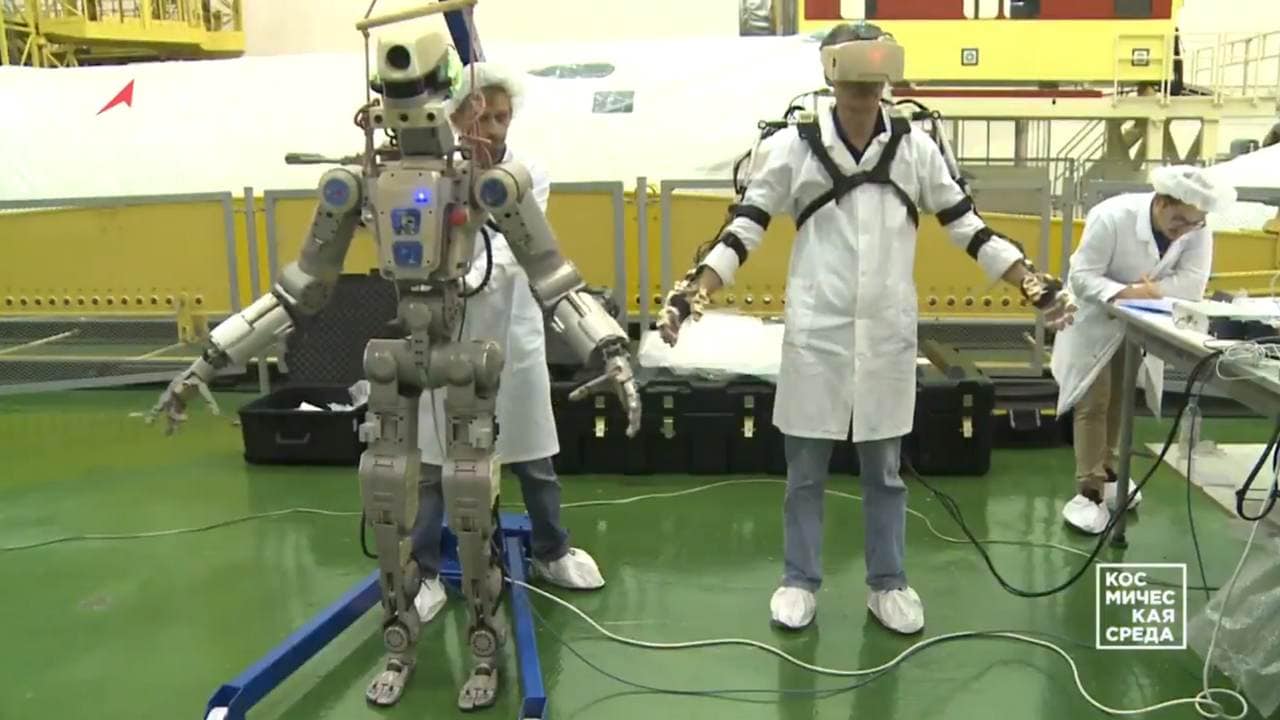
Russian humanoid robot "Skybot F850". Image credit: Twitter[/caption]Onboard, the robot will perform tasks supervised by Russian cosmonaut Alexander Skvortsov, who joined the ISS last month, and will wear an exoskeleton in a series of experiments scheduled for later this month.
Fedor not the first
Space agency chief Dmitry Rogozin showed pictures of the robot to President Vladimir Putin this month, saying it will be "an assistant to the crew". "In the future, we plan that this machine will also help us conquer deep space," he added.Fedor is not the first robot to go into space.In 2011, NASA sent up Robonaut 2, a humanoid robot developed with General Motors and a similar aim of working in high-risk environments. It was flown back to Earth in 2018 after experiencing technical problems.In 2013, Japan sent up a small robot called Kirobo along with the ISS's first Japanese space commander. Developed with Toyota, it was able to hold conversations — albeit only in Japanese.
First Published:Aug 22, 2019, 09:37:20 IST
Advertisement
Advertisement

Careless Whispers: Scientists discover that plants can 'talk' to each other using smells
Japanese scientists have recorded a video that shows plants, in certain conditions, communicate with each other using mists that carry smells. The discovery, reveals that plants release a fine mist of airborne compounds, to warn nearby plants of potential dangers
Life on Mars? European Space Agency’s Orbiter discovers ice water deposits at equator
European Space Agency's Mars Express Orbiter has identified massive ice and ice water deposits beneath the surface of Mars. The Mars Express orbiter was also the first to confirmed the presence of ice on Mars in 2004
Microsoft briefly overtakes Apple as the most valuable company, Apple back on top again
At its peak during the session, Microsoft's value reached $2.903 trillion, with a 2% surge. As of writing this article, Apple closed at $2.89 trillion, whereas Microsoft closed at $2.86 trillion
Even NASA is facing a tough time, starts layoffs following major budget cuts
NASA is facing some massive budget cuts, because of which, it has been forced to postpone some upcoming missions. NASA's Jet Propulsion Laboratory has been hit hard by recent federal budget cuts, resulting in the layoff of 100 contractors last week
ISRO, NASA's NISAR satellite to get ready by Jan-end, will monitor Earth's snow-covered regions
The NISAR satellite which has been developed jointly ISRO and NASA, should be ready for launch by the end of January 2024. The collaboration between NASA and ISRO on NISAR is the first time the two agencies have cooperated on hardware development for an Earth-observing mission
Advertisement
Advertisement