
Advertisement


Sections
Russia hopes to launch its own space station in 2025, says Roscosmos chief Dmitry Rogozin
"The first core module of the new Russian orbital station is in the works," Rogozin said in a statement.

Russia's space agency said Tuesday it hoped to launch its own orbital station in 2025 as Moscow considers withdrawing from the International Space Station programme to go it alone. Roscosmos chief Dmitry Rogozin said work had begun on the fist module of a new station, after officials warned that Russia was considering pulling out of the ISS, one of the few successful examples of cooperation with the West. The announcement came with tensions soaring over espionage claims, a Russian troop build-up along Ukraine's borders and the deteriorating health of President Vladimir Putin's imprisoned critic Alexei Navalny.[caption id="attachment_6553061" align="alignnone" width="1280"]![The International Space Station. Image credit: Wikipedia]()
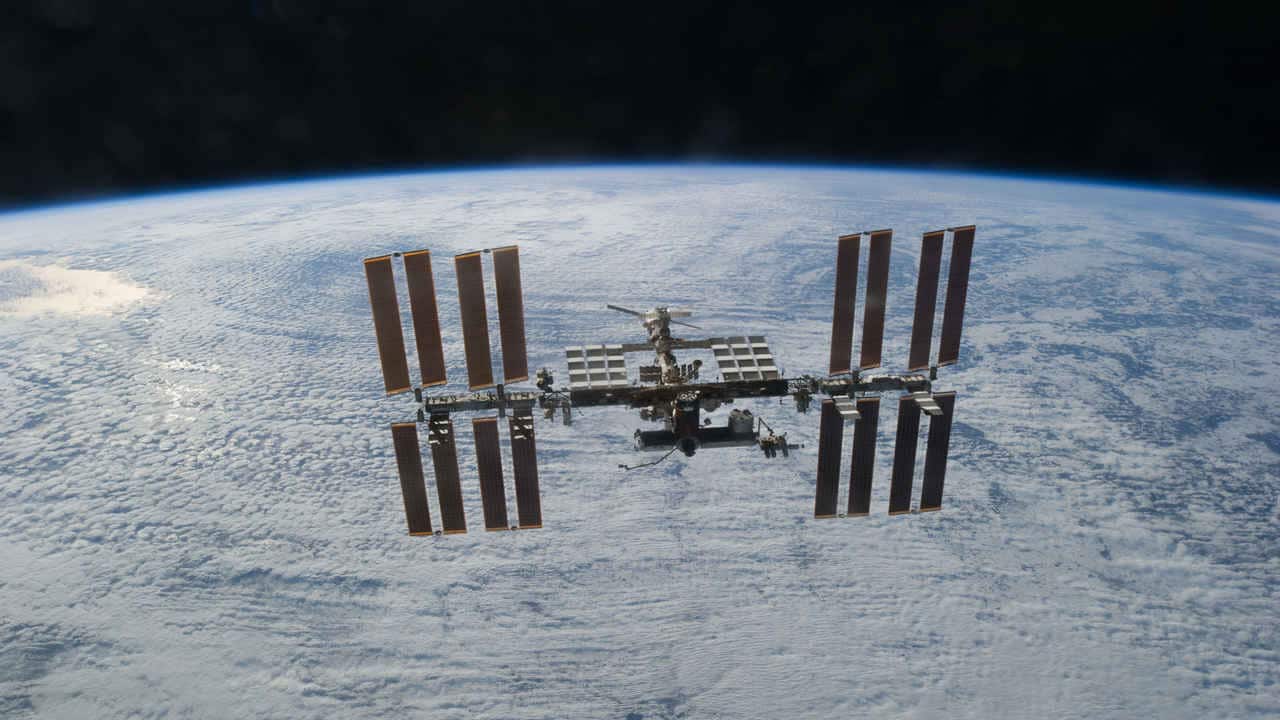
The International Space Station. Image credit: Wikipedia[/caption]"The first core module of the new Russian orbital station is in the works," Rogozin said in a statement on messaging app Telegram.He said Russia's Energia space corporation was aiming to have the module "ready for launch" in 2025 and released a video of Energia staff at work.Launched in 1998 and involving Russia, the United States, Canada, Japan, and the European Space Agency, the ISS is one of the most ambitious international collaborations in human history.
Russia's Deputy Prime Minister Yury Borisov said in recent days that Moscow was considering whether to leave the ISS programme from 2025 because of the station's age.Roscosmos said on Monday that a decision on quitting the ISS had not yet been made."When we make a decision we will start negotiations with our partners on forms and conditions of cooperation beyond 2024," the space agency told AFP in a statement.Russia lost its monopoly for manned flights to the ISS last year after the first successful mission of US company Space X.Despite its much-lauded history -- Russia this month marked the 60th anniversary of Yuri Gagarin becoming the first person in orbit -- the country's space programme has struggled in recent years.Rogozin has announced a series of ambitious plans in recent years but his agency has struggled under funding cuts, with analysts saying Putin is more interested in military technology than space exploration.First Published:Apr 23, 2021, 11:42:08 IST
Advertisement
Advertisement

Careless Whispers: Scientists discover that plants can 'talk' to each other using smells
Japanese scientists have recorded a video that shows plants, in certain conditions, communicate with each other using mists that carry smells. The discovery, reveals that plants release a fine mist of airborne compounds, to warn nearby plants of potential dangers
Life on Mars? European Space Agency’s Orbiter discovers ice water deposits at equator
European Space Agency's Mars Express Orbiter has identified massive ice and ice water deposits beneath the surface of Mars. The Mars Express orbiter was also the first to confirmed the presence of ice on Mars in 2004
Microsoft briefly overtakes Apple as the most valuable company, Apple back on top again
At its peak during the session, Microsoft's value reached $2.903 trillion, with a 2% surge. As of writing this article, Apple closed at $2.89 trillion, whereas Microsoft closed at $2.86 trillion
Even NASA is facing a tough time, starts layoffs following major budget cuts
NASA is facing some massive budget cuts, because of which, it has been forced to postpone some upcoming missions. NASA's Jet Propulsion Laboratory has been hit hard by recent federal budget cuts, resulting in the layoff of 100 contractors last week
ISRO, NASA's NISAR satellite to get ready by Jan-end, will monitor Earth's snow-covered regions
The NISAR satellite which has been developed jointly ISRO and NASA, should be ready for launch by the end of January 2024. The collaboration between NASA and ISRO on NISAR is the first time the two agencies have cooperated on hardware development for an Earth-observing mission
Advertisement
Advertisement