
Advertisement


Sections
Robots inspired by animals to be foot-soldiers in South Korea's military by 2024
USA and China are already making headways in this field and South Korea wants a piece of the pie.

Imagine you're a soldier fighting the good fight. You've got weapons in hand and an enemy to watch for. Out of nowhere comes an odd-looking dog that starts firing at your clan moments later. Extreme, yes. But worldwide, much like in any other industry, robots are finding their feet in military defense, too.South Korea has announced its plans to include robot soldiers in their military that look and move as animals do. Making robotic soldiers also brings a whole new meaning to "precision", which is something all military operations and war demands.The United States and China have already made heavy investments in this sector and are raring to go. South Korea, on the other hand, is one of the smaller players in the field. The country's Defense Acquisition Program Administration (DAPA) announced big plans for robotics, specifically, 'biomimetics', in their military operations by 2024.Birds, snakes, insects and marine species are all likely inspiration for the military robots. The field of biomimetics uses physics in the natural world as inspiration to engineer technology that serves a useful purpose.South Korea's biobot soldiers will not just be made in the likeness of animals, but also of human beings. What remains to be seen is just how exact the replication will be. In the initial stages, birds and marine robots will be used to carry out reconnaissance operations, according to a report in the Telegraph. Snake-like robots will be used to access constricted spaces and in areas hit by natural disasters.[caption id="attachment_6636821" align="alignnone" width="1280"]![An iRobot 310 Small Unmanned Ground Vehicle belonging to Combat Logistic Battalion 31, 31st Marine Expeditionary Unit, sits staged with 3-D printed lens covers aboard the USS Wasp (LHD-1) while underway in the Pacific Ocean, April 17, 2018. Marines with CLB-31 are now capable of ‘additive manufacturing,’ also known as 3-D printing, which is the technique of replicating digital 3-D models as tangible objects. The 31st Marine Expeditionary Unit partners with the Navy’s Amphibious Squadron 11 to form the Wasp Amphibious Ready Group, a cohesive blue-green team capable of accomplishing a variety of missions across the Indo-Pacific. (U.S. Marine Corps photo by Cpl. Stormy Mendez/Released)]()
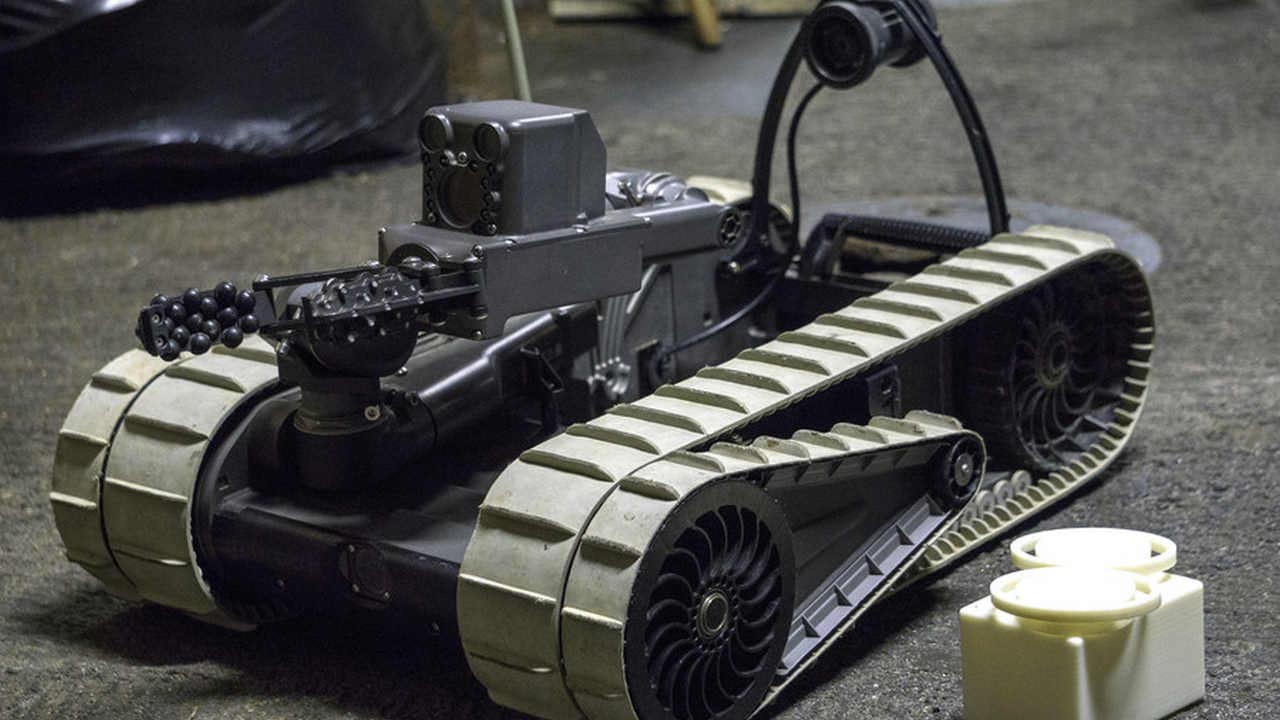
A US military robot. Image credit: US Marine Corps/Cpl. Stormy Mendez[/caption]Using designs in nature also cuts the work of designers in half — many of these muses have evolved to the best versions of themselves, adapted to suitable environments. "Biometric robots will be a game changer in future warfare, and related technologies are expected to bring about great ripple effects throughout the defence industry," Park Jeong-eun, spokesperson for the agency said in an interview with Yonhap News.
The Future is Robots
Let's admit it. Better have robots fighting and dying on the battlefield than humans. But if there's one thing science-fiction has taught us, it would be that robot armies come with downsides and evil overlords.The 2004 Will Smith starrer I, Robot is one good example of how robots doing our bidding can go so-very sideways. If we envisioned this outrageous outcome 15 years ago, the possibilities with today's technology are higher by a laughable degree.That said, humane robots programmed to do tasks cannot replace people, not yet. The emotional quotient is an important element that sets us apart, and we're still a while away from nailing that in a robot.Now that we've found ways to make robots look, talk and speak like human beings, can we also build more robots to do our anti-climate change bidding?
First Published:May 15, 2019, 14:58:03 IST
Advertisement
Advertisement

Careless Whispers: Scientists discover that plants can 'talk' to each other using smells
Japanese scientists have recorded a video that shows plants, in certain conditions, communicate with each other using mists that carry smells. The discovery, reveals that plants release a fine mist of airborne compounds, to warn nearby plants of potential dangers
Life on Mars? European Space Agency’s Orbiter discovers ice water deposits at equator
European Space Agency's Mars Express Orbiter has identified massive ice and ice water deposits beneath the surface of Mars. The Mars Express orbiter was also the first to confirmed the presence of ice on Mars in 2004
Microsoft briefly overtakes Apple as the most valuable company, Apple back on top again
At its peak during the session, Microsoft's value reached $2.903 trillion, with a 2% surge. As of writing this article, Apple closed at $2.89 trillion, whereas Microsoft closed at $2.86 trillion
Even NASA is facing a tough time, starts layoffs following major budget cuts
NASA is facing some massive budget cuts, because of which, it has been forced to postpone some upcoming missions. NASA's Jet Propulsion Laboratory has been hit hard by recent federal budget cuts, resulting in the layoff of 100 contractors last week
ISRO, NASA's NISAR satellite to get ready by Jan-end, will monitor Earth's snow-covered regions
The NISAR satellite which has been developed jointly ISRO and NASA, should be ready for launch by the end of January 2024. The collaboration between NASA and ISRO on NISAR is the first time the two agencies have cooperated on hardware development for an Earth-observing mission
Advertisement
Advertisement