


Reflections from a Nobel winner: Scientists need time to make discoveries, leaps
You can’t have applications of the sciences without the curiosity-driven research behind it.

Since the announcement that I won the Nobel Prize in physics for chirped pulse amplification, or CPA, there has been a lot of attention on its practical applications.It is understandable that people want to know how it affects them. But as a scientist, I would hope society would be equally interested in fundamental science. After all, you can’t have the applications without the curiosity-driven research behind it. Learning more about science — science for science’s sake — is worth supporting.Gérard Mourou, my co-recipient of the Nobel Prize, and I developed CPA in the mid-1980s.It all started when he wondered if we could increase laser intensity by orders of magnitude — or by factors of a thousand. He was my doctoral supervisor at the University of Rochester back then. Mourou suggested stretching an ultrashort pulse of light of low energy, amplifying it and then compressing it.As the graduate student, I had to handle the details.
A goal to revolutionize laser physics
The goal was to revolutionize the field of high-intensity laser physics, a fundamental area of science. We wanted the laser to show us how high-intensity light changes matter, and how matter affects light in this interaction.[caption id="attachment_5908471" align="alignnone" width="1280"]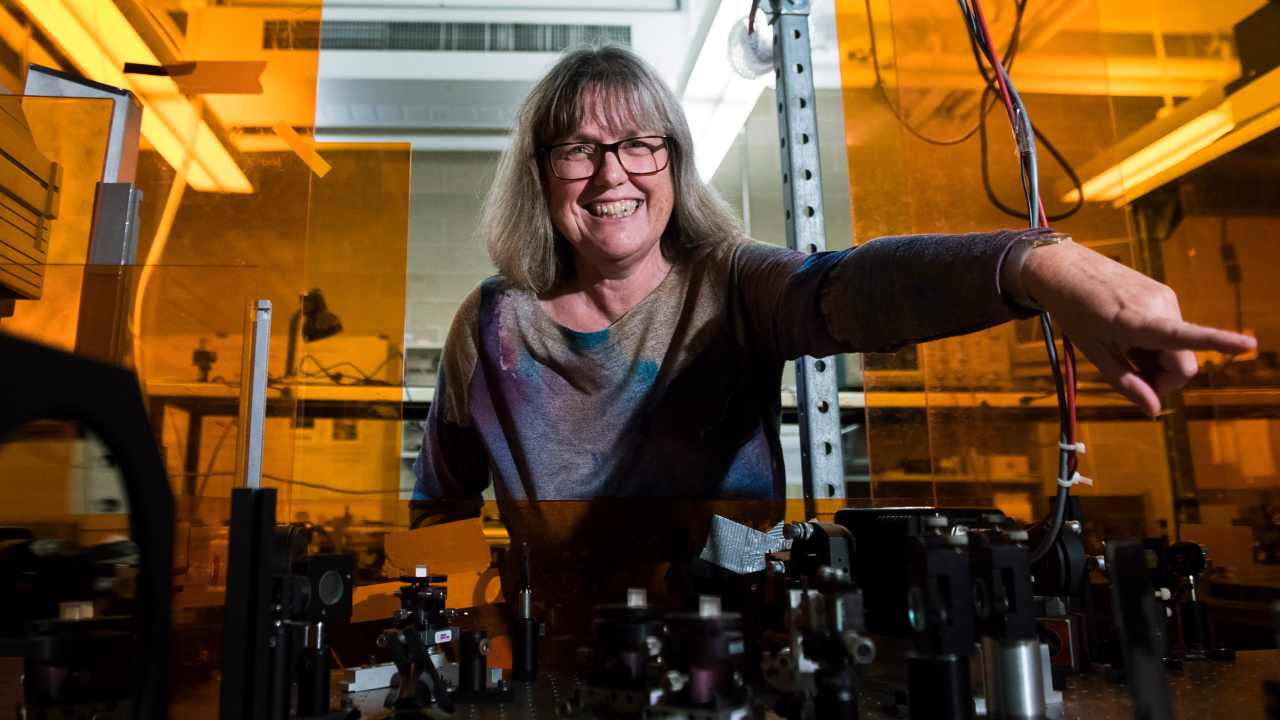
Noble Prize winner Donna Strickland in her lab at the University of Waterloo. She was awarded the prize for her groundbreaking inventions in the field of laser physics which has a variety of applications, including corrective laser eye surgery. Image credit: The Canadian Press/Nathan Denette[/caption]It took me a year to build the laser. We proved that we could increase laser intensity by orders of magnitude. In fact, CPA led to the most intense laser pulses ever recorded. Our findings changed the world’s understanding of how atoms interact with high-intensity light.It was about a decade before practical uses common today eventually came into view.
Many practical applications
 Donna Strickland, Professor, Department of Physics and Astronomy, University of WaterlooThis article is republished from The Conversation under a Creative Commons license. Read the original article.
Careless Whispers: Scientists discover that plants can 'talk' to each other using smells
Life on Mars? European Space Agency’s Orbiter discovers ice water deposits at equator
Microsoft briefly overtakes Apple as the most valuable company, Apple back on top again
Even NASA is facing a tough time, starts layoffs following major budget cuts
ISRO, NASA's NISAR satellite to get ready by Jan-end, will monitor Earth's snow-covered regions