


PSLV-C51 launch on 28 Feb: ISRO to launch Amazonia-1, 20 commercial satellites via NSIL
The Brazillian satellite Amazonia 1 is NewSpace India Limited's (NSIL) first commercial launch mission.

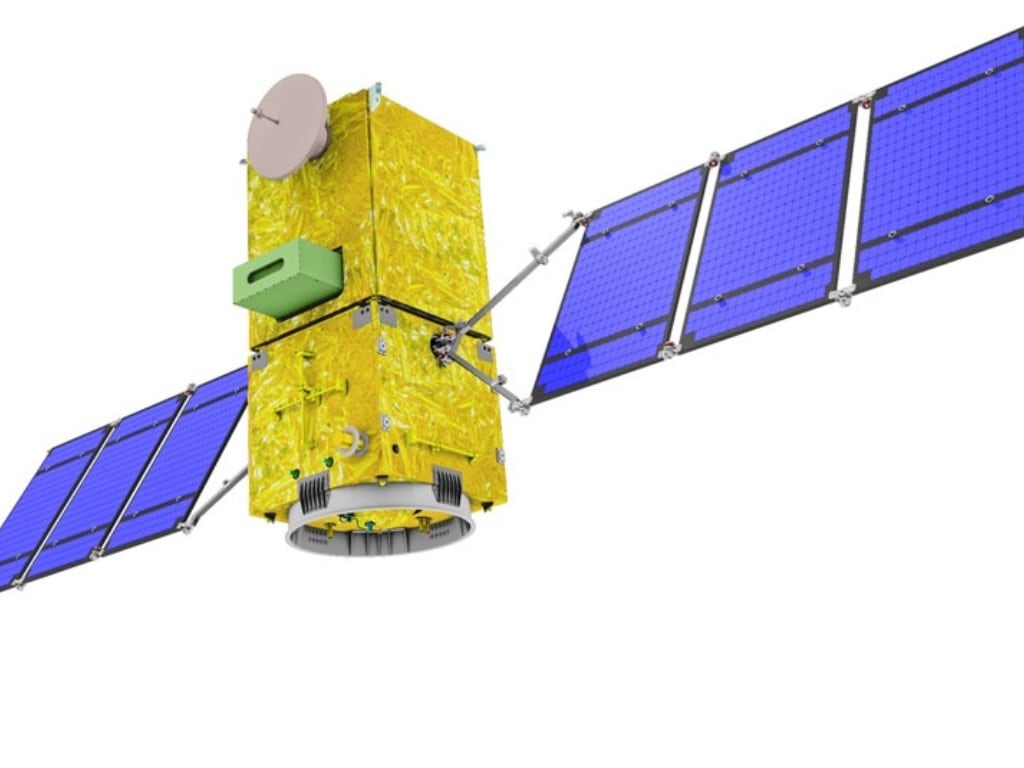
The Brazilian satellite Amazonia 1 Image credit: INEP[/caption]
About Amazonia 1
Amazonia-1 is an optical earth observation satellite that has been designed, integrated, tested and operated by Brazil's National Institute for Space Research (INPE) – the research unit under the Ministry of Science, Technology and Innovation. The satellite is a Sun-synchronous polar-orbiting satellite that can generate images every five days states INPE blog. It has a wide-view optical camera with three visible frequency bands and one near-infrared band.Amazonia-1 will be used to provide remote sensing data to users for monitoring deforestation in the Amazon region and analysis of diversified agriculture across the Brazilian territory. As per an ISRO statement, Amazonia-1 is NewSpace India Limited's (NSIL) first commercial mission.NSIL is a public sector undertaking that will commercially exploit ISRO's research and development work, co-produce PSLV, and manage launches of the Small Satellite Launch Vehicle (SSLV) which is also being developed with the help of ISRO and the private sector. It is also involved small satellite technology transfer to industry, manufacturing of SSLV and production of PSLVs.
Other satellites on the roster
Along with the primary payload on PSLV-C51, Amazonia-1, there will be 20 other satellites launched as secondary payloads. These include one ISRO nanosatellite INS-2TD, four from IN-SPACe, and 15 from NSIL.One of the satellites from IN-Space is the Satish Dhawan Satellite from Space Kidz India. The Satish Dhawan satellite (SD SAT) is named after former ISRO chairman Satish Dhawan, according to Space Kidz India. The satellite is designed to study space radiation and the magnetosphere, in addition to demonstrating indigenously-designed and developed nanosatellite components."The satellite also tests the capabilities of LoRa technology in Space which could be helpful for many applications in the future in short and M2M communication," the organisation said.Three other satellites from IN-Space are UNITYsats. According to a TOI report, UNITYsat is a consortium of three satellites: JITsat developed by Jeppiaar Institute of Technology, Sriperumbudur; GHRCEsat by G H Raisoni College of Engineering, Nagpur; and Sri Shakthi Sat Sri Shakthi Institute of Engineering and Technology, Coimbatore.‘Anand’, a satellite built by Indian space startup Pixxel, is also on the roster. The company plans to build a constellation of 30 satellites by 2023, and recently inaugurated it’s new facility last month. Pixxel CEO, Awais Ahmed told PTI, “We are elated with the fact that India's first commercial private satellite will now launch on an Indian rocket. This is not only a proud moment for us as an organisation but also as citizens to work with our nation's capabilities”.
 More from Science
The PSLV rocket
The PSLV is 44-metre-high and has four stages with six strap-on booster motors on to the first stage that gives it's a higher thrust during the initial flight moments.ISRO has developed and used different PSLV variants, including ones with either two or four strap-on motors, or the Core Alone variant without any strap-on motors. As the PSLV is not a reusable rocket, the first stage won't be reclaimed and it will crash into the Indian Ocean.

Careless Whispers: Scientists discover that plants can 'talk' to each other using smells
Life on Mars? European Space Agency’s Orbiter discovers ice water deposits at equator
Microsoft briefly overtakes Apple as the most valuable company, Apple back on top again
Even NASA is facing a tough time, starts layoffs following major budget cuts
ISRO, NASA's NISAR satellite to get ready by Jan-end, will monitor Earth's snow-covered regions