
Advertisement


Sections
Pan-STARRS telescope, 'Universe in a Box' has enough data to fill 30,000 Wikipedias
The newest download of data from the 1.4 billion-pixel telescope camera is roughly 1.6 petabytes.

The volume of online data in the field of astronomy grew by 1.6 petabytes with the latest batch of data from a Hawaiian telescope.The data is enough to fill 30,000 Wikipedias, or 15 Libraries of Congress (below is a glimpse of one Library of Congress to compare).[caption id="attachment_5999491" align="alignnone" width="1280"]![Here's one corridor of one quarter of the Library of Congress.]() Here's one fraction of the Library of Congress.[/caption]The telescope that sourced all the data is the Panoramic Survey Telescope and Rapid Response System, or Pan-STARRS, telescope in Hawaii. The download is the second such download from the telescope, after the first 2-petabyte download in 2016.Part of the new data-dump is four years' worth of images captured by PAN-STARRS's powerful 1.5-meter, 1.4 billion-pixel camera.[caption id="attachment_5999451" align="alignnone" width="1280"]
Here's one fraction of the Library of Congress.[/caption]The telescope that sourced all the data is the Panoramic Survey Telescope and Rapid Response System, or Pan-STARRS, telescope in Hawaii. The download is the second such download from the telescope, after the first 2-petabyte download in 2016.Part of the new data-dump is four years' worth of images captured by PAN-STARRS's powerful 1.5-meter, 1.4 billion-pixel camera.[caption id="attachment_5999451" align="alignnone" width="1280"]![A composite image, or sky survey, of the sky above the Pan-STARRS observatory in Hawaii. Image courtesy: STSI]() A composite image, or sky survey, of the sky above the Pan-STARRS observatory in Hawaii. Image courtesy: STSI[/caption]"We put the universe in a box, and everyone can take a peek," Conrad Holmberg, database engineer at PAN-STARRS project, said in a statement.The PAN-STARRS study is designed to find what astronomers call 'transient' and 'variable' objects in the universe. These are objects that appear very briefly in the universe. This is also the telescope that picked up on the still-debated 'Oumuamua, the first known interstellar visitor to our solar system in October 2017.Since its early days in 2008, PAN-STARRS has discovered many rogue planets, supernovas and quasars, as well as half of all near-Earth asteroids and comets recorded by telescopes each year since 2014."The Pan-STARRS1 survey allows anyone access to millions of images and catalogs containing precision measurements of billions of stars, galaxies and moving objects," Ken Chambers, director of the Pan-STARRS observatories, said in the statement."We hope people will discover all kinds of things we missed in this incredibly large and rich data set."The new data is available for professionals and amateur astronomers to access on the Space Telescope Science Institute's webpage.
A composite image, or sky survey, of the sky above the Pan-STARRS observatory in Hawaii. Image courtesy: STSI[/caption]"We put the universe in a box, and everyone can take a peek," Conrad Holmberg, database engineer at PAN-STARRS project, said in a statement.The PAN-STARRS study is designed to find what astronomers call 'transient' and 'variable' objects in the universe. These are objects that appear very briefly in the universe. This is also the telescope that picked up on the still-debated 'Oumuamua, the first known interstellar visitor to our solar system in October 2017.Since its early days in 2008, PAN-STARRS has discovered many rogue planets, supernovas and quasars, as well as half of all near-Earth asteroids and comets recorded by telescopes each year since 2014."The Pan-STARRS1 survey allows anyone access to millions of images and catalogs containing precision measurements of billions of stars, galaxies and moving objects," Ken Chambers, director of the Pan-STARRS observatories, said in the statement."We hope people will discover all kinds of things we missed in this incredibly large and rich data set."The new data is available for professionals and amateur astronomers to access on the Space Telescope Science Institute's webpage.
 Here's one fraction of the Library of Congress.[/caption]The telescope that sourced all the data is the Panoramic Survey Telescope and Rapid Response System, or Pan-STARRS, telescope in Hawaii. The download is the second such download from the telescope, after the first 2-petabyte download in 2016.Part of the new data-dump is four years' worth of images captured by PAN-STARRS's powerful 1.5-meter, 1.4 billion-pixel camera.[caption id="attachment_5999451" align="alignnone" width="1280"]
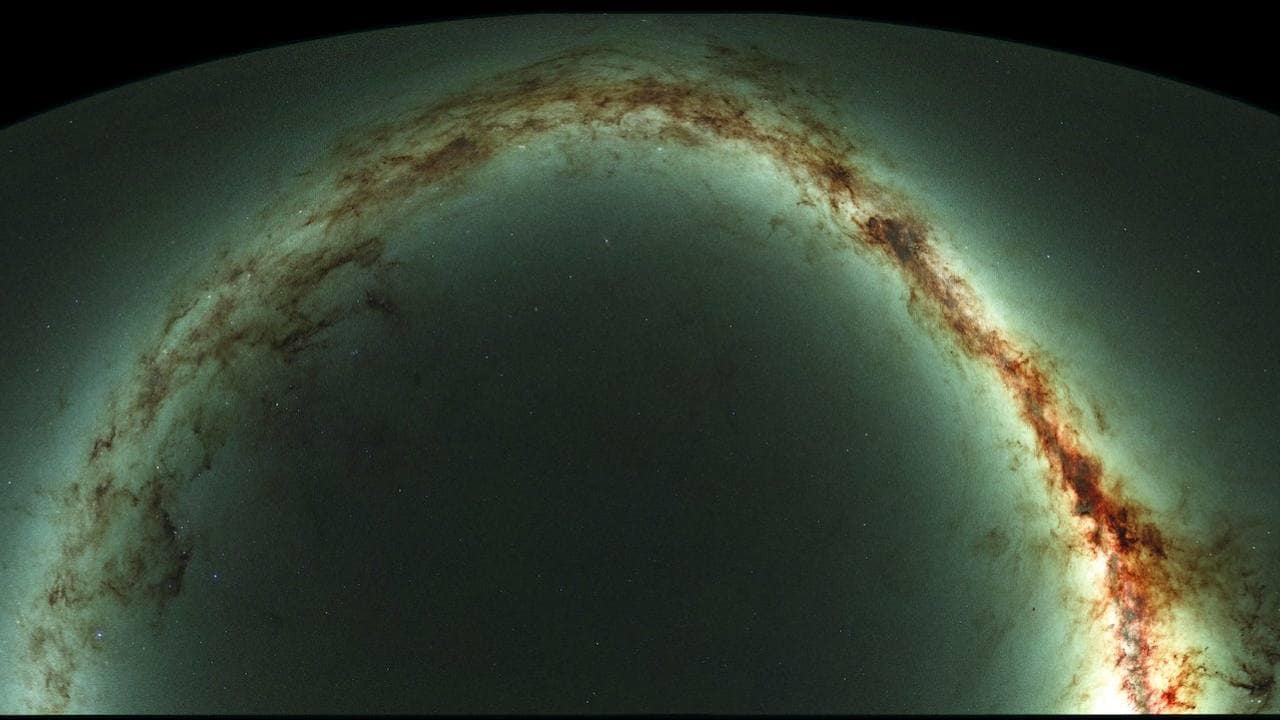 A composite image, or sky survey, of the sky above the Pan-STARRS observatory in Hawaii. Image courtesy: STSI[/caption]"We put the universe in a box, and everyone can take a peek," Conrad Holmberg, database engineer at PAN-STARRS project, said in a statement.The PAN-STARRS study is designed to find what astronomers call 'transient' and 'variable' objects in the universe. These are objects that appear very briefly in the universe. This is also the telescope that picked up on the still-debated 'Oumuamua, the first known interstellar visitor to our solar system in October 2017.Since its early days in 2008, PAN-STARRS has discovered many rogue planets, supernovas and quasars, as well as half of all near-Earth asteroids and comets recorded by telescopes each year since 2014.
First Published:Jan 31, 2019, 14:55:56 IST
Advertisement
Advertisement

Careless Whispers: Scientists discover that plants can 'talk' to each other using smells
Japanese scientists have recorded a video that shows plants, in certain conditions, communicate with each other using mists that carry smells. The discovery, reveals that plants release a fine mist of airborne compounds, to warn nearby plants of potential dangers
Life on Mars? European Space Agency’s Orbiter discovers ice water deposits at equator
European Space Agency's Mars Express Orbiter has identified massive ice and ice water deposits beneath the surface of Mars. The Mars Express orbiter was also the first to confirmed the presence of ice on Mars in 2004
Microsoft briefly overtakes Apple as the most valuable company, Apple back on top again
At its peak during the session, Microsoft's value reached $2.903 trillion, with a 2% surge. As of writing this article, Apple closed at $2.89 trillion, whereas Microsoft closed at $2.86 trillion
Even NASA is facing a tough time, starts layoffs following major budget cuts
NASA is facing some massive budget cuts, because of which, it has been forced to postpone some upcoming missions. NASA's Jet Propulsion Laboratory has been hit hard by recent federal budget cuts, resulting in the layoff of 100 contractors last week
ISRO, NASA's NISAR satellite to get ready by Jan-end, will monitor Earth's snow-covered regions
The NISAR satellite which has been developed jointly ISRO and NASA, should be ready for launch by the end of January 2024. The collaboration between NASA and ISRO on NISAR is the first time the two agencies have cooperated on hardware development for an Earth-observing mission
Advertisement
Advertisement