


World Ozone Day 2019: 32 years of the Montreal Protocol, the ozone layer is still on the mend
As CFCs are phased out, the ozone hole is generally growing smaller – a rare success for international environmentalism.


Past and predicted levels of controlled gases in the Antarctic atmosphere, quoted as equivalent effective stratospheric chlorine (EESC) levels, a measure of their contribution to stratospheric ozone depletion. Image: Paul Krummel/CSIRO, Author provided[/caption]Back in 2012, our Saving the Ozone series marked the Montreal Protocol’s silver jubilee and reflected on its success. But how has the ozone hole fared in the five years since?The Antarctic ozone hole has continued to appear each spring, as it has since the late 1970s. This is expected, as levels of the ozone-destroying halocarbon gases controlled by the Montreal Protocol are still relatively high. The figure below shows that concentrations of these human-made substances over Antarctica have fallen by 14 percent since their peak in about 2000.It typically takes a few decades for these gases to cycle between the lower atmosphere and the stratosphere, and then ultimately to disappear. The most recent official assessment, released in 2014, predicted that it will take 30-40 years for the Antarctic ozone hole to shrink to the size it was in 1980.
Signs of recovery
Monitoring the ozone hole’s gradual recovery is made more complicated by variations in atmospheric temperatures and winds, and the amount of microscopic particles called aerosols in the stratosphere. In any given year these can make the ozone hole bigger or smaller than we might expect purely on the basis of halocarbon concentrations.[caption id="attachment_7345061" align="alignnone" width="1080"]
Launching an ozone-measuring balloon from Australia’s Davis Research Station in Antarctica. Image: Barry Becker/BOM/AAD, Author provided[/caption]The 2014 assessment indicated that the size of the ozone hole varied more during the 2000s than during the 1990s. While this might suggest it has become harder to detect the healing effects of the Montreal Protocol, we can nevertheless tease out recent ozone trends with the help of sophisticated atmospheric chemistry models.Reassuringly, a recent study showed that the size of the ozone hole each September has shrunk overall since the turn of the century, and that more than half of this shrinking trend is consistent with reductions in ozone-depleting substances. However, another study warns that careful analysis is needed to account for a variety of natural factors that could confound our detection of ozone recovery.
The 2015 volcano
One such factor is the presence of ozone-destroying volcanic dust in the stratosphere. Chile’s Calbuco volcano seems to have played a role in enhancing the size of the ozone hole in 2015.At its maximum size, the 2015 hole was the fourth-largest ever observed. It was in the top 15 percent in terms of the total amount of ozone destroyed. Only 2006, 1998, 2001 and 1999 had more ozone destruction, whereas other recent years (2013, 2014 and 2016) ranked near the middle of the observed range.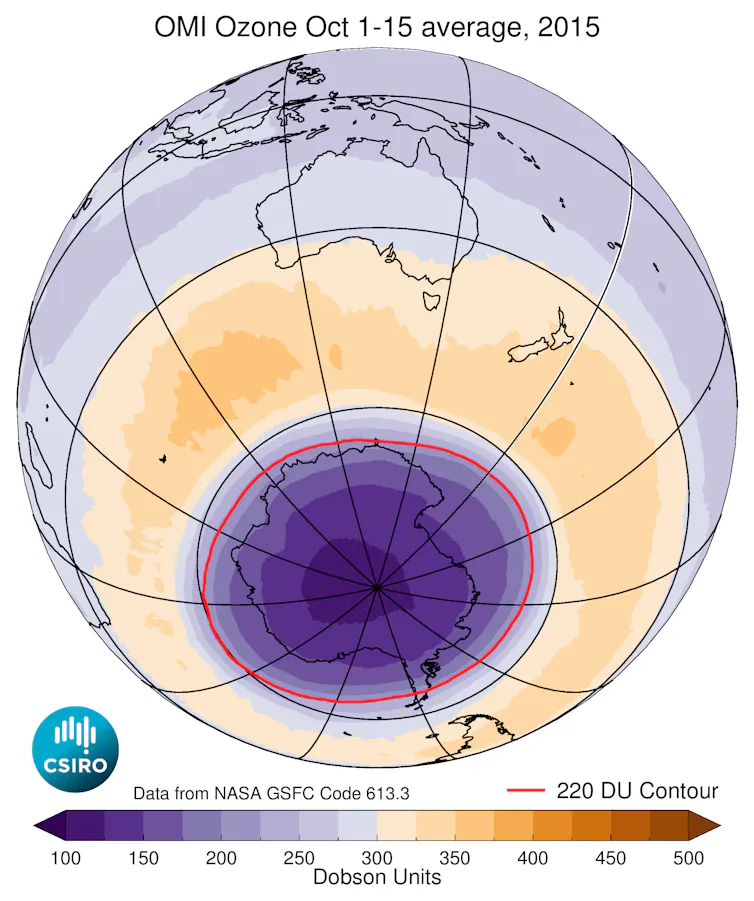
Average ozone concentrations over the southern hemisphere during October 1-15, 2015, when the Antarctic ozone hole for that year was near its maximum extent. The red line shows the boundary of the ozone hole. Image: Paul Krummel/CSIRO/EOS, Author provided[/caption]
The 2017 hole
 Andrew Klekociuk, Adjunct Senior Lecturer, University of Tasmania and Paul Krummel, Research Group Leader, CSIROThis article is republished from The Conversation under a Creative Commons license. Read the original article.
Tags

Careless Whispers: Scientists discover that plants can 'talk' to each other using smells
Life on Mars? European Space Agency’s Orbiter discovers ice water deposits at equator
Microsoft briefly overtakes Apple as the most valuable company, Apple back on top again
Even NASA is facing a tough time, starts layoffs following major budget cuts
ISRO, NASA's NISAR satellite to get ready by Jan-end, will monitor Earth's snow-covered regions