
Advertisement


Sections
Odd, amorphous amphibian could soon be honoured as Kerala's state frog
This purplish, puffy termite eater with a blister for a nose is native to the Western Ghats of India.

Imagine for a moment that you’re a god, even a minor one, and that you’re tasked with creating life on a freshly-baked planet.You create a world of wondrous beauty, populate it with creatures as serenely magnificent as the blue whale, as disarmingly charming as the house cat and as vigorously colourful as the mandarin fish.On a lark you create a creature as hilarious as the blue-butted mandrill or as scary as the goliath birdeater. But why would you, or any god (no matter how puny) for that matter, create something as absurdly amorphous and odd-looking as India’s purple frog?[caption id="attachment_6566501" align="alignnone" width="1024"]![This amorphous creature is to be Kerala's state frog.]() This amorphous creature is to be Kerala's state frog.[/caption]This very same frog, by the way, is on its way to being recognised as Kerala’s state frog. Manorama Online reports that Sandeep Das, a researcher at the Kerala Forest Research Institute, has set things in motion to make this happen.This purplish, puffy termite-eater with a blister for a nose is native to the Western Ghats of India and has apparently been around since the age of the dinosaurs. Its ancestors survived the splitting of the Earth – they were on Gondwanaland at one point, survived an ice age or two as well as the meteor that wiped out the dinosaurs and numerous earth-shattering quakes and volcanic eruptions.As weirdly unattractive as it looks, this creature is a survivor, and that’s deserving of anyone’s respect. But it’s now met its match.Already on the endangered species list, the Maveli frog – as it’s known in Kerala – is fast on its way to extinction. We humans, it seems, find this frog’s babies very tasty (again, go figure) and eat as many as 400 tadpoles apiece on an annual basis. According to a report in The Wire, indigenous tribes in Kerala easily consume between 15,000 and 20,000 tadpoles annually during the monsoon season.Adult frogs are believed to have medicinal benefits and are also considered aphrodisiacs. As per a report in Edge of Existence, children wear amulets made from Adult Maveli frogs as it is believed that doing so will reduce their fear of storms.The frog may be cosmically unattractive, but we humans can come up with some mightily ridiculous reasons for wiping out an entire species.Being a burrowing species, the frog wasn’t officially discovered till 2003 (locals had been consuming it for decades though). The frog spends the bulk of its life underground and only comes up for about two weeks before the monsoons in order to mate. According to a 2015 report, only 135 of these frogs have been spotted by scientists in the wild, and of these, only three were female.Just before the monsoon, males guide females to their location via mating calls. Being a third of the size of the female, the males once paired up, hitch a ride on the female and head to the nearest breeding site, usually a shaded rocky pool near a rain-fed stream, according to The Wire. With both frogs being slimy and the male being so small, in order to maintain his grip on the female, the male must grip the female’s spine. He then proceeds to push the eggs out of her and fertilise them.[caption id="attachment_6566601" align="alignnone" width="793"]
This amorphous creature is to be Kerala's state frog.[/caption]This very same frog, by the way, is on its way to being recognised as Kerala’s state frog. Manorama Online reports that Sandeep Das, a researcher at the Kerala Forest Research Institute, has set things in motion to make this happen.This purplish, puffy termite-eater with a blister for a nose is native to the Western Ghats of India and has apparently been around since the age of the dinosaurs. Its ancestors survived the splitting of the Earth – they were on Gondwanaland at one point, survived an ice age or two as well as the meteor that wiped out the dinosaurs and numerous earth-shattering quakes and volcanic eruptions.As weirdly unattractive as it looks, this creature is a survivor, and that’s deserving of anyone’s respect. But it’s now met its match.Already on the endangered species list, the Maveli frog – as it’s known in Kerala – is fast on its way to extinction. We humans, it seems, find this frog’s babies very tasty (again, go figure) and eat as many as 400 tadpoles apiece on an annual basis. According to a report in The Wire, indigenous tribes in Kerala easily consume between 15,000 and 20,000 tadpoles annually during the monsoon season.Adult frogs are believed to have medicinal benefits and are also considered aphrodisiacs. As per a report in Edge of Existence, children wear amulets made from Adult Maveli frogs as it is believed that doing so will reduce their fear of storms.The frog may be cosmically unattractive, but we humans can come up with some mightily ridiculous reasons for wiping out an entire species.Being a burrowing species, the frog wasn’t officially discovered till 2003 (locals had been consuming it for decades though). The frog spends the bulk of its life underground and only comes up for about two weeks before the monsoons in order to mate. According to a 2015 report, only 135 of these frogs have been spotted by scientists in the wild, and of these, only three were female.Just before the monsoon, males guide females to their location via mating calls. Being a third of the size of the female, the males once paired up, hitch a ride on the female and head to the nearest breeding site, usually a shaded rocky pool near a rain-fed stream, according to The Wire. With both frogs being slimy and the male being so small, in order to maintain his grip on the female, the male must grip the female’s spine. He then proceeds to push the eggs out of her and fertilise them.[caption id="attachment_6566601" align="alignnone" width="793"]![It sounds mean, I know, but this frog certainly redefines the term 'bumping uglies']() It sounds mean, I know, but this frog makes a strong case for redefining the term 'bumping uglies'![/caption]Classified as an explosive breeder, the female of the species lays thousands of eggs at a breeding site. The timing of this egg-laying is critical. If the eggs are laid too late, predators will have established themselves in the monsoon streams and feasted on the bountyOnce hatched, the tadpoles join the stream where they use oral suckers – their mouths – to maintain a vice-like grip on sheer rocks in said stream.These tadpoles only need 100 days to metamorphose and their choice of resting spot keeps them secure from most predators, but this is not a matter of concern for humans.Indigenous tribes that hunt these tadpoles simply block off a stream and use brooms to “sweep” these tadpoles off the rocks. The hapless tadpoles are then collected downstream for later consumption.We’re eating these tadpoles at such an alarming rate that some experts believe the species will be extinct in their lifetime.Marking the species as Kerala’s state frog should go some way towards securing a future for these hardy (evolutionarily speaking) creatures, but unless effective and immediate conservation mechanisms are introduced, it might already be too late for one of nature’s most exotic creations.
It sounds mean, I know, but this frog makes a strong case for redefining the term 'bumping uglies'![/caption]Classified as an explosive breeder, the female of the species lays thousands of eggs at a breeding site. The timing of this egg-laying is critical. If the eggs are laid too late, predators will have established themselves in the monsoon streams and feasted on the bountyOnce hatched, the tadpoles join the stream where they use oral suckers – their mouths – to maintain a vice-like grip on sheer rocks in said stream.These tadpoles only need 100 days to metamorphose and their choice of resting spot keeps them secure from most predators, but this is not a matter of concern for humans.Indigenous tribes that hunt these tadpoles simply block off a stream and use brooms to “sweep” these tadpoles off the rocks. The hapless tadpoles are then collected downstream for later consumption.We’re eating these tadpoles at such an alarming rate that some experts believe the species will be extinct in their lifetime.Marking the species as Kerala’s state frog should go some way towards securing a future for these hardy (evolutionarily speaking) creatures, but unless effective and immediate conservation mechanisms are introduced, it might already be too late for one of nature’s most exotic creations.
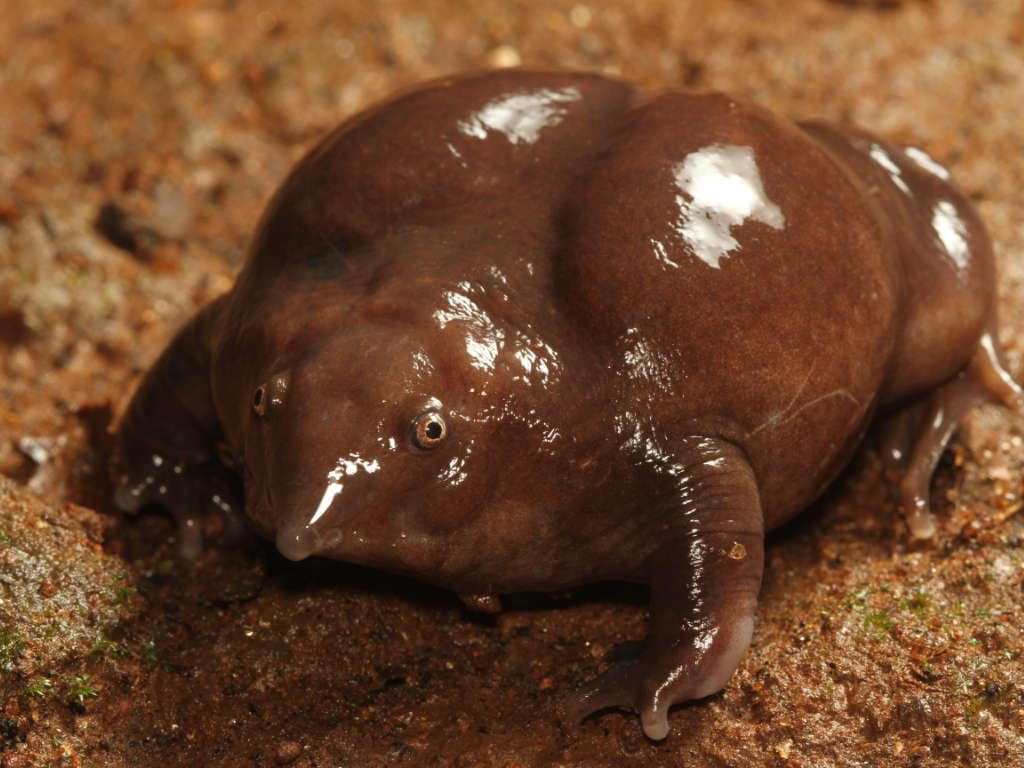 This amorphous creature is to be Kerala's state frog.[/caption]This very same frog, by the way, is on its way to being recognised as Kerala’s state frog. Manorama Online reports that Sandeep Das, a researcher at the Kerala Forest Research Institute, has set things in motion to make this happen.This purplish, puffy termite-eater with a blister for a nose is native to the Western Ghats of India and has apparently been around since the age of the dinosaurs. Its ancestors survived the splitting of the Earth – they were on Gondwanaland at one point, survived an ice age or two as well as the meteor that wiped out the dinosaurs and numerous earth-shattering quakes and volcanic eruptions.As weirdly unattractive as it looks, this creature is a survivor, and that’s deserving of anyone’s respect. But it’s now met its match.
 It sounds mean, I know, but this frog makes a strong case for redefining the term 'bumping uglies'![/caption]Classified as an explosive breeder, the female of the species lays thousands of eggs at a breeding site. The timing of this egg-laying is critical. If the eggs are laid too late, predators will have established themselves in the monsoon streams and feasted on the bountyOnce hatched, the tadpoles join the stream where they use oral suckers – their mouths – to maintain a vice-like grip on sheer rocks in said stream.These tadpoles only need 100 days to metamorphose and their choice of resting spot keeps them secure from most predators, but this is not a matter of concern for humans.Indigenous tribes that hunt these tadpoles simply block off a stream and use brooms to “sweep” these tadpoles off the rocks. The hapless tadpoles are then collected downstream for later consumption.We’re eating these tadpoles at such an alarming rate that some experts believe the species will be extinct in their lifetime.Marking the species as Kerala’s state frog should go some way towards securing a future for these hardy (evolutionarily speaking) creatures, but unless effective and immediate conservation mechanisms are introduced, it might already be too late for one of nature’s most exotic creations.
First Published:May 03, 2019, 17:28:13 IST
Advertisement
Advertisement

Careless Whispers: Scientists discover that plants can 'talk' to each other using smells
Japanese scientists have recorded a video that shows plants, in certain conditions, communicate with each other using mists that carry smells. The discovery, reveals that plants release a fine mist of airborne compounds, to warn nearby plants of potential dangers
Life on Mars? European Space Agency’s Orbiter discovers ice water deposits at equator
European Space Agency's Mars Express Orbiter has identified massive ice and ice water deposits beneath the surface of Mars. The Mars Express orbiter was also the first to confirmed the presence of ice on Mars in 2004
Microsoft briefly overtakes Apple as the most valuable company, Apple back on top again
At its peak during the session, Microsoft's value reached $2.903 trillion, with a 2% surge. As of writing this article, Apple closed at $2.89 trillion, whereas Microsoft closed at $2.86 trillion
Even NASA is facing a tough time, starts layoffs following major budget cuts
NASA is facing some massive budget cuts, because of which, it has been forced to postpone some upcoming missions. NASA's Jet Propulsion Laboratory has been hit hard by recent federal budget cuts, resulting in the layoff of 100 contractors last week
ISRO, NASA's NISAR satellite to get ready by Jan-end, will monitor Earth's snow-covered regions
The NISAR satellite which has been developed jointly ISRO and NASA, should be ready for launch by the end of January 2024. The collaboration between NASA and ISRO on NISAR is the first time the two agencies have cooperated on hardware development for an Earth-observing mission
Advertisement
Advertisement