


Not convinced climate action is urgent? Here's what happens to Earth over 1.5 degrees Celsius of global heating
At 1.5 degrees Celsius of warming, we could expect to lose between 70 and 90 percent of our coral reefs.


Secretary-General Antonio Guterres addresses the Climate Action Summit at the UN General Assembly in New York. Image: AP.[/caption]
Climate battleground
At 1.5 degrees Celsius of warming, about one in twenty insect and vertebrate species will disappear from half of the area they currently inhabit, as will around one in ten plants. At 2 degrees Celsius, this proportion doubles for plants and vertebrates. For insects, it triples.[caption id="attachment_7407901" align="alignnone" width="1280"]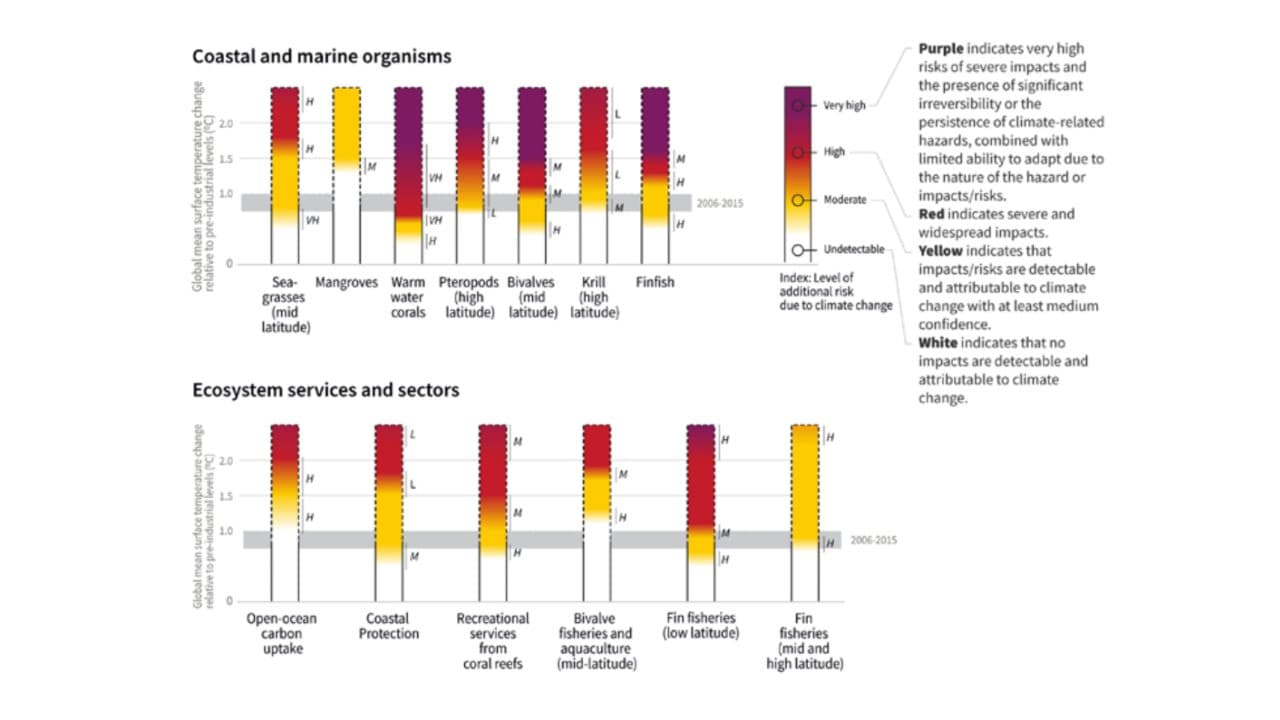 A great many risks for specific nature, managed and human systems will be amplified between 1.5 and 2 degrees of warming. Image: IPCC SR15 Report[/caption]Such high levels of species loss will put many ecosystems across the world at risk of collapse. We rely on healthy ecosystems to pollinate crops, maintain fertile soil, prevent floods, purify water, and much more. Conserving them is essential for human survival and prosperity.Between 1.5 degrees Celsius and 2 degrees Celsius, the number of extremely hot days increases exponentially. Some parts of the world can also expect less rain and more consecutive dry days, while others will receive more extreme floods. Collectively, this will place agriculture, water levels and human health under severe stress – especially in southern African nations, where temperatures will increase faster than the global average. The Mediterranean is another key area at particular risk above 1.5 degrees Celsius of heating, where increased drought will alter flora and fauna in a way without precedent in ten millennia.At 1.5 degrees Celsius of warming, we could expect to lose between 70 and 90 percent of our coral reefs. While this would be catastrophic for the millions of ocean creatures and human livelihoods these beautiful ecosystems support, there would still be a chance of recovery in the long term if oceans warm slowly. But at 2 degrees Celsius of warming, we could kill 99 percent of reefs. To be clear, this is a line that once crossed cannot be easily uncrossed. It could mean the extinction of thousands of species.Arctic sea ice has been a constant on our planet for hundreds of thousands, perhaps millions of years. If we limit global heating to 1.5 degrees Celsius, there’s a 70 percent chance of it remaining that way. But at 2 degrees Celsius, some Arctic summers will be ice-free. Polar bears and other species who depend on frozen sea ice to eat and breed will be left homeless and struggling to survive.Studies show that at 1.5 degrees Celsius, we could expect one metre of sea-level rise in 2300, with an extra 26cm at 2 degrees Celsius. However, between these two levels of global heating, the risk of the Greenland and West Antarctic Ice Sheets starting a slow process of decline dramatically increases. For the Greenland sheet, this is likeliest to happen at 1.6 degrees Celsius, with the Antarctic ice sheet’s tipping point hovering not far above this mark.[caption id="attachment_7407951" align="alignnone" width="1280"]
 Polar bears depend on normal levels of Arctic sea ice.[/caption]If these ice sheets melt, seas could rise by up to two metres over the next two centuries. These rises could lead to millions more people being exposed to flooding each year. Many of those living in coastal cities, deltas, or small islands will be faced with little option but to build upwards or relocate.
Way off track
The impacts of climate breakdown are accelerating. The planet has warmed by 1.1 degrees Celsius since 1850-79, but 0.2 degrees Celsius of this warming happened between 2011 and 2015 alone. The last four years were the warmest in the global temperature record.Despite knowing all the above, many country-level commitments and action are nowhere near enough to limit warming to 2 degrees Celsius, let alone 1.5 degrees Celsius. We’re heading for 2.9 to 3.4 degrees of warming. By this point, many dangerous tipping points could be crossed, leading to rainforest die-back, deadly heatwaves, and significant sea-level rise. Half of all insect and plant species are projected to disappear from more than half of the area they currently inhabit, potentially causing widespread ecosystem collapse and threatening organised human civilisation itself.Limiting warming to 1.5 degrees will save the global economy trillions of dollars in the long run, even accounting for the seemingly gargantuan cost of transitioning our energy systems. But this is more than just an economic or academic issue – its a matter of life and death for millions of humans and animal species, and a severe threat to the well-being of billions.Tackling climate breakdown is perhaps the tallest order humanity has ever faced, and there is no simple solution. The only way forward is accepting that we must fundamentally change the way we live our lives. It won’t be an easy transition, but there is no alternative if we are to preserve the well-being of humans, wildlife, and ecosystems. The coming year is vital, and there’s too much at stake not to act now. Rachel Warren, Professor of Global Change, University of East Anglia and Sally Brown, Senior Research Fellow, University of SouthamptonThis article is republished from The Conversation under a Creative Commons license. Read the original article.

Careless Whispers: Scientists discover that plants can 'talk' to each other using smells
Life on Mars? European Space Agency’s Orbiter discovers ice water deposits at equator
Microsoft briefly overtakes Apple as the most valuable company, Apple back on top again
Even NASA is facing a tough time, starts layoffs following major budget cuts
ISRO, NASA's NISAR satellite to get ready by Jan-end, will monitor Earth's snow-covered regions