


Nobel Prize Medicine 2020 awarded to three researchers for discovery Hepatitis C virus, facilitating a cure
Discovery of the hepatitis C virus, the Nobel Committee said, had "made possible blood tests and new medicines that have saved millions of lives."

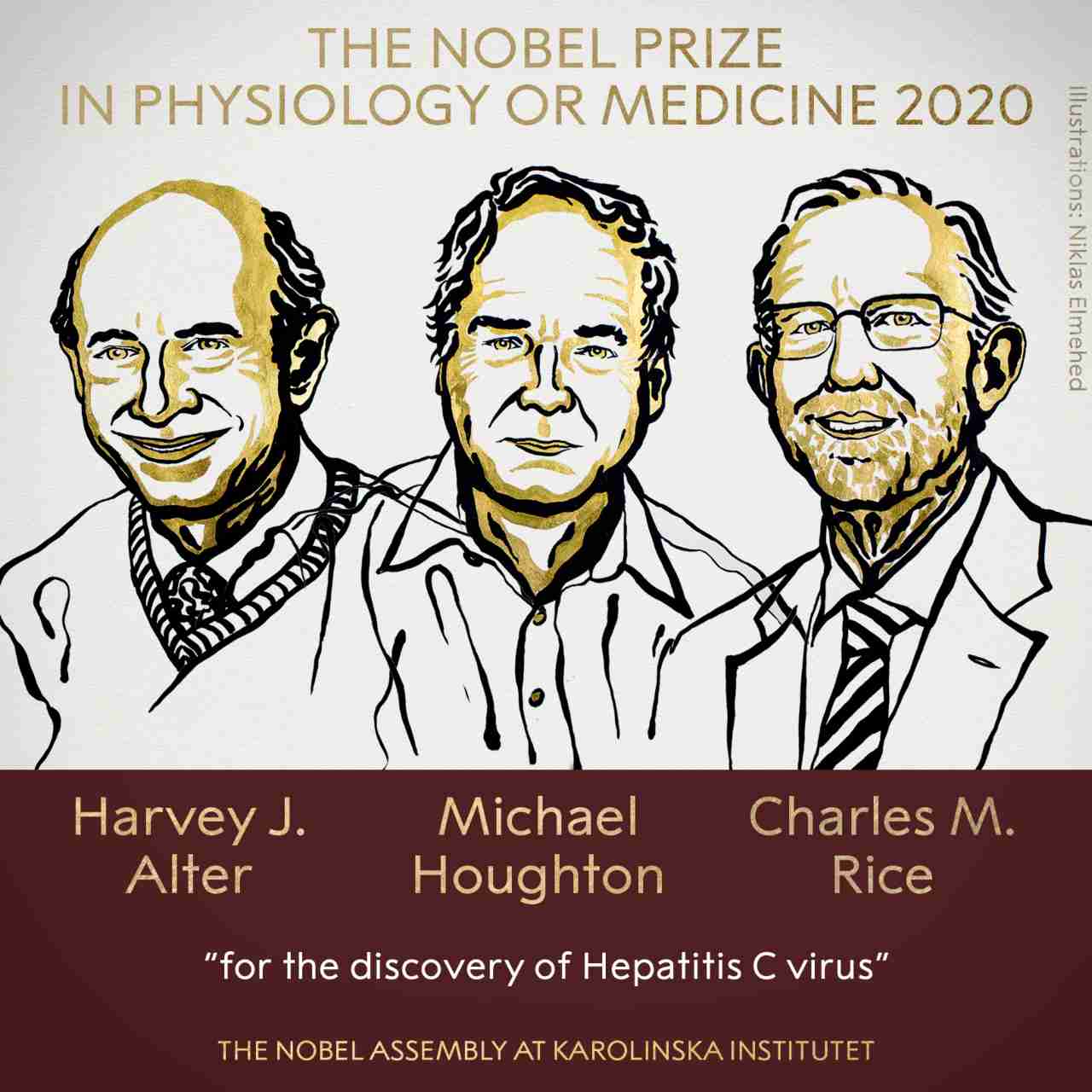
Nobel Prize 2020 in Medicine/Physiology laureates (L to R: Dr Harvey Alter, Dr Michael Houghton, Dr Charles Rice). Image Credit: Niklas Elmehed/Twitter/@NobelPrize[/caption]
Why did they win?
Why is the work important?
The hepatitis C virus is responsible for tens of millions of long-term infections. Because the infections can spread and persist without symptoms, many don’t know they carry the virus. But once it establishes itself in the body, the pathogen can silently erode the liver’s function over the course of years and decades, later flaring up as severe inflammation or cancer.If not caught early, a long-term hepatitis infection can be extremely difficult to treat. Many people infected with the hepatitis C virus require liver transplants.Work by the three awardees paved the path for highly accurate and effective blood tests for the hepatitis C virus. In many parts of the world, screening blood for hepatitis has driven post-transfusion hepatitis rates down to near zero.Still, most people living with the hepatitis C virus have not received a diagnosis, especially in low-income countries, where testing rates remain below 10%.Numerous life-saving treatments have also been developed for the hepatitis C virus, many of which are in regular use today. When available, hepatitis C antivirals can block the virus from multiplying in the body, and can cure people of the infection in weeks. Researchers around the world, including Houghton, are now at work on a vaccine that could prevent future hepatitis C virus infections and disease.“For the longest time, we had nothing to treat this virus with,” said Dr. Guadalupe Garcia Tsao, a cirrhosis expert at Yale University.Preventing the disease, she added, was also nearly impossible without accurate tests.“For most of my career, it was the bane of my existence. But from the moment they made these discoveries, the numbers of sick people went down dramatically,” Garcia Tsao said.Even hepatitis C drugs that originally failed to clear the approval pipeline have found new use in modern times: Remdesivir, one of only a handful of treatments with emergency authorization from the Food and Drug Administration to treat severely sick COVID-19 patients, was originally developed as an antiviral against the hepatitis C virus.“That’s really the story of investing in basic science, and having it pay off later down the road,” said Stephanie Langel, a virologist and immunologist at Duke University.
Who are the winners?
Alter, an American, is a medical researcher for the National Institutes of Health in Maryland. Born in 1935 in New York City, he earned a medical degree at the University of Rochester before joining the NIH in 1961.After treating some of the first “non-A, non-B” hepatitis patients decades ago, Alter expressed wonder at watching treatment for the illness evolve. Modern drugs can cure more than 95% of patients.“I could never have imagined this, really, not in my lifetime,” he said Monday during an NIH news conference.With more testing and affordable access to drugs, it would be possible to “eradicate this disease over the next decades, even in the absence of a vaccine,” he said.Rice, born in Sacramento, California, in 1952, is a professor at Rockefeller University in New York. From 2001-18, he was the scientific and executive director at the Center for the Study of Hepatitis C. He earned his doctorate from the California Institute of Technology in 1981.In an interview Monday, Rice described the utter shock he felt at receiving the early morning phone call notifying him of the award.“I thought it was because a freezer in the lab was warming up, or it was a wrong number,” he said. Even after getting over “being mad at the phone for ringing,” added Rice, a self-described night owl, “my initial impression was this had to be a crank phone call.”Cameron, a frequent collaborator of Rice’s, described him as welcoming, generous and a dedicated and prolific mentor.“His lab has really populated the flavivirus field,” Cameron said, referring to the virus family that includes the hepatitis C virus. “I was not formally a trainee, but I feel like I was adopted by him early on.”Houghton, born in Britain, is a Canada Excellence Research Chair in Virology and the Li Ka Shing professor of virology at the University of Alberta. He is also director of the Li Ka Shing Applied Virology Institute at the university. He earned his doctorate from King’s College London in 1977.Katherine J. Wu and Daniel Victor. c.2020 The New York Times Company
 More from Science
Careless Whispers: Scientists discover that plants can 'talk' to each other using smells
Life on Mars? European Space Agency’s Orbiter discovers ice water deposits at equator
Microsoft briefly overtakes Apple as the most valuable company, Apple back on top again
Even NASA is facing a tough time, starts layoffs following major budget cuts
ISRO, NASA's NISAR satellite to get ready by Jan-end, will monitor Earth's snow-covered regions