
Advertisement


Sections
Nobel Prize in Physics conferred to Arthur Ashkin, Gerard Mourou, and Donna Strickland for their work in laser
Donna Strickland from Canada becomes the third woman to have won the physics prize.

Three scientists won the Nobel Prize in Physics on Tuesday for their work with lasers. Arthur Ashkin of the United States was awarded half the 9-million-kronor ($1.01 million) prize; the other half is shared by Gerard Mourou of France and Canadian Donna Strickland.Sweden’s Royal Academy of Sciences, which chose the winners, said Ashkin, 96, developed “optical tweezers” that can grab tiny particles such as viruses without damaging them.[caption id="attachment_5302111" align="alignnone" width="1024"]![Winners of the Nobel Prize in Physics. Reuters.]() Winners of the Nobel Prize in Physics. Reuters.[/caption]Strickland and Mourou helped develop short and intense laser pulses that have broad industrial and medical applications.Strickland is the first female Nobel laureate to be named in three years and is only the third woman to have won the physics prize; the first was Marie Curie in 1903.“Obviously we need to celebrate women physicists, because we’re out there. And hopefully, in time it’ll start to move forward at a faster rate, maybe,” Strickland said in a phone call with the academy after the prize announcement.On Monday, American James Allison and Japan’s Tasuku Honjo won the Nobel medicine prize for groundbreaking work in fighting cancer with the body’s own immune system. The Nobel chemistry prize comes Wednesday, followed by the peace prize on Friday. The economics prize, which is not technically a Nobel, will be announced Oct. 8.
Winners of the Nobel Prize in Physics. Reuters.[/caption]Strickland and Mourou helped develop short and intense laser pulses that have broad industrial and medical applications.Strickland is the first female Nobel laureate to be named in three years and is only the third woman to have won the physics prize; the first was Marie Curie in 1903.“Obviously we need to celebrate women physicists, because we’re out there. And hopefully, in time it’ll start to move forward at a faster rate, maybe,” Strickland said in a phone call with the academy after the prize announcement.On Monday, American James Allison and Japan’s Tasuku Honjo won the Nobel medicine prize for groundbreaking work in fighting cancer with the body’s own immune system. The Nobel chemistry prize comes Wednesday, followed by the peace prize on Friday. The economics prize, which is not technically a Nobel, will be announced Oct. 8.
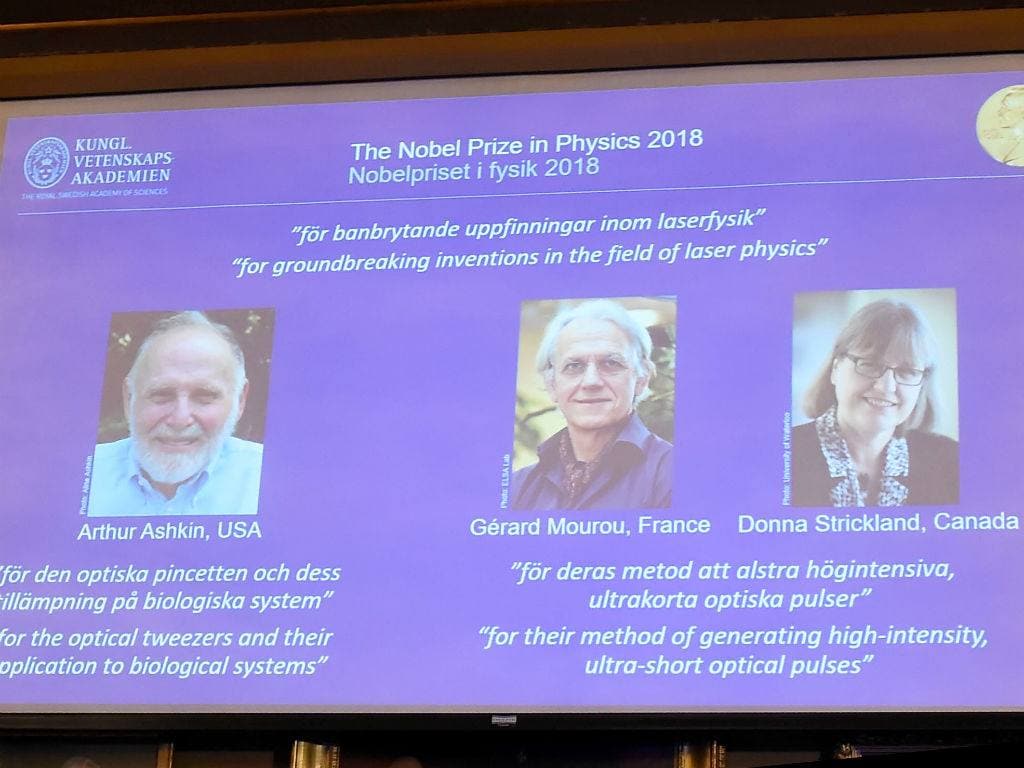 Winners of the Nobel Prize in Physics. Reuters.[/caption]Strickland and Mourou helped develop short and intense laser pulses that have broad industrial and medical applications.Strickland is the first female Nobel laureate to be named in three years and is only the third woman to have won the physics prize; the first was Marie Curie in 1903.“Obviously we need to celebrate women physicists, because we’re out there. And hopefully, in time it’ll start to move forward at a faster rate, maybe,” Strickland said in a phone call with the academy after the prize announcement.On Monday, American James Allison and Japan’s Tasuku Honjo won the Nobel medicine prize for groundbreaking work in fighting cancer with the body’s own immune system. The Nobel chemistry prize comes Wednesday, followed by the peace prize on Friday. The economics prize, which is not technically a Nobel, will be announced Oct. 8.
First Published:Oct 02, 2018, 16:27:08 IST
Advertisement
Advertisement

Careless Whispers: Scientists discover that plants can 'talk' to each other using smells
Japanese scientists have recorded a video that shows plants, in certain conditions, communicate with each other using mists that carry smells. The discovery, reveals that plants release a fine mist of airborne compounds, to warn nearby plants of potential dangers
Life on Mars? European Space Agency’s Orbiter discovers ice water deposits at equator
European Space Agency's Mars Express Orbiter has identified massive ice and ice water deposits beneath the surface of Mars. The Mars Express orbiter was also the first to confirmed the presence of ice on Mars in 2004
Microsoft briefly overtakes Apple as the most valuable company, Apple back on top again
At its peak during the session, Microsoft's value reached $2.903 trillion, with a 2% surge. As of writing this article, Apple closed at $2.89 trillion, whereas Microsoft closed at $2.86 trillion
Even NASA is facing a tough time, starts layoffs following major budget cuts
NASA is facing some massive budget cuts, because of which, it has been forced to postpone some upcoming missions. NASA's Jet Propulsion Laboratory has been hit hard by recent federal budget cuts, resulting in the layoff of 100 contractors last week
ISRO, NASA's NISAR satellite to get ready by Jan-end, will monitor Earth's snow-covered regions
The NISAR satellite which has been developed jointly ISRO and NASA, should be ready for launch by the end of January 2024. The collaboration between NASA and ISRO on NISAR is the first time the two agencies have cooperated on hardware development for an Earth-observing mission
Advertisement
Advertisement