


New beast: Astronomers detect another rare blue optical transient in the universe, 500 million-light-years-away
This explosion has taken scientists by surprise because of its speed and heaviness of the material outflows.

It was in 2016 that scientists had observed a bright burst in a small galaxy 500 million light-years away from the Earth. They found out that that blue light was known to have been a result of a fast blue optical transient (FBOT) that was described as a new form of an explosion in the universe.
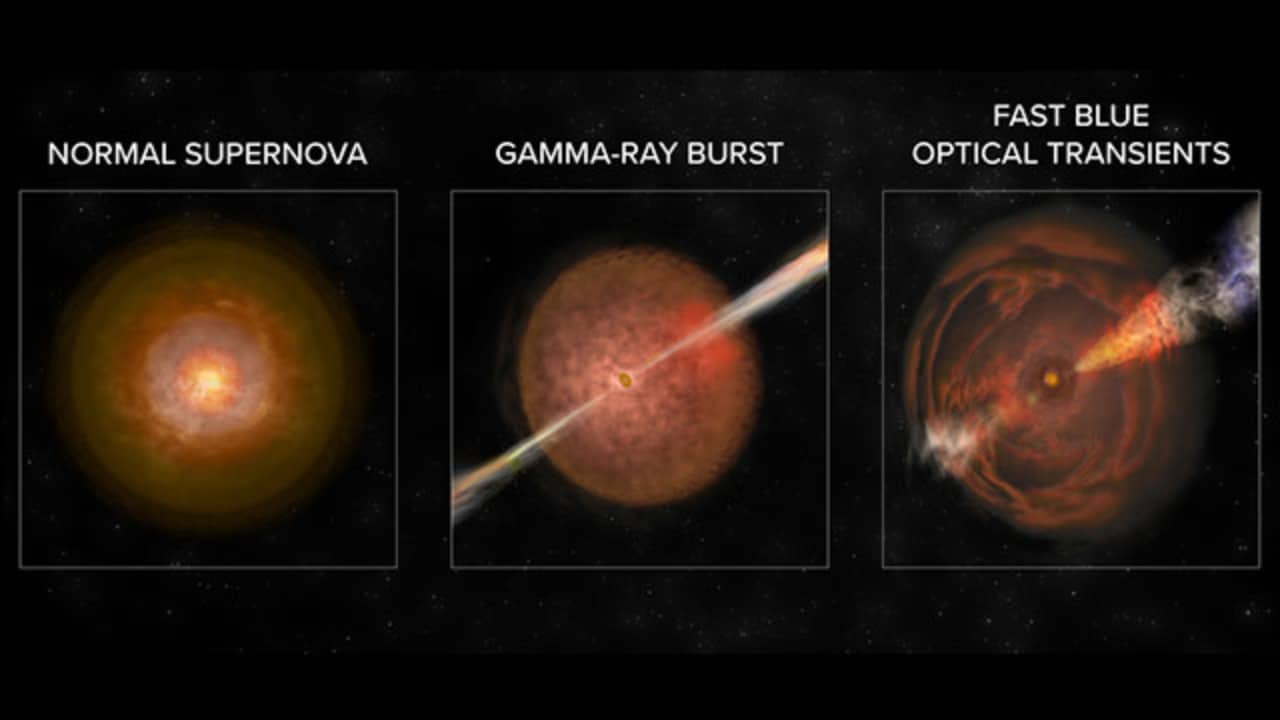
An artistic illustration of a fast blue optical transient as compared to a supernova and a gamma-ray burst. Image credit: Bill Saxton NRAO/AUI/NSF[/caption]The FBOT has spat out material weighing about one to 10 percent of the mass of our Sun and has established that it belongs to a new class of “rare H-rich transients” which can launch “mildly relativistic outflows”. It has launched out gas and other particles at over 55 times the speed of light.
Scientists have found it difficult to detect or study FBOTs because of their virtue of being fast, fading as quickly as they had appeared. The most famous of this kind is perhaps the COW or AT2018COW, seen on 16 June 2018. The sudden explosion of light which was at least 10 times brighter than any supernova (the powerful explosion that marks the death of a massive star) had baffled scientists. They thought that it was most likely the birth of a black hole or a neutron star.
 More from Science
Apart from collapse of a “massive star with a gamma-ray burst or two neutron stars merging,” the FBOT has shown a third way of producing outflows in nature, pointed out Raffaella Margutti, senior study author, assistant professor of physics and astronomy in Northwestern University's Weinberg College of Arts and Sciences.
“There is a new beast out there, and it's able to produce the same energetic phenomenon,” the professor added.
Although these vanished before scientists could find out what caused the explosion, the experts are sure about the presence of a black hole or neutron star inside.

Careless Whispers: Scientists discover that plants can 'talk' to each other using smells
Life on Mars? European Space Agency’s Orbiter discovers ice water deposits at equator
Microsoft briefly overtakes Apple as the most valuable company, Apple back on top again
Even NASA is facing a tough time, starts layoffs following major budget cuts
ISRO, NASA's NISAR satellite to get ready by Jan-end, will monitor Earth's snow-covered regions