


NASA’s Voyager 1 detects humming sound that is caused by gas in interstellar space
Launched 44 years ago by NASA, Voyager 1 is part of the Voyager program to study the outer Solar System.

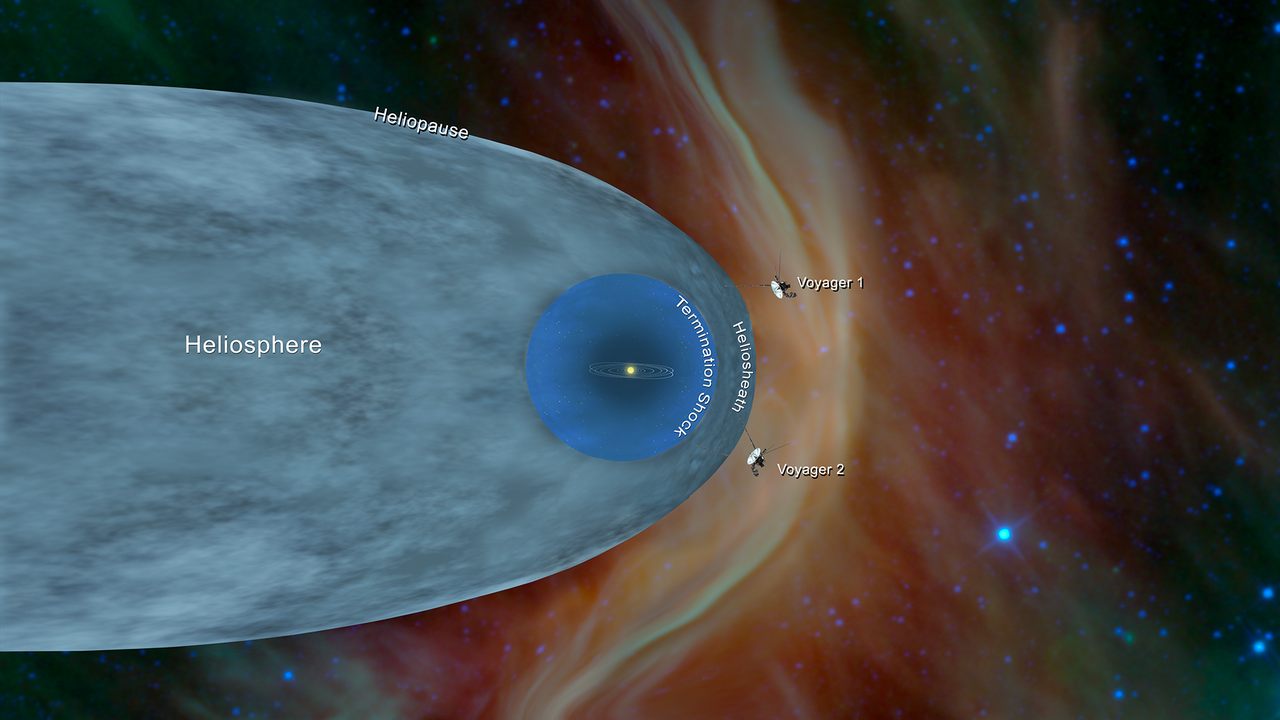
This graphic shows the position of NASA's Voyager 1 and Voyager 2 probes, outside of the heliosphere, a protective bubble created by the Sun that extends well past the orbit of Pluto. Image credit: NASA[/caption]According to the Cornell Chronicle, the research which was published in Nature Astronomy on 10 May allows scientists to determine how interstellar medium interacts.The interstellar medium has turbulent waves and the crashing waves give us clues about its density. Aspects like the shape of the heliosphere, star formation, and our location in the galaxy are determined by the density of the interstellar mediumSpeaking about their findings, the lead author of the study Stella Koch Ocker said that there is more low-level activity in the interstellar gas than scientists had previously thought. Stella called the research a testament to Voyager 1. The spacecraft is engineering’s gift to science that keeps on giving. Stella is a doctoral student in astronomy at Cornell University.Shami Chatterjee, another researcher involved with the study said that the voyager is sending back details regardless of what the sun was doing. He added that now, in order to measure interstellar plasma, they do not need a fortuitous event related to the sun.

Careless Whispers: Scientists discover that plants can 'talk' to each other using smells
Life on Mars? European Space Agency’s Orbiter discovers ice water deposits at equator
Microsoft briefly overtakes Apple as the most valuable company, Apple back on top again
Even NASA is facing a tough time, starts layoffs following major budget cuts
ISRO, NASA's NISAR satellite to get ready by Jan-end, will monitor Earth's snow-covered regions