


NASA's Perseverance rover makes successful Mars landing to renew search for extinct life
With NASA’s rover on the surface, space watchers will soon turn their eyes back toward China’s Tianwen-1 mission

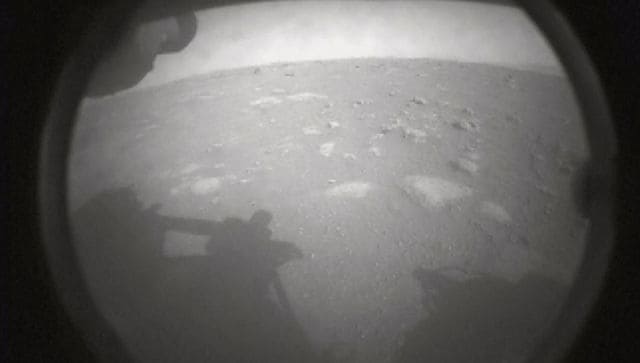
A still image made from video provided by NASA, shows an image sent by the Perseverance rover, showing the surface of Mars, just after landing on Thursday. NASA via The New York Times[/caption]But NASA’s spacecraft did not go into orbit first. Instead it zipped along a direct path to the surface.At 3.48 pm Eastern time (2.18 am IST), controllers at the mission operations center at NASA’s Jet Propulsion Laboratory near Pasadena, California, received word from Perseverance that it had entered the top of the Martian atmosphere at a speed of more than 12,000 mph. The spacecraft was beginning the landing maneuvers that would bring it to a soft stop in just seven anxiety-drenched minutes.All that anyone on Earth could do was watch and hope that Perseverance performed as designed.Mars is currently 126 million miles from Earth. Radio signals, traveling at the speed of light, take more than 11 minutes to travel from there to here. That means that when the message announcing the start of the landing sequence reached Earth, the rover had already been on Mars for four minutes. The only uncertainty was whether it had safely arrived in one piece, or had crashed into many pieces, another human-made crater on the planet’s surface.NASA’s operations centre — more sparsely filled than previous Mars landings because of precautions required by the coronavirus pandemic — was mostly pensively quiet. There were periodic announcements — and applause — as the spacecraft descended through the atmosphere: the deceleration and heating as it sliced through the thin Martian air, the deployment of a huge parachute even as it was still supersonic in speed, the shedding of the rover’s heat shield so that its cameras could navigate to its destination, the firing of rocket engines to further slow its descent.In the final step, the rover was lowered at the end of a cable beneath a rocket-powered jetpack until it touched the surface.At 3:55 pm (2.25 am IST), cheers erupted in the control room when Perseverance arrived on the surface. “Touchdown confirmed,” said Swati Mohan, the engineer who provided commentary on the descent. With their task accomplished, the team members clapped and exchanged high-fives and fist bumps.NASA will first turn its focus to testing the performance of its experimental helicopter. Over the coming weeks, Perseverance will deploy the 4-pound flying machine named Ingenuity. If it works, it will be the first such flight in the atmosphere of another world in the solar system.Flying on Mars is not a trivial endeavor. There is not much air there to push against to generate lift. At the surface of Mars, the atmosphere is just 1/100th as dense as Earth’s. The lesser gravity — one-third of Earth’s — helps with getting airborne. But taking off from the surface of Mars is like flying through air as thin as that found at an altitude of 100,000 feet on Earth.Ingenuity is the flying equivalent of Sojourner, NASA’s first Martian rover, which landed on the red planet in 1997. Although it was the size of a microwave oven and just a demonstration of the basic technology, scientists could already see the benefits of driving to explore a variety of rocks and surface features, instead of sitting in one place like the earlier Viking landers.With NASA’s rover on the surface, space watchers will soon turn their eyes back toward China’s Tianwen-1 mission. As it orbits Mars, the spacecraft is preparing for a rover landing of its own. In May or June, the mission’s lander and unnamed rover will try to set down in a basin called Utopia Planitia. If it succeeds, that explorer will study the ice composition of the region, potentially helping future astronauts understand what resources are available to them should they set off for the red planet.Kenneth Chang c.2021 The New York Times Company

Careless Whispers: Scientists discover that plants can 'talk' to each other using smells
Life on Mars? European Space Agency’s Orbiter discovers ice water deposits at equator
Microsoft briefly overtakes Apple as the most valuable company, Apple back on top again
Even NASA is facing a tough time, starts layoffs following major budget cuts
ISRO, NASA's NISAR satellite to get ready by Jan-end, will monitor Earth's snow-covered regions