


NASA's Perseverance rover: Getting to Mars is easy, it’s the stopping that can kill you
The landing on Mars "is the result of reasoned, engineering thought. But it still looks crazy” says Adam Steltzner, a NASA engineer.

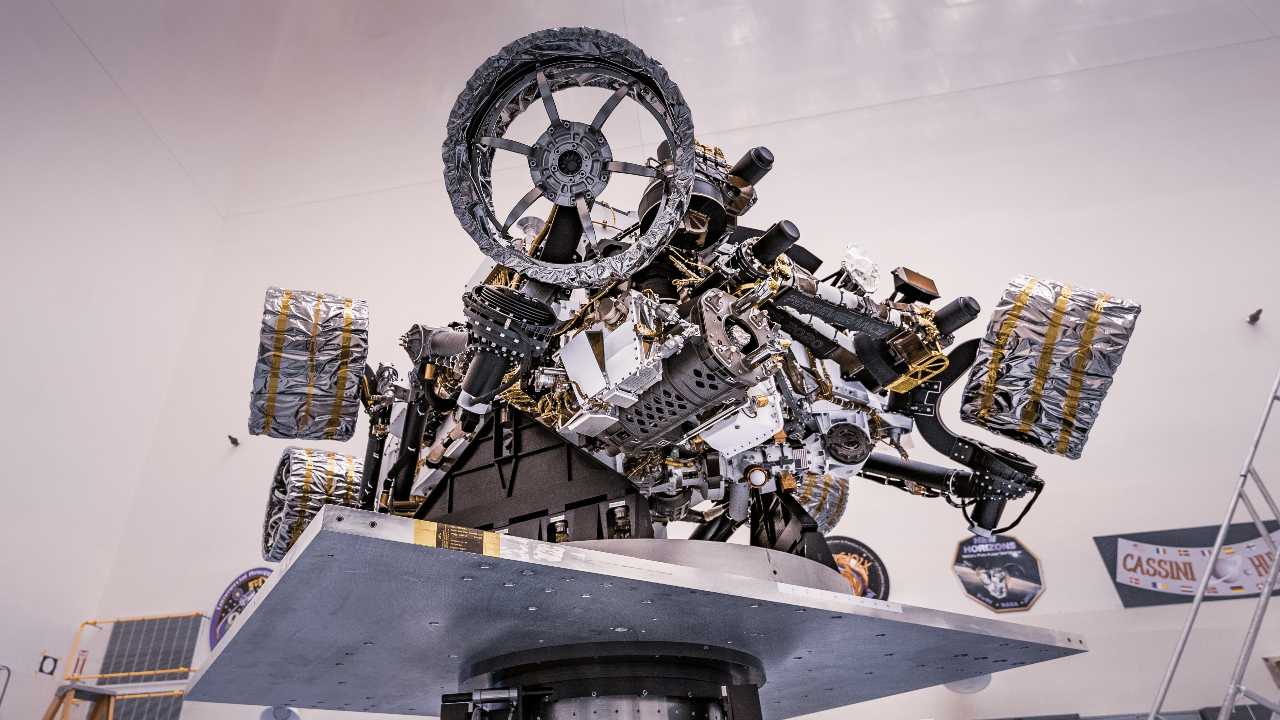
NASA's Perseverance rover can be seen attached to a spin table during a test of its mass properties at the Kennedy Space Center in Florida. During the test, the rover was rotated clockwise and counterclockwise to determine its center of gravity. Image credit: NASA/JPL-Caltech[/caption]Spacecraft from Europe and the Soviet Union have made it all the way to the red planet, only to end up as expensive scorch marks on its dusty surface. But NASA has a good track record with Mars. It is the only space agency so far to pull off a successful mission on the surface of the red planet.Perseverance is largely the same design as the Curiosity rover, which set down in 2012 and will have the same convoluted but now tried-and-true “sky crane” landing choreography.“When people look at it, it looks crazy,” Adam Steltzner, a NASA engineer, said in a video that NASA produced leading up to Curiosity’s landing that described the components: heat shield, parachute, rocket engines and, finally, a hovering crane that lowered the rover to the surface.“That’s a very natural thing,” Stelzner said. “Sometimes when we look at it, it looks crazy. It is the result of reasoned, engineering thought. But it still looks crazy.”While everything worked, the engineers got a chance to take a look at what could be improved this time around.“We don’t usually get a chance to kind of redo or fix the mistakes we made last time,” Allen Chen, who leads the Perseverance entry, descent and landing team for NASA’s Jet Propulsion Laboratory, said in an interview.For example, Curiosity actually landed too slowly, hitting the ground at 1.4 mph instead of the 1.7 mph that had been expected. That, by itself, was not a problem. A softer landing is gentler on the spacecraft.But the engineers wanted to understand what had happened in order to make sure that the next landing — that of Perseverance — did not come down faster than intended.It turns out that their calculation of the gravity of Mars was slightly wrong. In areas of the planet that possess less mass — like the 96-mile-wide crater that Curiosity landed in — the pull of gravity is a bit weaker.“We didn’t have sufficient fidelity in our gravity modelling to understand that the gravity there was actually different than elsewhere on the planet,” Chen said. “So that was one thing that we fixed.”Another component that was tweaked was the parachute that is unfurled when the spacecraft is hurtling down at supersonic speeds.A parachute failure in a prototype test of a future Mars landing system led Chen’s team to make sure they had not just gotten lucky with Curiosity. “That gave us pause,” he said.The engineers are now confident of Perseverance’s parachute after supersonic tests of a strengthened design.One major addition to Perseverance is what NASA calls “terrain-relative navigation.” A camera on the spacecraft will take pictures of the landscape and match them with its stored maps. It would then steer to what looks like the safest landing spot it can. “I don’t need the whole place to be flat and boring,” Chen said. “I just need parts of it that I can reach to be flat and boring.”Without this system, there would be more than a 1-in-5 chance that Perseverance would end up somewhere unfortunate — damaged by a boulder, tipped over on a steep slope or surrounded by sand traps. That would be an unacceptably high risk for such a high-profile, expensive mission.If it works, the same technology will be used when NASA sends a mission to pick up the rock samples that Perseverance will be collecting, part of the so-called Mars sample return. That spacecraft will carry enough fuel that it is able not only to avoid obstacles but also to fly to a specific location, landing within tens of yards of the target.Still, next Feb. 18, the control room at the Jet Propulsion Laboratory is expected to be full of nervous engineers watching the telemetry coming back from Perseverance. That data will take minutes to travel millions of miles — far too far and too slow for anyone at NASA to make last-second corrections.“Mars is not for the faint of heart,” Chen said.Kenneth Chang c.2020 The New York Times CompanyAlso Read:NASA’s fifth and finest Mars rover Perseverance lifts off successfully in spite of tremors, delays, COVID-19 lockdownNASA’s Perseverance rover on its way to become fifth rover on Mars – its science objectives, instruments, the Ingenuity helicopterNASA's Perseverance rover will bring Mars rocks to Earth: Our greatest interplanetary circus act

Careless Whispers: Scientists discover that plants can 'talk' to each other using smells
Life on Mars? European Space Agency’s Orbiter discovers ice water deposits at equator
Microsoft briefly overtakes Apple as the most valuable company, Apple back on top again
Even NASA is facing a tough time, starts layoffs following major budget cuts
ISRO, NASA's NISAR satellite to get ready by Jan-end, will monitor Earth's snow-covered regions