


'Mole' on NASA's InSight Mars lander is dead after years of failed attempts to drill into surface
InSight was recently granted a two-year extension for its science missions, and will now continue its study of Mars till end of 2022.

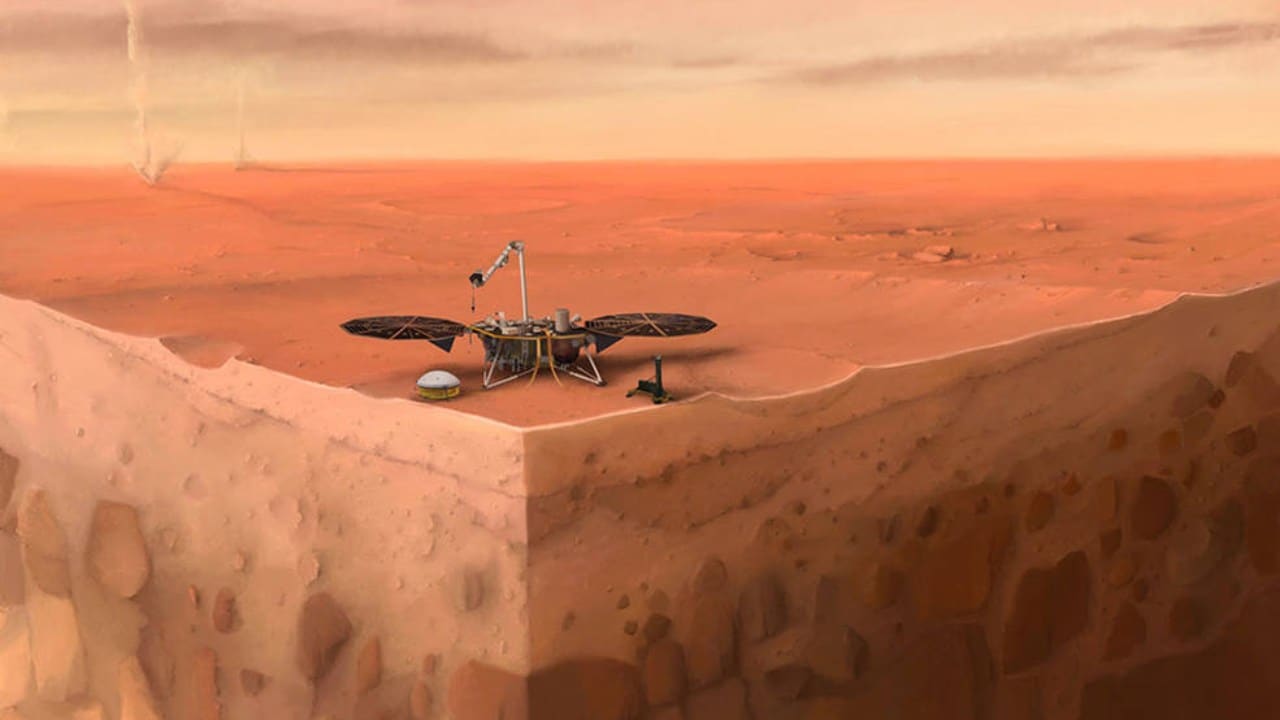
In this artist's concept of NASA's InSight lander on Mars, layers of the planet's subsurface can be seen below, and dust devils can be seen in the background. Credits: IPGP/Nicolas Sarter[/caption]“We’ve given it everything we’ve got, but Mars and our heroic mole remain incompatible,” Tilman Spohn, the German Space Agency’s lead scientist for the experiment said in a statement. When astronauts go to Mars in future expeditions, all this information will help them dig into the subsurface for frozen drinking water, fuel or finding microscopic signs of life.
The Mole
The mole’s design was based on Martian soil examined by previous spacecraft, and it turned out to be nothing like the clumpy dirt that InSight encountered. According to the statement, the clumpy soil deprived the spike-like mole of the friction it needs to hammer itself to a sufficient depth. The sensors of the Heat Flow and Physical Properties Package (HP3) were designed to measure heat flowing from the planet once the mole has dug at least three meters deep, which it was unable to do, despite trying for two years.However, this is the first time that any NASA mission has tried to burrow into the Mars soil other than NASA’s Phoenix lander which just scraped the top layer of the surface.“We are so proud of our team who worked hard to get InSight’s mole deeper into the planet. It was amazing to see them troubleshoot from millions of miles away,” said Thomas Zurbuchen in a statement.InSight’s French seismometer, meanwhile, has recorded nearly 500 Marsquakes, while the lander’s weather station is providing daily reports. On Tuesday, the high was 17 degrees Fahrenheit (minus 8 degrees Celsius) and the low was minus 56 degrees Fahrenheit (minus 49 degrees Celsius) at Mars’ Elysium Planitia, an equatorial plain.InSight landed on Mars in November 2018 and was recently granted a two-year extension for other scientific work and will now last until the end of 2022. It will soon be joined by NASA’s newest rover, Perseverance, which will attempt a touchdown on 18 February. Curiosity rover has been roaming Mars since 2012.With inputs from The Associated Press

Careless Whispers: Scientists discover that plants can 'talk' to each other using smells
Life on Mars? European Space Agency’s Orbiter discovers ice water deposits at equator
Microsoft briefly overtakes Apple as the most valuable company, Apple back on top again
Even NASA is facing a tough time, starts layoffs following major budget cuts
ISRO, NASA's NISAR satellite to get ready by Jan-end, will monitor Earth's snow-covered regions