


NASA's Mars 2020 rover takes to Iceland's lava fields to get ready for the Red Planet
It will continue the work of the "Curiosity" rover, which has been exploring Mars since 2012.

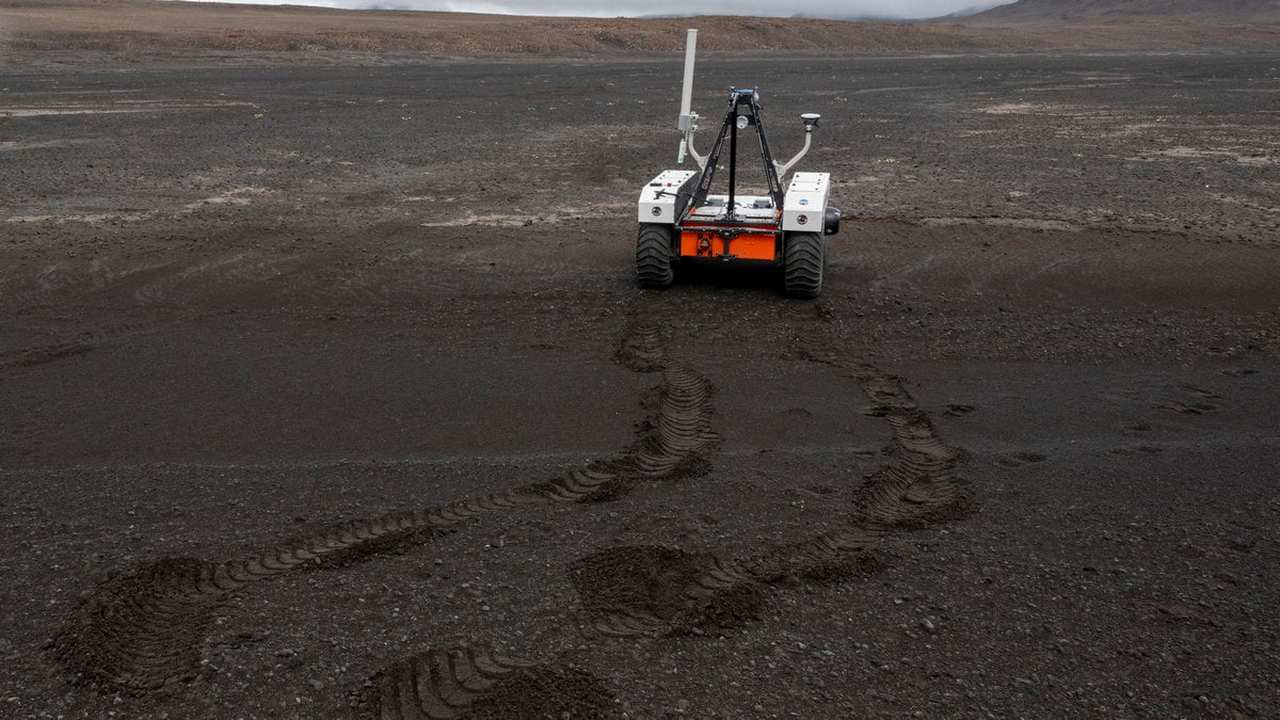
To prepare for the next mission to Mars in 2020, NASA has taken to the lava fields of Iceland to get its new robotic space explorer ready for the job.With its black basalt sand, wind-swept dunes and craggy peaks, the Lambahraun lava field at the foot of Iceland's second biggest glacier, Langjokull, was chosen as a stand-in for the Red Planet's surface.For three weeks, 15 scientists and engineers sent by the US space agency descended on the site, 100 kilometres from the capital, Reykjavik, last month to develop a prototype.It will aim to continue the work of the "Curiosity" rover, which has been exploring Mars since 2012 in search of signs of ancient life and making preparations for human exploration.
Indestructible
The prototype is a small, electric vehicle with white panels and an orange chassis. It has a four-wheel-drive propelled by two motors and is powered by 12 small car batteries stacked inside."This rover we have... (is) basically indestructible," Deslauriers told AFP. "The rovers that we have on Mars and the Moon would be a lot more sensitive to the environment and conditions of Iceland. A Moon rover is completely unprepared for rain," he added, just as a rain shower swept in.Equipped with sensors, a computer, a dual-lens camera and controlled remotely, the rover moves its approximately 570 kilograms at a leisurely speed of about 20 centimetres per second.The speed needs to be slow to enable the rover to collect data and imagery properly, Mark Vandermeulen, a robotics engineer at Mission Control Space Services, said.The meagre pace on the lava field is still two to four times faster than the speed it will be driving at its extraterrestrial destination.
Transmitting from Mars to Earth
Utilising its sensors and camera, the rover gathers and classifies data from its environment and sends back the findings to the engineers' trailer.The engineers then package the data and forward it to a tent where the scientists are huddled, to simulate how the data would be sent from Mars to Earth.The rover exploring Iceland is just a prototype for the one that will be going to Mars next year.

Similar to Mars
The sites are selected to study how the chemical composition and physical properties of the sand and rocks change as they move from the glacier to a nearby river.Before Mars became an inhospitable frozen desert with an average temperature of minus 63 degrees C (minus 81.4 degrees F), scientists believe that the planet shared many of the characteristics of the subarctic island."The mineralogy in Iceland is very similar to what we would find on Mars," Ryan Ewing, associate professor of geology at Texas A&M University, said.In particular, Ewing referred to minerals such as olivine and pyroxenes, both dark so-called mafic rocks, which have also been found on Mars."In addition to that, we don't have much vegetation, it's cold and we have some of the environments like sand dunes and rivers and glaciers that Mars has evidence of in the past," Ewing said.


Careless Whispers: Scientists discover that plants can 'talk' to each other using smells
Life on Mars? European Space Agency’s Orbiter discovers ice water deposits at equator
Microsoft briefly overtakes Apple as the most valuable company, Apple back on top again
Even NASA is facing a tough time, starts layoffs following major budget cuts
ISRO, NASA's NISAR satellite to get ready by Jan-end, will monitor Earth's snow-covered regions