
Advertisement


Sections
NASA's InSight Mars mission's six minutes of terror: Here's what we can expect
InSight's landing sequence on Mars from start to finish is pre-programmed into an onboard computer.

A spacecraft that cost nearly a billion dollars is on course to make a perilous landing Monday on Mars, if it can survive a high-speed approach and the scorching heat of entering the Red Planet's atmosphere, a process NASA has nicknamed "six and a half minutes of terror.""There is very little room for things to go wrong," said Rob Grover, head of the entry, descent and landing team at NASA's Jet Propulsion Laboratory in Pasadena, California.If successful, the entry, descent, and landing of the Mars InSight – designed to be the first mission to listen to the interior of another planet and reveal how rocky planets formed – will add another success to NASA's record when it comes to sending spacecraft to Mars.[caption id="attachment_5479701" align="alignnone" width="1280"]![The InSight lander. Image courtesy: NASA]() Countdown to MarsThere will not be any live video streaming of Mars Insight's approach on Monday, and signals will be transmitted back to Earth on an eight-minute delay.Nor can mission managers intervene if anything goes awry. The entire landing sequence is pre-programmed into the onboard flight computer.Here's what to expect:
Countdown to MarsThere will not be any live video streaming of Mars Insight's approach on Monday, and signals will be transmitted back to Earth on an eight-minute delay.Nor can mission managers intervene if anything goes awry. The entire landing sequence is pre-programmed into the onboard flight computer.Here's what to expect:
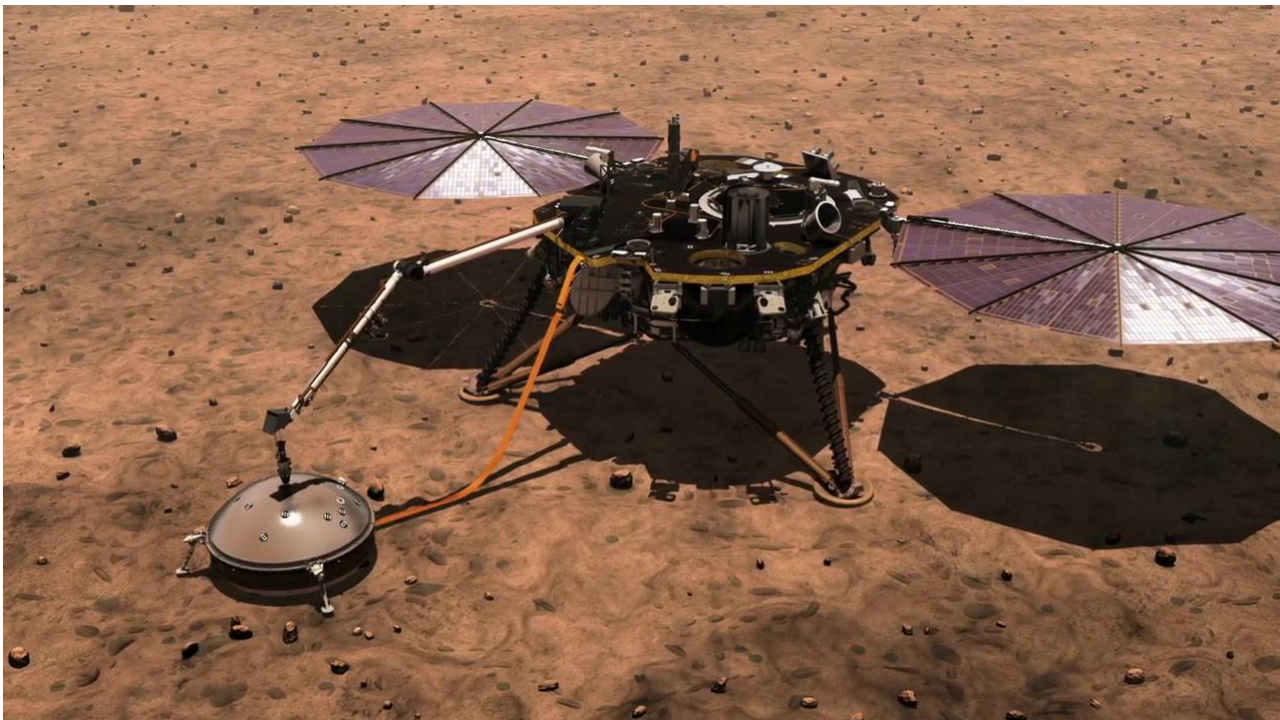
The InSight lander. Image courtesy: NASA[/caption]So far the United States is the only nation to have made it there, and only NASA's unmanned Curiosity robotic rover is still tooling around on the surface.But if it fails, it certainly won't be the first.Of 43 other international attempts to send orbiters, probes, landers or rovers to Mars, 25 have not made it. Either they crashed into the surface, missed their planned orbit, or disappeared after.
- At 1.10 am IST (7.40 pm GMT), the spacecraft separates from the cruise stage that carried it to Mars. A minute later, the spacecraft makes a turn to orient itself for atmospheric entry.
- At 1.17 am IST (7.47 pm GMT) the spacecraft is hurtling through space at a speed of 12,300 miles per hour (19,800 kilometers per hour) as it begins to enter Mars' atmosphere.
- Two minutes later, friction with the atmosphere raises the heat shield temperature to its peak of 2,700 Fahrenheit (1,500 Celsius). This intense heat could cause temporary dropouts in radio signals.
- At 1.21 am IST (7.51 pm GMT), the parachutes deploy. Fifteen seconds later, the heat shield separates from the spacecraft. Ten seconds on, the lander's three legs deploy to get ready for touchdown.
- At 1.22 am IST (7.52 pm GMT), a radar activates to sense the distance to the ground.
- At 1.23 am IST (7.53 pm GMT), the first radar signal is expected, followed 20 second later by the spacecraft's separation from the back shell and parachute. Then, the descent engines, known as retrorockets, begin to fire. InSight's speed slows drastically, from 17 mph to a constant five mph (27 kph to eight kph) for its soft landing.
- At 1.24 am IST (7.54 pm GMT) – it's touchdown time.
- The first "beep" from the spacecraft's X-band radio – indicating whether InSight survived the landing – is scheduled for 1.31 am IST (8.01 pm GMT).
- The first image from the surface of Mars is expected at 1.34 am IST (8.04 pm GMT). However, it's possible this image may not arrive until Tuesday.
- The orbital pattern of the Mars Odyssey spacecraft, flying overhead, means NASA won't know until 7.05 am IST (1.35 am GMT) on Tuesday if InSight's solar arrays have deployed or not. This step is crucial because the quake-sensor is powered by the Sun for its one-year mission.
First Published:Nov 24, 2018, 10:41:01 IST
Advertisement
Advertisement

Careless Whispers: Scientists discover that plants can 'talk' to each other using smells
Japanese scientists have recorded a video that shows plants, in certain conditions, communicate with each other using mists that carry smells. The discovery, reveals that plants release a fine mist of airborne compounds, to warn nearby plants of potential dangers
Life on Mars? European Space Agency’s Orbiter discovers ice water deposits at equator
European Space Agency's Mars Express Orbiter has identified massive ice and ice water deposits beneath the surface of Mars. The Mars Express orbiter was also the first to confirmed the presence of ice on Mars in 2004
Microsoft briefly overtakes Apple as the most valuable company, Apple back on top again
At its peak during the session, Microsoft's value reached $2.903 trillion, with a 2% surge. As of writing this article, Apple closed at $2.89 trillion, whereas Microsoft closed at $2.86 trillion
Even NASA is facing a tough time, starts layoffs following major budget cuts
NASA is facing some massive budget cuts, because of which, it has been forced to postpone some upcoming missions. NASA's Jet Propulsion Laboratory has been hit hard by recent federal budget cuts, resulting in the layoff of 100 contractors last week
ISRO, NASA's NISAR satellite to get ready by Jan-end, will monitor Earth's snow-covered regions
The NISAR satellite which has been developed jointly ISRO and NASA, should be ready for launch by the end of January 2024. The collaboration between NASA and ISRO on NISAR is the first time the two agencies have cooperated on hardware development for an Earth-observing mission
Advertisement
Advertisement