


NASA's InSight lands on Mars: First robot geologist to study Marsquakes, meteorite impacts and what constitutes rocky planets
NASA's InSight lander is packed with instruments to study Mars' interiors for "vitals" and Marsquakes.

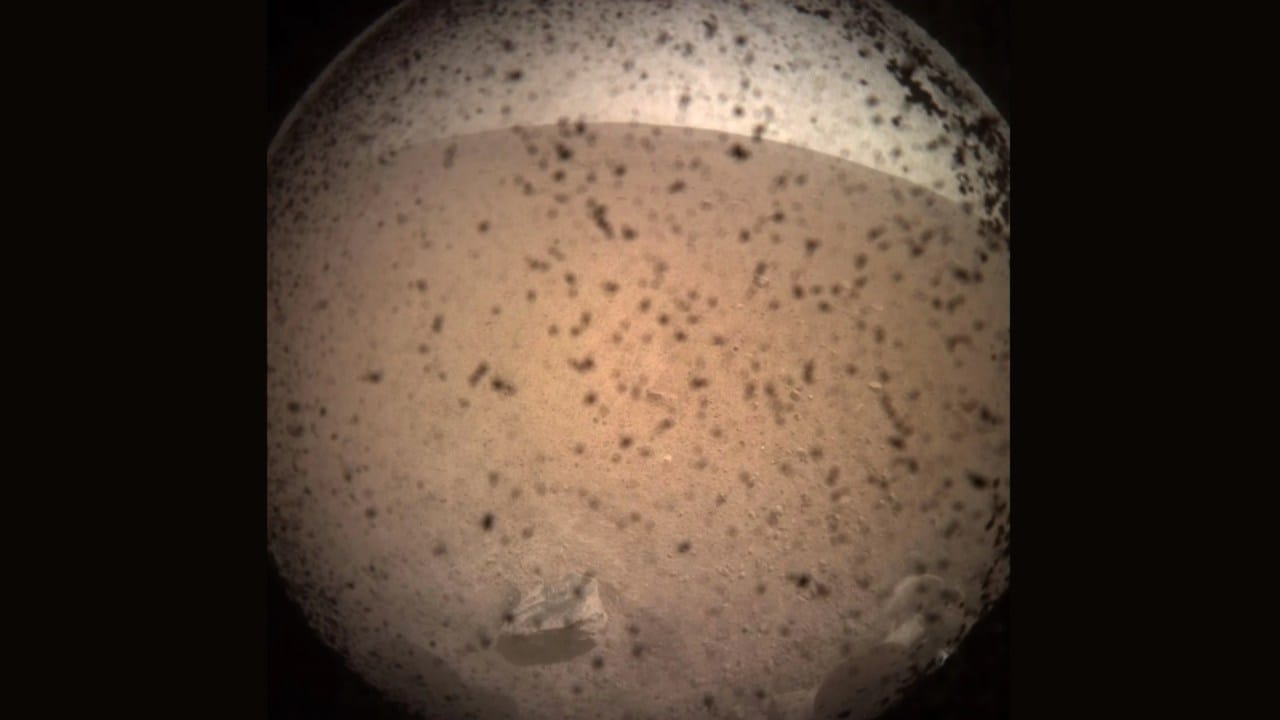
The first image of Mars taken by NASA's InSight Mars lander after its successful landing on the 'parking lot'-like Elysium Planitia on 26 November, 2018. The dust seen in the image is a dust cover protecting its camera till InSight sends back a signal assuring the team it has landed in a safe spot. Image courtesy: NASA JPL[/caption]Over the next two years, the probe will scan the rocky planet’s interiors and measure how many quakes and meteorite impacts Mars experiences over the mission’s duration.Mars InSight, or the ‘Interior Exploration using Seismic Investigations, Geodesy and Heat Transport’, is NASA’s first landing probe built to study Mars’ interiors in-depth.
InSight lander on Mars: All you need to know
Why study Mars’ interiors?
In terms of all the features required to study planet formation, Mars fits the bill, according to NASA:- Getting a 'complete’ record of rocky-planet geology: Mars has fewer earthquakes and lesser geological activity than Earth does. This gives scientists a closer look at the planet’s undisturbed, more ‘complete’ record — specifically, how signatures from the planet’s core, mantle and crust that indicate how it formed and changed in the 4.5 billion years since the Big Bang.
- Mars as a model for planets in the habitable ‘Goldilocks zone’: The size, structure and distance of Mars from the Sun make it a ‘Goldilocks’ planet, capable of hosting life in theory. On Mars, InSight will study the size and composition of the planet’s different layers, allowing scientists to get a closer look at how a Goldilocks planet might form and evolve.
- How geologically active Mars really is: So far, scientist are aware that Mars has low levels of geological activity, but no idea as to how active Mars really is. InSight is equipped to listen for tremors, whether from Marsquakes, meteorite impacts, or volcanic activity, over the mission’s two-year duration.
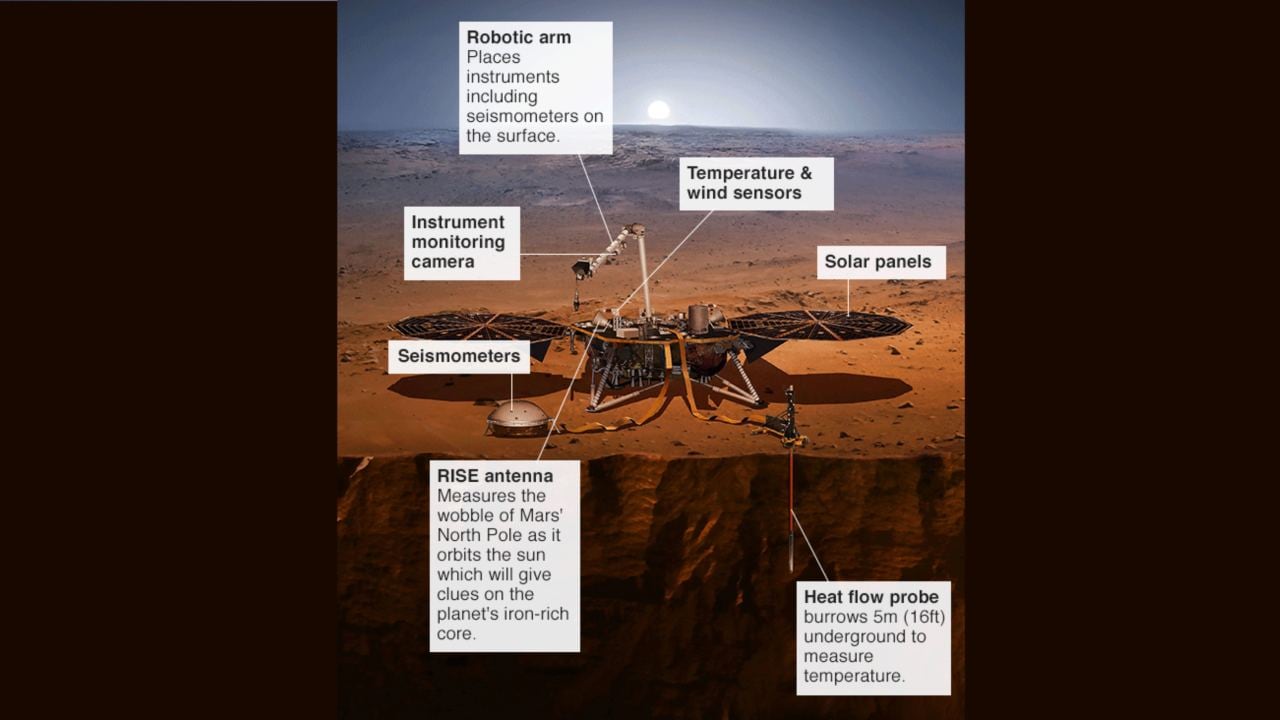
The many tools on NASA's first expert Martian geologist, InSight. Image courtesy: NASA JPL[/caption]
InSight’s science instruments
- The Seismic Experiment for Interior Structure (SEIS): To pick up on any seismic activity from meteorites hitting the planet, moving magma and Marsquakes.
- The Heat Flow and Physical Properties Probe (HP3): To dig 5 metres into the surface and pick up heat signatures from Mars’ dusty surface. It will provide precise data on how much heat escapes the planet’s interior, a vital sign of a planet that also indicates the destiny of Mars’ future: how quickly its core energy is diminishing.
- The Rotation and Interior Structure Experiment (RISE): It will look at the size and composition of Mars’ core. The RISE instrument will use the lander’s location and pings from Earth’s satellites to accurately measure Mars’ angle and speed of rotation.
- Laser Retroreflectors: The InSight mission also has another non-essential fitting – a set of 8 laser reflectors on its top surface. While this isn’t part of InSight’s science missions, it will reflect any incoming long-range light signals back to its source. With its location known and unchanging, scientists intend to make use of the reflectors in laser-light experiments in astronomy and planetary science on Earth.

Careless Whispers: Scientists discover that plants can 'talk' to each other using smells
Life on Mars? European Space Agency’s Orbiter discovers ice water deposits at equator
Microsoft briefly overtakes Apple as the most valuable company, Apple back on top again
Even NASA is facing a tough time, starts layoffs following major budget cuts
ISRO, NASA's NISAR satellite to get ready by Jan-end, will monitor Earth's snow-covered regions