


NASA's Hubble telescope tracks the lifecycle of giant storms on Neptune's surface
The storms on Neptune are so giant in size that their longest dimension is the size of the Earth.

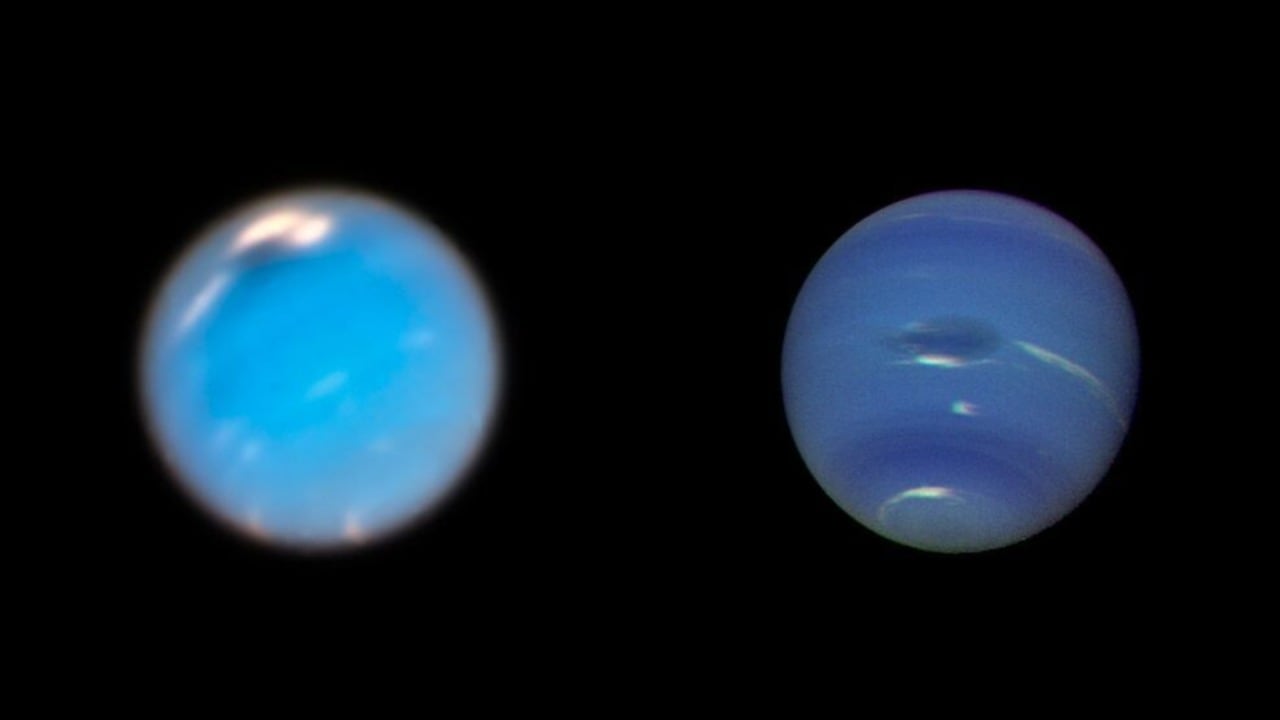
A composite picture of the storms on Neptune as seen from the Hubble Space Telescope (left) and the Voyager 2 spacecraft (right). The Hubble Wide Field Camera 3 image of Neptune, taken in Sept. and Nov. 2018, shows a new dark storm (top center). In the Voyager image, a storm known as the Great Dark Spot is seen at the center. It is about 13,000 km by 6,600 km in size — as large as the Earth in its longer dimension. Image credit: NASA[/caption]The Hubble images also helped the researchers pinpoint how often Neptune gets dark spots and how long they last.The findings not only give scientists insights on the inner workings of the ice giant planets but also have implications for studying exoplanets of similar size and composition."If you study the exoplanets and you want to understand how they work, you really need to understand our planets first," said Amy Simon, a planetary scientist at NASA's Goddard Space Flight Center in the US."We have so little information on Uranus and Neptune," said Simon, lead author of the study published in journal Geophysical Research Letters.Scientists first saw a Great Dark Spot on Neptune in 1989, when NASA's Voyager 2 probe flew past the mysterious blue planet. As the spacecraft zoomed by, it snapped pictures of two giant storms brewing in Neptune's southern hemisphere.Scientists dubbed the storms "The Great Dark Spot" and "Dark Spot 2."

Careless Whispers: Scientists discover that plants can 'talk' to each other using smells
Life on Mars? European Space Agency’s Orbiter discovers ice water deposits at equator
Microsoft briefly overtakes Apple as the most valuable company, Apple back on top again
Even NASA is facing a tough time, starts layoffs following major budget cuts
ISRO, NASA's NISAR satellite to get ready by Jan-end, will monitor Earth's snow-covered regions