


NASA's Hubble Telescope stumbles upon a dwarf galaxy 30 million light years away
Researchers used the Hubble Telescope to study white dwarf stars within the globular cluster NGC 6752.

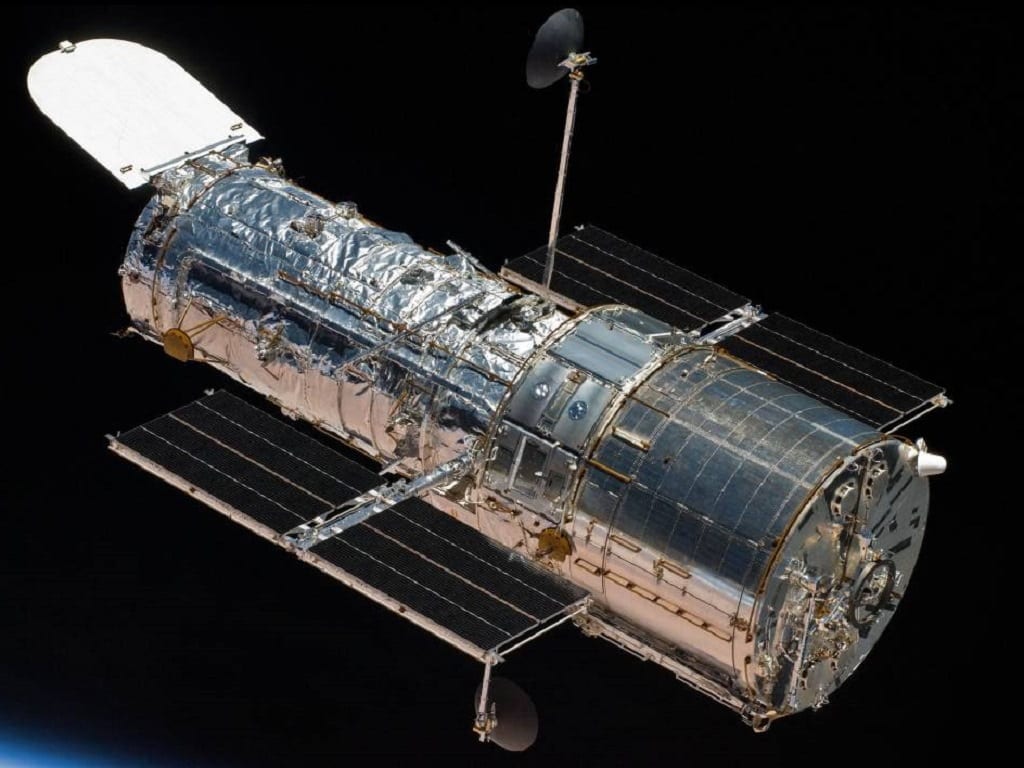
NASA's Hubble Telescope[/caption]After a careful analysis of their brightnesses and temperatures, the astronomers concluded that these stars did not belong to the cluster -- which is part of the Milky Way -- but rather they are millions of light-years more distant.The cosmic neighbour, nicknamed Bedin 1, is a modestly sized, elongated galaxy. It measures only around 3000 light-years at its greatest extent -- a fraction of the size of the Milky Way.Not only is it tiny, but it is also incredibly faint, researchers said. These properties led astronomers to classify it as a dwarf spheroidal galaxy.Dwarf spheroidal galaxies are defined by their small size, low-luminosity, lack of dust and old stellar populations. 36 galaxies of this type are already known to exist in the Local Group of Galaxies, 22 of which are satellite galaxies of the Milky Way.
While dwarf spheroidal galaxies are not uncommon, Bedin 1 has some notable features. Not only is it one of just a few dwarf spheroidals that have a well-established distance but it is also extremely isolated.It lies about 30 million light-years from the Milky Way and 2 million light-years from the nearest plausible large galaxy host, NGC 6744. This makes it possibly the most isolated small dwarf galaxy discovered to date.From the properties of its stars, astronomers were able to infer that the galaxy is around 13 billion years old — nearly as old as the Universe itself.Due to its isolation — which resulted in hardly any interaction with other galaxies -- and its age, Bedin 1 is the astronomical equivalent of a living fossil from the early Universe.The discovery of Bedin 1 was a truly serendipitous find. Very few Hubble images allow such faint objects to be seen, and they cover only a small area of the sky.Future telescopes with a large field of view, such as the WFIRST telescope, will have cameras covering a much larger area of the sky and may find many more of these galactic neighbours.
Careless Whispers: Scientists discover that plants can 'talk' to each other using smells
Life on Mars? European Space Agency’s Orbiter discovers ice water deposits at equator
Microsoft briefly overtakes Apple as the most valuable company, Apple back on top again
Even NASA is facing a tough time, starts layoffs following major budget cuts
ISRO, NASA's NISAR satellite to get ready by Jan-end, will monitor Earth's snow-covered regions