
Advertisement


Sections
NASA's faraway space snowman Ultima Thule has a flat, not round, behind
The finding may spark new theories on how such primitive objects formed early in the solar system.

The faraway space snowman visited by NASA last month has a surprisingly flat — not round — behind.New photos from the New Horizons spacecraft offer a new perspective on the small cosmic body 4 billion miles (6.4 billion kilometers) away. The two-lobed object, nicknamed Ultima Thule, is actually flatter on the backside than originally thought, according to scientists.Pictures released late last week — taken shortly after closest approach on New Year’s Day — provide an outline of the side not illuminated by the sun.When viewed from the front, Ultima Thule still resembles a two-ball snowman. But from the side, the snowman looks squashed, sort of like a lemon and pie stuck together, end to end.[caption id="attachment_5973941" align="alignnone" width="1280"]![The most high-res image New Horizons has captured and beamed back of the tumbling snowman-looking Kuiper belt object, Ultima Thule. Image credit: NASA]()
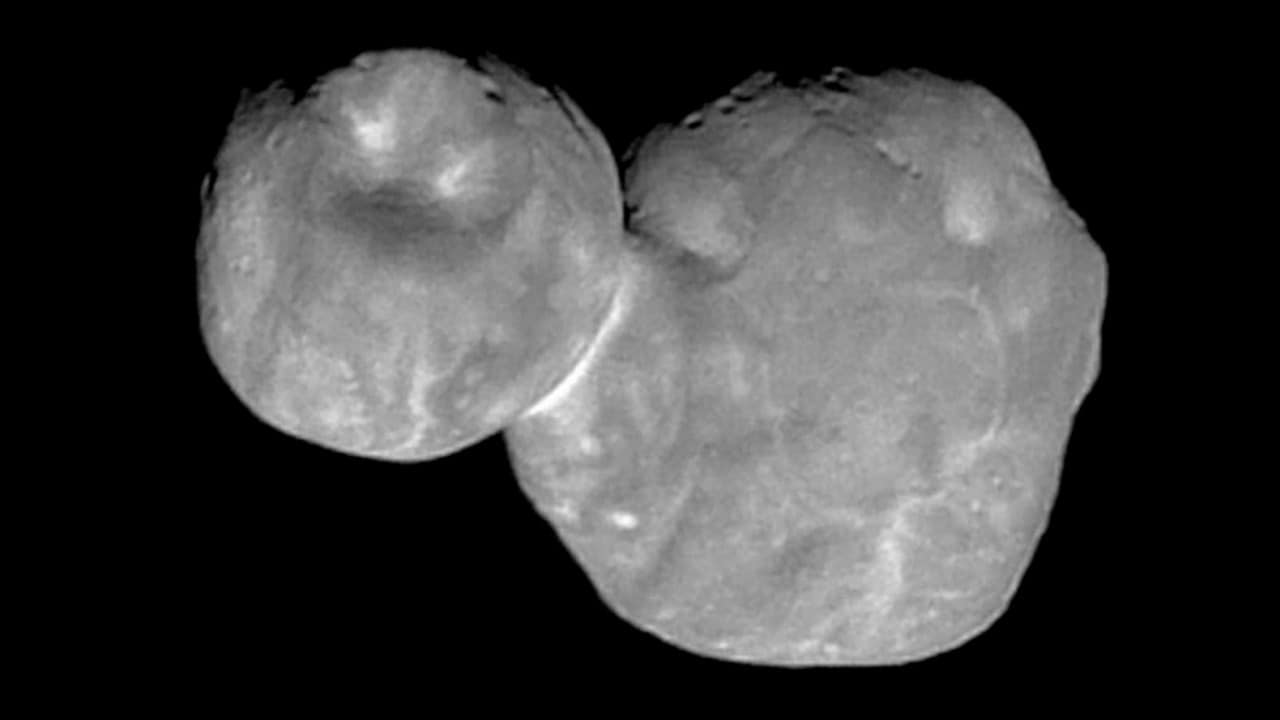
The most high-res image New Horizons has captured and beamed back of the tumbling snowman-looking Kuiper belt object, Ultima Thule. Image credit: NASA[/caption]
“Seeing more data has significantly changed our view,” Southwest Research Institute’s Alan Stern, the lead scientist, said in a statement. “It would be closer to reality to say Ultima Thule’s shape is flatter, like a pancake. But more importantly, the new images are creating scientific puzzles about how such an object could even be formed. We’ve never seen something like this orbiting the sun.”Project scientist Hal Weaver of Johns Hopkins University, home to New Horizons flight control center, said the finding should spark new theories on how such primitive objects formed early in the solar system.Ultima Thule — considered a contact binary — is the most distant world ever explored. New Horizons zipped past it at high speed, after becoming the first visitor to Pluto in 2015. Mission managers hope to target an even more distant celestial object in this so-called Kuiper Belt, on the frozen fringes of the solar system, if the spacecraft remains healthy.New Horizons is already 32 million miles (52 million kilometers) beyond Ultima Thule. It will take another 1 ½ years to beam back all the flyby data.The spacecraft rocketed from Florida in 2006.First Published:Feb 12, 2019, 09:49:54 IST
Advertisement
Advertisement

Careless Whispers: Scientists discover that plants can 'talk' to each other using smells
Japanese scientists have recorded a video that shows plants, in certain conditions, communicate with each other using mists that carry smells. The discovery, reveals that plants release a fine mist of airborne compounds, to warn nearby plants of potential dangers
Life on Mars? European Space Agency’s Orbiter discovers ice water deposits at equator
European Space Agency's Mars Express Orbiter has identified massive ice and ice water deposits beneath the surface of Mars. The Mars Express orbiter was also the first to confirmed the presence of ice on Mars in 2004
Microsoft briefly overtakes Apple as the most valuable company, Apple back on top again
At its peak during the session, Microsoft's value reached $2.903 trillion, with a 2% surge. As of writing this article, Apple closed at $2.89 trillion, whereas Microsoft closed at $2.86 trillion
Even NASA is facing a tough time, starts layoffs following major budget cuts
NASA is facing some massive budget cuts, because of which, it has been forced to postpone some upcoming missions. NASA's Jet Propulsion Laboratory has been hit hard by recent federal budget cuts, resulting in the layoff of 100 contractors last week
ISRO, NASA's NISAR satellite to get ready by Jan-end, will monitor Earth's snow-covered regions
The NISAR satellite which has been developed jointly ISRO and NASA, should be ready for launch by the end of January 2024. The collaboration between NASA and ISRO on NISAR is the first time the two agencies have cooperated on hardware development for an Earth-observing mission
Advertisement
Advertisement