
Advertisement


Sections
NASA's Chandra spots 'Star Trek Enterprise' in colliding galaxy clusters far, far away
Trekkies can now rest easy in the know that there will always be an Enterprise (or 2) out there.

Captain Kirk may have called space the ‘final frontier’, but its also where astronomers have spotted what they think looks like the iconic USS Enterprise from the legendary science fiction series, Star Trek.NASA published images captured by the agency’s Chandra X-ray Observatory of a galaxy cluster called Abell 1033, a star system with an “uncanny resemblance” to the fictional starship Enterprise, it said in a statement.The blue wisps of gas on the left vaguely look like a side view of the Enterprise, with the saucer section at the top of the image. The smaller blue formation in the bottom could easily pass for bunny ears.Abell 1033 is 1.6 billion light-years away from Earth, with structures that appear to be some of the “largest objects in the Universe held together by gravity,” according to NASA.![a1033_rollover_525 (1)]() The high-energy electrons in these 'electron jets' appear to be moving nearly at the speed of light into the black hole located in one of the two colliding galaxy clusters.Funnily enough, this isn’t the first time NASA spotted what it thinks looks like an Enterprise starship. In 2016, the Spitzer telescope captured images of distant nebulae.Much like a child looking at shapes in the clouds, NASA saw not one, but two of the series’ beloved starship, the USS Enterprise.We get it NASA, Star Trek fandom and a colourful imagination are a big part of what you are.
The high-energy electrons in these 'electron jets' appear to be moving nearly at the speed of light into the black hole located in one of the two colliding galaxy clusters.Funnily enough, this isn’t the first time NASA spotted what it thinks looks like an Enterprise starship. In 2016, the Spitzer telescope captured images of distant nebulae.Much like a child looking at shapes in the clouds, NASA saw not one, but two of the series’ beloved starship, the USS Enterprise.We get it NASA, Star Trek fandom and a colourful imagination are a big part of what you are.
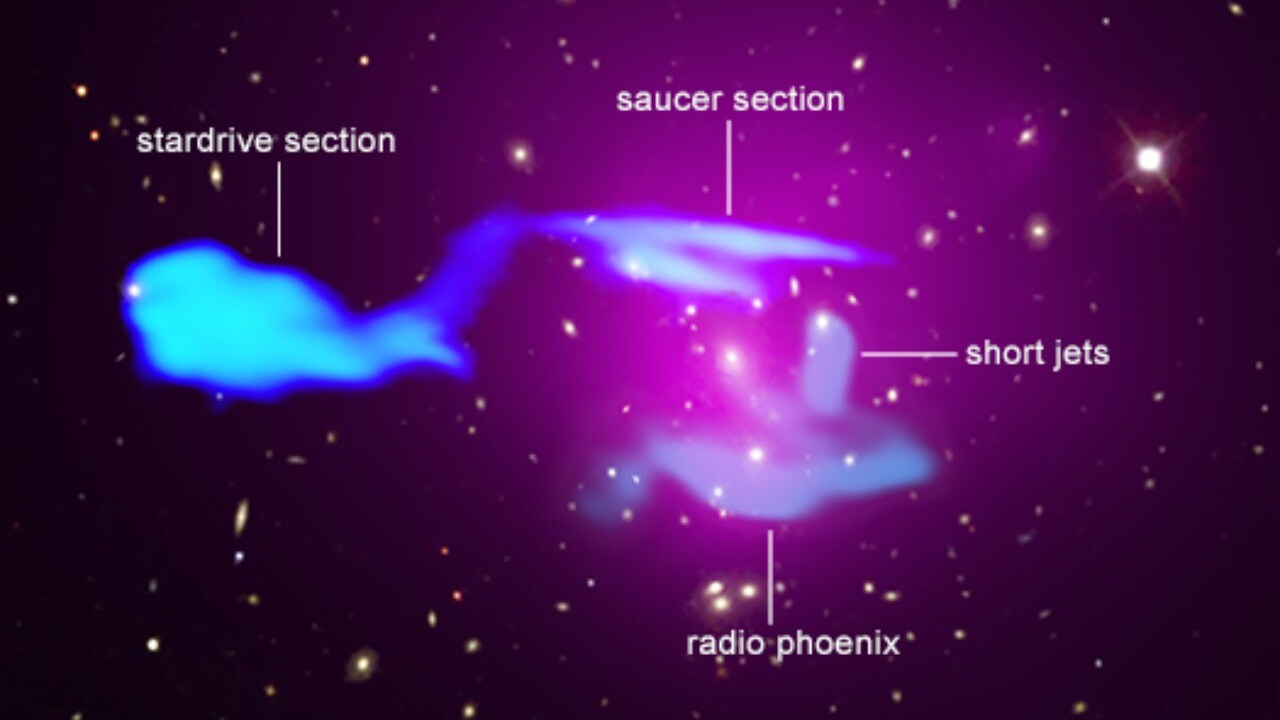
What’s more, Chandra’s X-ray and radio wave data have indicated that the galaxy cluster is actually two galaxy clusters in the process of collision. This unusual, ultra-high-energy event “has produced turbulence and shock waves” in the universe, similar to what sonic booms made by ultrasonic jets.And if that wasn’t nearly dramatic enough, the galactic collision also appears to be interacting with a second, high-energy cosmic event. NASA researchers have spotted what looks like a stream of high-energy particles made by matter as it spirals into a supermassive black hole.
First Published:Nov 20, 2018, 12:14:02 IST
Advertisement
Advertisement

Careless Whispers: Scientists discover that plants can 'talk' to each other using smells
Japanese scientists have recorded a video that shows plants, in certain conditions, communicate with each other using mists that carry smells. The discovery, reveals that plants release a fine mist of airborne compounds, to warn nearby plants of potential dangers
Life on Mars? European Space Agency’s Orbiter discovers ice water deposits at equator
European Space Agency's Mars Express Orbiter has identified massive ice and ice water deposits beneath the surface of Mars. The Mars Express orbiter was also the first to confirmed the presence of ice on Mars in 2004
Microsoft briefly overtakes Apple as the most valuable company, Apple back on top again
At its peak during the session, Microsoft's value reached $2.903 trillion, with a 2% surge. As of writing this article, Apple closed at $2.89 trillion, whereas Microsoft closed at $2.86 trillion
Even NASA is facing a tough time, starts layoffs following major budget cuts
NASA is facing some massive budget cuts, because of which, it has been forced to postpone some upcoming missions. NASA's Jet Propulsion Laboratory has been hit hard by recent federal budget cuts, resulting in the layoff of 100 contractors last week
ISRO, NASA's NISAR satellite to get ready by Jan-end, will monitor Earth's snow-covered regions
The NISAR satellite which has been developed jointly ISRO and NASA, should be ready for launch by the end of January 2024. The collaboration between NASA and ISRO on NISAR is the first time the two agencies have cooperated on hardware development for an Earth-observing mission
Advertisement
Advertisement