


NASA volunteers spend 45 days to prepare for HERA mission to Mars' moon Phobos
It has been designed to stimulate deep space environments such as remote conditions, isolation, and confinement in exploration scenarios.

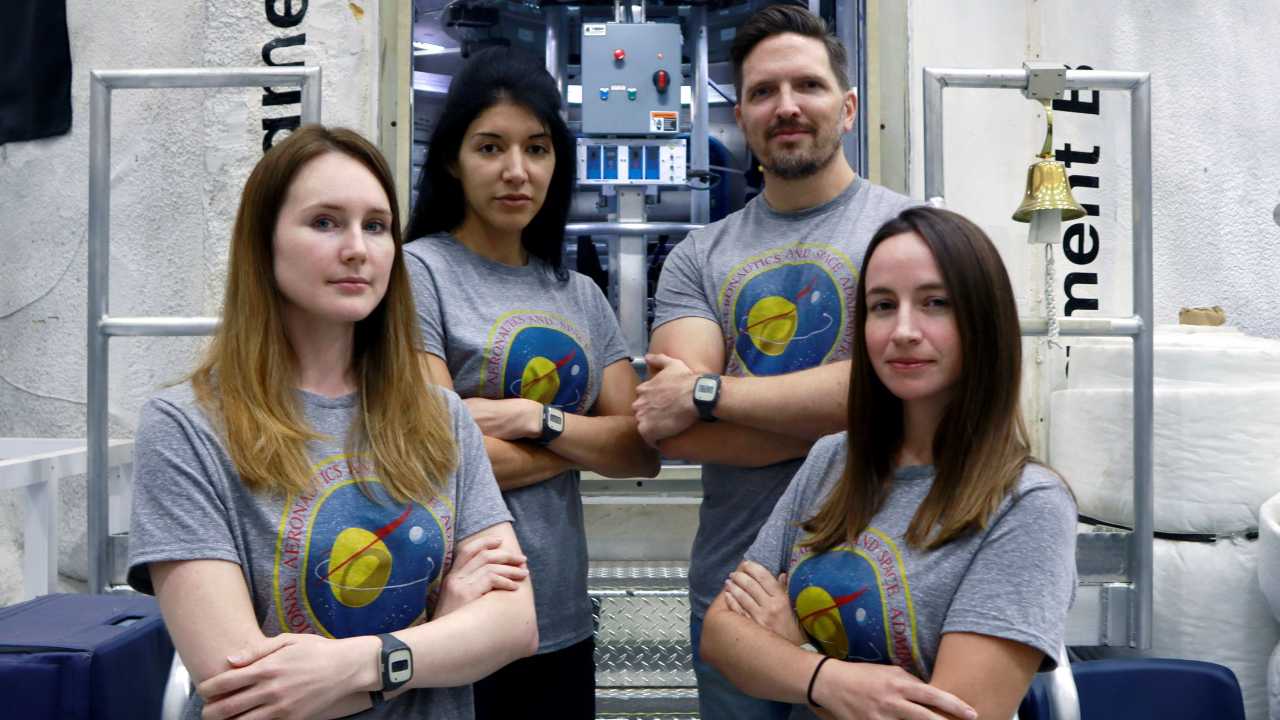
The new crew for the upcoming mission of NASA's Human Exploration Research Analog, or HERA, stands in front of the habitat that will be their home for 45 days. From left to right: Lauren Cornell, Monique Garcia, Christopher Roberts, and Madelyne Willis. Image Credits: NASA[/caption]The mission has been named Human Exploration Research Analog, or HERA. It has been designed to stimulate deep space environments such as remote conditions, isolation, and confinement in exploration scenarios. According to NASA, HERA will house all the crew members for 45 days until the mission ends on 15 November. Following this, those inside the space centre will experience more delays in communicating with the outside world as the journey takes crew members closer to Phobos.This mission began at the start of HERA’s Campaign 6, after which three additional missions will follow. Throughout the missions, NASA’s Human Research Program will perform 15 total studies that will take the help of seven returning and eight new investigations.
Below are the names of four of the volunteers, who will form the primary crew, while the other two are backup crew members. The primary crew team includes Monique Garcia, Christopher Roberts, Lauren Cornell, and Madelyne Willis. The backup crew involves Justin Lawrence and Pu Wang.Similar to this mission, on 4 January 2020, six scientists embarked on their first “mission to Mars” on the slopes of the largest volcano in the world which is Mauna Loa in Hawaii. It was not a traditional Mars mission but an “analogue” astronaut mission where scientists and explorers worked and studied remote locations on Earth that were resembling the features, terrain, and composition of the moon or Mars.Experts believe that a mission like this usually generates important information and data about the scientific objectives and the preparedness of the astronauts to take on a mission to another world. During that week, a team of six analogue astronauts was lifted off on the Sensoria I spacecraft. It was the inaugural venture of the Sensoria project.For the unversed, the Sensoria project involved a series of missions at the Hawaii Space Exploration Analog and Simulation (HI-SEAS). It is a Mars habitat analogue exclusively for scientists and experts. The whole project lasted from 4 to 18 January, where the crew resurfaced from their "Martian" habitat.
Careless Whispers: Scientists discover that plants can 'talk' to each other using smells
Life on Mars? European Space Agency’s Orbiter discovers ice water deposits at equator
Microsoft briefly overtakes Apple as the most valuable company, Apple back on top again
Even NASA is facing a tough time, starts layoffs following major budget cuts
ISRO, NASA's NISAR satellite to get ready by Jan-end, will monitor Earth's snow-covered regions