
Advertisement


Sections
NASA shares image of supernova remnant RCW 103 captured by Chandra
Data from Chandra, Swift and ESA's XMM-Newton confirmed that 1E 1613 has properties of a magnetar, making it only the 30th known magnetar.

NASA has shared a dazzling image of a supernova captured by the Chandra X-ray Observatory telescope. NASA shared the image on its Instagram page, writing, "The bright source at the centre of supernova remnant RCW 103 is a neutron star. Matter in a neutron star is packed together so tightly that a sugar-cube-sized amount of neutron star material would weigh more than one billion tons — roughly the weight of Mount Everest!" According to a statement by Chandra X-Ray Observatory, the compact source at the centre of RCW 103 is the remains of a supernova explosion located about 9,000 light-years from Earth.[caption id="attachment_9229191" align="alignnone" width="1280"]![Using Chandra and other X-ray observatories, astronomers have found evidence for what is likely one of the most extreme pulsars, or rotating neutron stars, ever detected. This composite image shows RCW 103 and its central source 161348-5055 in three bands of X-rays detected by Chandra with low, medium, and high-energy X-rays colored red, green, and blue respectively. (The X-ray data have been combined with an optical image.) The central source RCW 103 has properties of a magnetar, a highly magnetized neutron star, yet spins at the relatively slow rate of once about every six and a half hours. This would make it the slowest spinning neutron star ever detected. X-ray: NASA/CXC/University of Amsterdam/N.Rea et al; Optical: DSS]()
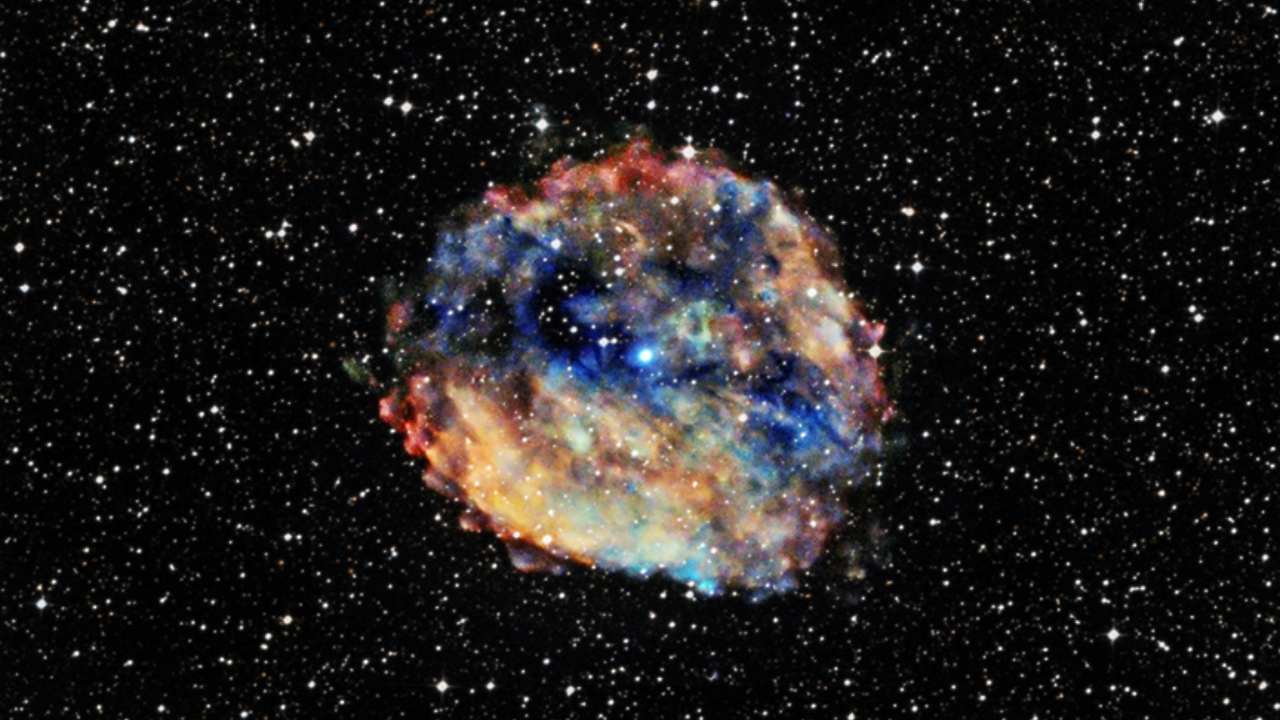
This composite image shows RCW 103 and its central source 161348-5055 in three bands of X-rays detected by Chandra with low, medium, and high-energy X-rays colored red, green, and blue respectively. Image credit: NASA/CXC/University of Amsterdam/N.Rea et al; Optical: DSS[/caption]
In the image, there are three bands of X-ray light detected by Chandra. The lowest energy X-rays from Chandra are red, the medium band is green, while blue denotes the highest-energy X-rays. The bright blue X-ray source in the middle of RCW 103 is called its central source - 1E 1613.RCW 103 according to a statement by Chandra team is one of the most "extreme pulsars, or rotating neutron stars, ever detected".A while back astronomers had agreed that 1E 1613 is a neutron story and now they have discovered that it actually might be a highly magnetized neutron star (magnetar). However, the amount of time it takes to spin is thousands of times longer than any pulsar ever observed. In 2016, an instrument aboard NASA's Swift telescope captured the release of a short burst of X-rays from 1E 1613. The source exhibited intense, extremely rapid fluctuations that are similar to magnetars.Magnetars possess the most powerful magnetic fields in the Universe and can erupt with enormous amounts of energy.Data from a trio of high energy telescopes and archival data from Chandra, Swift and ESA's XMM-Newton confirmed that 1E 1613 has the properties of a magnetar, making it only the 30th known magnetar.First Published:Jan 22, 2021, 12:47:56 IST
Advertisement
Advertisement

Careless Whispers: Scientists discover that plants can 'talk' to each other using smells
Japanese scientists have recorded a video that shows plants, in certain conditions, communicate with each other using mists that carry smells. The discovery, reveals that plants release a fine mist of airborne compounds, to warn nearby plants of potential dangers
Life on Mars? European Space Agency’s Orbiter discovers ice water deposits at equator
European Space Agency's Mars Express Orbiter has identified massive ice and ice water deposits beneath the surface of Mars. The Mars Express orbiter was also the first to confirmed the presence of ice on Mars in 2004
Microsoft briefly overtakes Apple as the most valuable company, Apple back on top again
At its peak during the session, Microsoft's value reached $2.903 trillion, with a 2% surge. As of writing this article, Apple closed at $2.89 trillion, whereas Microsoft closed at $2.86 trillion
Even NASA is facing a tough time, starts layoffs following major budget cuts
NASA is facing some massive budget cuts, because of which, it has been forced to postpone some upcoming missions. NASA's Jet Propulsion Laboratory has been hit hard by recent federal budget cuts, resulting in the layoff of 100 contractors last week
ISRO, NASA's NISAR satellite to get ready by Jan-end, will monitor Earth's snow-covered regions
The NISAR satellite which has been developed jointly ISRO and NASA, should be ready for launch by the end of January 2024. The collaboration between NASA and ISRO on NISAR is the first time the two agencies have cooperated on hardware development for an Earth-observing mission
Advertisement
Advertisement