
Advertisement


Sections
NASA mission to Saturn's moon Titan with its Dragonfly drone will cost $1 billion
The dragonfly drone is as big as a land mower and it is built to last its mission life 2.7 years.

NASA has announced that it is going to Saturn’s moon Titan.The mission is called Dragonfly and it is slated to launch in 2026 and will arrive at the moon on 2034. This will be the first time that NASA will fly a rotorcraft that is similar to a large drone or a lawnmower. Titan’s atmosphere is denser than that of Earth’s and NASA aims to take advantage of it to be the first agency to fly its payloads to new sites to conduct their experiments. The craft will conduct its exploration in short flight increasing the length to 8 km. NASA has described the flight as "leapfrog" (short flights of up to 8 kilometres).[caption id="attachment_6896211" align="alignnone" width="1280"]![This illustration shows NASA’s Dragonfly rotorcraft-lander approaching a site on Saturn’s exotic moon, Titan. Image credit: NASA]() This will be NASA's second planned rotorcraft mission. The first is the Mars helicopter test vehicle which will be part of the Mars 2020 Rover mission that is scheduled to launch in July 2020 and arrive in February 2021. The helicopter will be stored in the belly rover and weighs approximately 1.8 kilograms. This will be the first vehicle in history to attempt to establish the viability of heavier-than-air vehicles flying on another planet, NASA said in a press release.The selection process started in 2017 and the Titan mission was selected from a long list of contenders. It is part of NASA’s New Frontiers program that includes the mission to Pluto and the Kuiper Belt, Jupiter and asteroid Bennu.
This will be NASA's second planned rotorcraft mission. The first is the Mars helicopter test vehicle which will be part of the Mars 2020 Rover mission that is scheduled to launch in July 2020 and arrive in February 2021. The helicopter will be stored in the belly rover and weighs approximately 1.8 kilograms. This will be the first vehicle in history to attempt to establish the viability of heavier-than-air vehicles flying on another planet, NASA said in a press release.The selection process started in 2017 and the Titan mission was selected from a long list of contenders. It is part of NASA’s New Frontiers program that includes the mission to Pluto and the Kuiper Belt, Jupiter and asteroid Bennu.
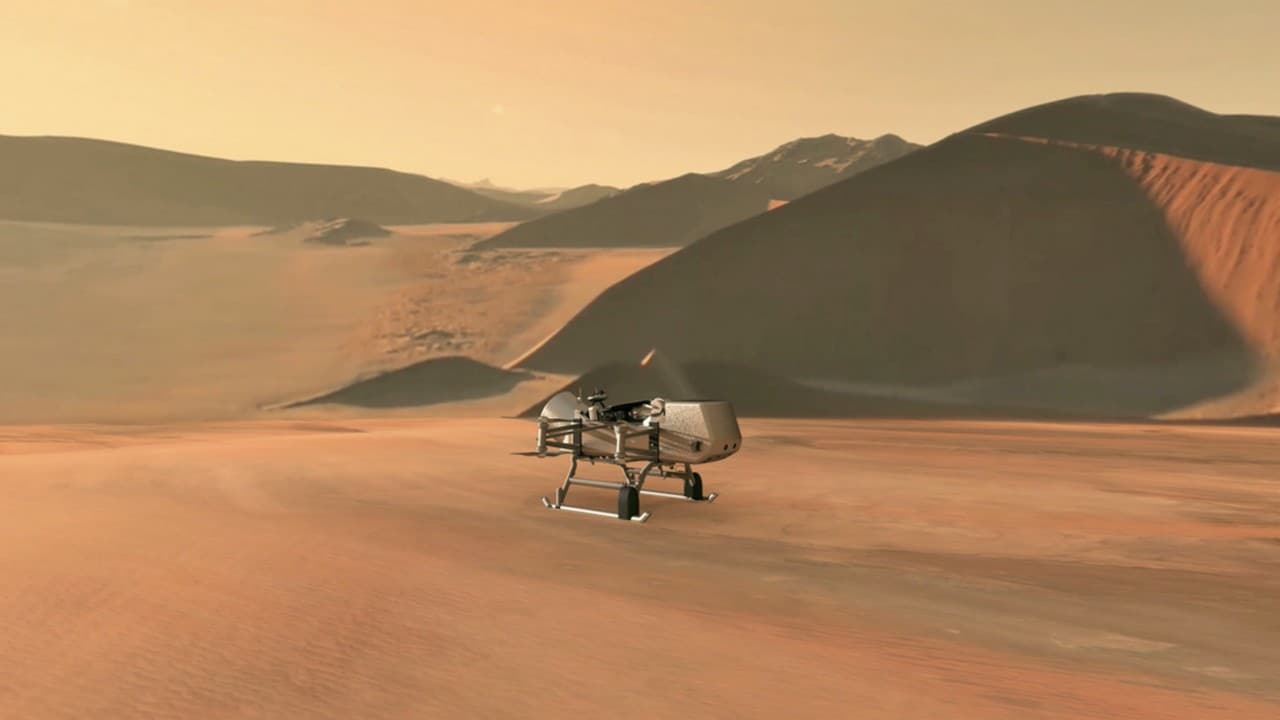
This illustration shows NASA’s Dragonfly rotorcraft-lander approaching a site on Saturn’s exotic moon, Titan. Image credit: NASA[/caption]The atmosphere is not the only bit that has similarities to Earth’s even though Titan's atmosphere is mostly made up of nitrogen. Titan also has liquid rivers and seas that are hundreds of feet deep. Its seas are largely made up of methane and ethane and Dragonfly will study it.
It is built to last its mission life of 2.7 years, is 3-meter long and will travel 175 km. Dragonfly will explore different parts of Titan’s environment and search for evidence of past life on the Moon. It will look at organic dunes, an impact crater which has liquid water and how far prebiotic chemistry may have progressed. It will be helped by the data that Cassini has collected over its mission span of 13 years.Dragonfly will land during a calm period on the Moon, in a dune field Shangri-La which is similar to the dune in Namibia in South Africa. The total cost of this mission will be $1 billion, according to Space.com.First Published:Jul 09, 2019, 09:49:35 IST
Advertisement
Advertisement

Careless Whispers: Scientists discover that plants can 'talk' to each other using smells
Japanese scientists have recorded a video that shows plants, in certain conditions, communicate with each other using mists that carry smells. The discovery, reveals that plants release a fine mist of airborne compounds, to warn nearby plants of potential dangers
Life on Mars? European Space Agency’s Orbiter discovers ice water deposits at equator
European Space Agency's Mars Express Orbiter has identified massive ice and ice water deposits beneath the surface of Mars. The Mars Express orbiter was also the first to confirmed the presence of ice on Mars in 2004
Microsoft briefly overtakes Apple as the most valuable company, Apple back on top again
At its peak during the session, Microsoft's value reached $2.903 trillion, with a 2% surge. As of writing this article, Apple closed at $2.89 trillion, whereas Microsoft closed at $2.86 trillion
Even NASA is facing a tough time, starts layoffs following major budget cuts
NASA is facing some massive budget cuts, because of which, it has been forced to postpone some upcoming missions. NASA's Jet Propulsion Laboratory has been hit hard by recent federal budget cuts, resulting in the layoff of 100 contractors last week
ISRO, NASA's NISAR satellite to get ready by Jan-end, will monitor Earth's snow-covered regions
The NISAR satellite which has been developed jointly ISRO and NASA, should be ready for launch by the end of January 2024. The collaboration between NASA and ISRO on NISAR is the first time the two agencies have cooperated on hardware development for an Earth-observing mission
Advertisement
Advertisement