
Advertisement


Sections
NASA InSight unfolds solar arrays, snaps some pictures on Mars after safety checks
Engineers plan to fold open & use InSight’s five arms to get cracking on some geology experiments.

NASA’s InSight lander touched down safely on Mars after a seven-month-long journey, and sent its mission team an image for confirmation just minutes later.[caption id="attachment_5644951" align="alignnone" width="1280"]![InSight acquired this image of the area in front of the lander using its lander-mounted Instrument Context Camera (ICC) hours after landing. Image courtesy: NASA]() InSight acquired this dust-laden image of the area in front of the lander using its lander-mounted Instrument Context Camera (ICC) hours after landing. Image courtesy: NASA[/caption]Soon after, InSight got to work on some self-imposed health checks before unfolding its robot arm and solar arrays to soak up some sun and charge its batteries.The lander has also deployed its first sensors from science experiments on Mars: quake-detectors.[caption id="attachment_5644961" align="alignnone" width="1280"]
InSight acquired this dust-laden image of the area in front of the lander using its lander-mounted Instrument Context Camera (ICC) hours after landing. Image courtesy: NASA[/caption]Soon after, InSight got to work on some self-imposed health checks before unfolding its robot arm and solar arrays to soak up some sun and charge its batteries.The lander has also deployed its first sensors from science experiments on Mars: quake-detectors.[caption id="attachment_5644961" align="alignnone" width="1280"]![InSight took this image using its robotic arm-mounted, Instrument Deployment Camera (IDC) on the day it landed. All the instruments in the frame are parts of the lander's onboard experiments. Image courtesy: NASA]() InSight took this image using its robotic arm-mounted, Instrument Deployment Camera (IDC) on the day it landed. All the instruments in the frame are parts of the lander's onboard experiments. Image courtesy: NASA[/caption]"Slowly releasing all my pent-up tension, starting with loosening my grapple, as these before-and-after pics show," NASA InSight's Twitter account said."Until I'm ready to stretch my arm out, my camera angles will be the same."Engineers are soon planning to use InSight’s five arms to get started on some more of the robot geologist’s experiments.InSight has two full-colour cameras onboard, that have sent back 3 images already over the 2 days since its successful landing.NASA is yet to announce that all the other instruments on InSight are in good shape: the CERN-engineered seismometer to seek out Marsquakes small or large, and its sensors to measure escaping heat from Mars’ surface.[caption id="attachment_5645051" align="alignnone" width="1280"]
InSight took this image using its robotic arm-mounted, Instrument Deployment Camera (IDC) on the day it landed. All the instruments in the frame are parts of the lander's onboard experiments. Image courtesy: NASA[/caption]"Slowly releasing all my pent-up tension, starting with loosening my grapple, as these before-and-after pics show," NASA InSight's Twitter account said."Until I'm ready to stretch my arm out, my camera angles will be the same."Engineers are soon planning to use InSight’s five arms to get started on some more of the robot geologist’s experiments.InSight has two full-colour cameras onboard, that have sent back 3 images already over the 2 days since its successful landing.NASA is yet to announce that all the other instruments on InSight are in good shape: the CERN-engineered seismometer to seek out Marsquakes small or large, and its sensors to measure escaping heat from Mars’ surface.[caption id="attachment_5645051" align="alignnone" width="1280"]![A replica of the Mars InSight lander at NASA's Jet Propulsion Laboratory in California. Image courtesy: NASA]() A replica of the Mars InSight lander at NASA's Jet Propulsion Laboratory in California. Image courtesy: NASA[/caption]InSight has no instruments or missions to detect life, though. That will be left to future rovers like the Mars 2020, which will collect rocks that will eventually be brought back to Earth and analysed for evidence of ancient life.The spacecraft was built by NASA to last for a two-year mission on the planet, during which it is expected to learn more than any spacecraft before about Mars' rocky, quake(y) geology.
A replica of the Mars InSight lander at NASA's Jet Propulsion Laboratory in California. Image courtesy: NASA[/caption]InSight has no instruments or missions to detect life, though. That will be left to future rovers like the Mars 2020, which will collect rocks that will eventually be brought back to Earth and analysed for evidence of ancient life.The spacecraft was built by NASA to last for a two-year mission on the planet, during which it is expected to learn more than any spacecraft before about Mars' rocky, quake(y) geology.
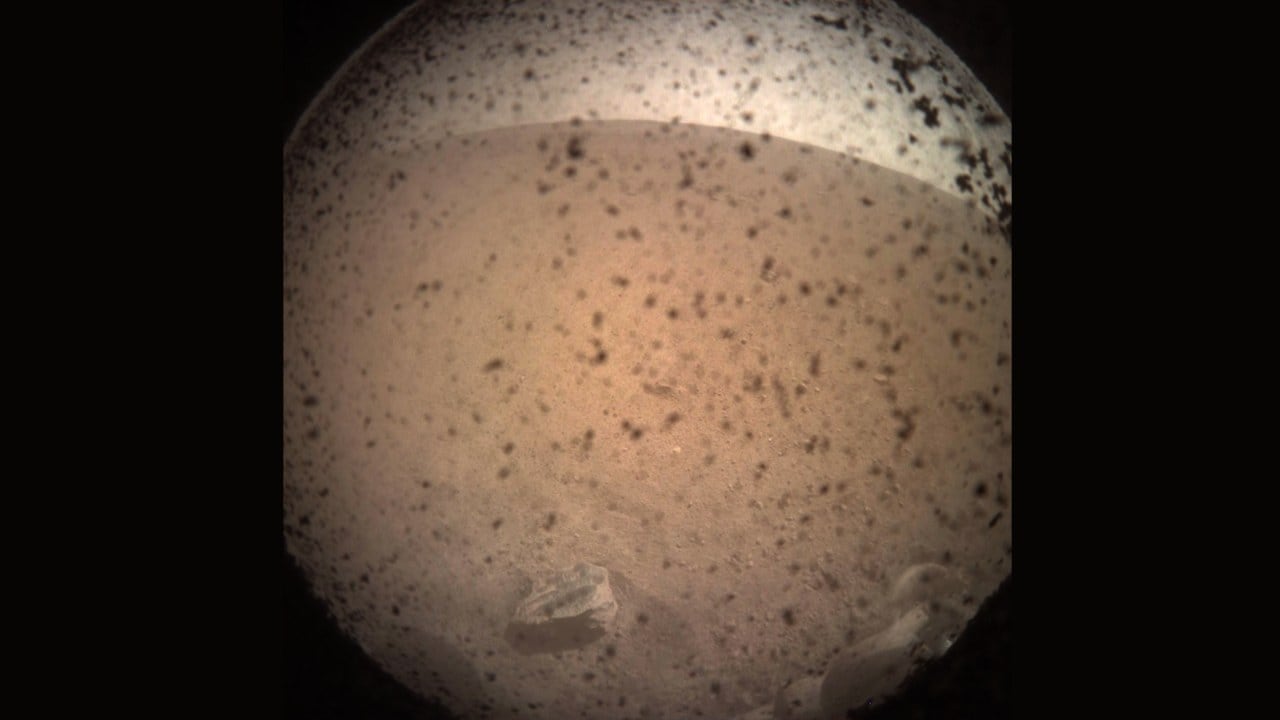 InSight acquired this dust-laden image of the area in front of the lander using its lander-mounted Instrument Context Camera (ICC) hours after landing. Image courtesy: NASA[/caption]Soon after, InSight got to work on some self-imposed health checks before unfolding its robot arm and solar arrays to soak up some sun and charge its batteries.The lander has also deployed its first sensors from science experiments on Mars: quake-detectors.[caption id="attachment_5644961" align="alignnone" width="1280"]
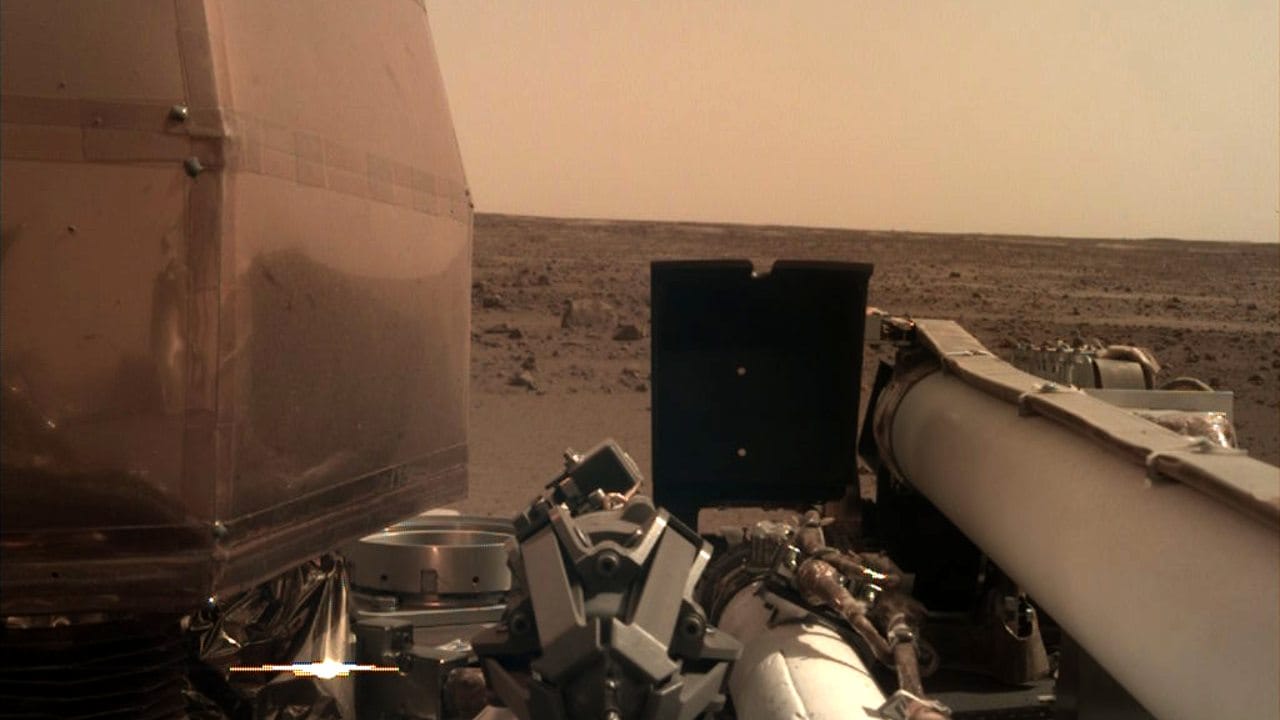 InSight took this image using its robotic arm-mounted, Instrument Deployment Camera (IDC) on the day it landed. All the instruments in the frame are parts of the lander's onboard experiments. Image courtesy: NASA[/caption]"Slowly releasing all my pent-up tension, starting with loosening my grapple, as these before-and-after pics show," NASA InSight's Twitter account said."Until I'm ready to stretch my arm out, my camera angles will be the same."Engineers are soon planning to use InSight’s five arms to get started on some more of the robot geologist’s experiments.InSight has two full-colour cameras onboard, that have sent back 3 images already over the 2 days since its successful landing.NASA is yet to announce that all the other instruments on InSight are in good shape: the CERN-engineered seismometer to seek out Marsquakes small or large, and its sensors to measure escaping heat from Mars’ surface.[caption id="attachment_5645051" align="alignnone" width="1280"]
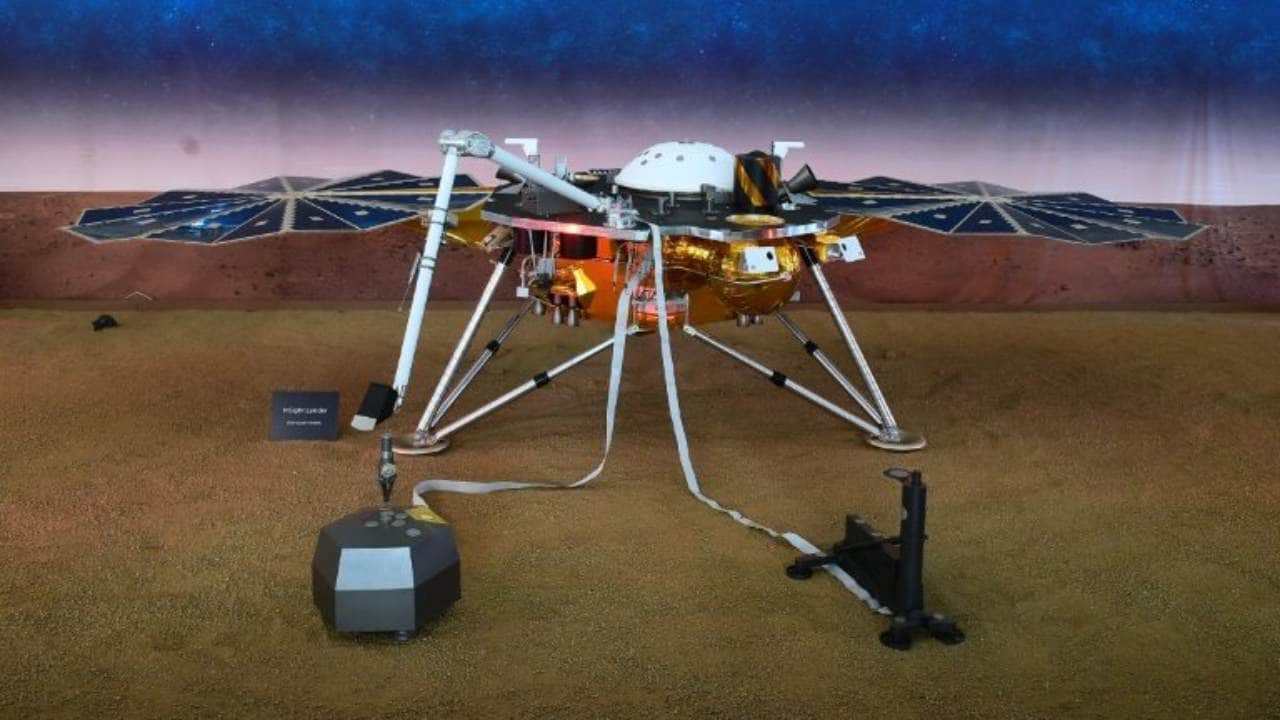 A replica of the Mars InSight lander at NASA's Jet Propulsion Laboratory in California. Image courtesy: NASA[/caption]InSight has no instruments or missions to detect life, though. That will be left to future rovers like the Mars 2020, which will collect rocks that will eventually be brought back to Earth and analysed for evidence of ancient life.The spacecraft was built by NASA to last for a two-year mission on the planet, during which it is expected to learn more than any spacecraft before about Mars' rocky, quake(y) geology.
First Published:Nov 30, 2018, 09:41:31 IST
Advertisement
Advertisement

Careless Whispers: Scientists discover that plants can 'talk' to each other using smells
Japanese scientists have recorded a video that shows plants, in certain conditions, communicate with each other using mists that carry smells. The discovery, reveals that plants release a fine mist of airborne compounds, to warn nearby plants of potential dangers
Life on Mars? European Space Agency’s Orbiter discovers ice water deposits at equator
European Space Agency's Mars Express Orbiter has identified massive ice and ice water deposits beneath the surface of Mars. The Mars Express orbiter was also the first to confirmed the presence of ice on Mars in 2004
Microsoft briefly overtakes Apple as the most valuable company, Apple back on top again
At its peak during the session, Microsoft's value reached $2.903 trillion, with a 2% surge. As of writing this article, Apple closed at $2.89 trillion, whereas Microsoft closed at $2.86 trillion
Even NASA is facing a tough time, starts layoffs following major budget cuts
NASA is facing some massive budget cuts, because of which, it has been forced to postpone some upcoming missions. NASA's Jet Propulsion Laboratory has been hit hard by recent federal budget cuts, resulting in the layoff of 100 contractors last week
ISRO, NASA's NISAR satellite to get ready by Jan-end, will monitor Earth's snow-covered regions
The NISAR satellite which has been developed jointly ISRO and NASA, should be ready for launch by the end of January 2024. The collaboration between NASA and ISRO on NISAR is the first time the two agencies have cooperated on hardware development for an Earth-observing mission
Advertisement
Advertisement