
Advertisement


Sections
NASA InSight lands safely on Mars, begins early tests on its dusty, equatorial home after relaying first images from the Red Planet
NASA's InSight spacecraft is stationary & will operate from the same spot for the next 2 years.

Cheers and applause filled the mission control room at NASA's Jet Propulsion Laboratory on Monday as a the agency's newest unmanned lander, InSight, make a successful touchdown on Mars, bringing a satisfactory end to a 7-year journey from design to launch to landing.The $993 million spacecraft is build to study quakes and tremors, map the Red Planet's interiors, detect signs of its formation billions of years ago and, by extension, how other rocky planets like Earth came to be. This now marks the eighth successful Mars landing in NASA's history."It was intense and you could feel the emotion," said NASA administrator Jim Bridenstine, in an interview on NASA television afterward.The vehicle appeared to be in good shape, according to NASA engineers that studies the first sensor pings from InSight's survey of the Mars surface.As the mission team expected, dust from the probe's landing created a film of dust and bits of rock on the first image InSight sent back."Here's a quick-and-dirty attempt at processing out distortion in the first image from InSight," Emily Lakdawalla, senior editor at the Planetary Society, wrote on Twitter."It does look like the lander is a bit tilted, which is not ideal, but the workspace looks flat as a pancake and nearly rock-free," Tom Hoffman, InSight Project Manager at NASA JPL, said at the post-landing briefing. The principal investigator on the French seismometer, Philippe Lognonne, said he was "relieved and very happy" at the outcome. "I've just received confirmation that there are no rocks in front of the lander," he told AFP.InSight will soon gear up to open its solar arrays, as NASA waits to learn if this crucial phase went as planned, and wasn't affected by the spacecraft's journey or landing.Like all the rovers sent to Mars before it, the new lander will also run on solar power once it reaches the Martian surface.Entry, descent, landingThe spacecraft is NASA's first to touch down on Earth's neighboring planet since the Curiosity rover arrived in 2012.More than half of 43 attempts to reach Mars with rovers, orbiters and probes by space agencies from around the world have failed.[caption id="attachment_5622031" align="alignnone" width="1280"]![The first image of Mars taken by NASA's InSight Mars lander after its successful landing on the 'aprking lot'-like Elysium Planitia on 26 November, 2018. The dust seen in the image is a dust cover protecting its camera till InSight sends back a signal assuring the team it has landed in a safe spot. Image courtesy: NASA JPL]() The first image of Mars taken by NASA's InSight Mars lander after its successful landing on the 'aprking lot'-like Elysium Planitia on 26 November, 2018. The dust seen in the image is a dust cover protecting its camera till InSight sends back a signal assuring the team it has landed in a safe spot. Image courtesy: NASA JPL[/caption]NASA is the only space agency to have made it, and is invested in these robotic missions as a way to prepare for the first Mars-bound human explorers in the 2030s."We never take Mars for granted. Mars is hard," Thomas Zurbuchen, NASA associate administrator for the science mission directorate, said on Sunday.The nail-biting entry, descent and landing phase began at 11.47 am (7 pm GMT) at NASA's Jet Propulsion Laboratory in Pasadena, California, home to mission control for Mars InSight, and ended one second before 7.53 pm GMT.A carefully orchestrated sequence — already fully preprogrammed on board the spacecraft — unfolded over the following several minutes, coined "six and a half minutes of terror."Speeding faster than a bullet at 12,300 miles (19,800 kilometers) an hour, the heat-shielded spacecraft encountered scorching friction as it entered the Mars atmosphere.The heat shield soared to a temperature of 2,700 Fahrenheit (about 1,500 Celsius) before it was discarded, the three landing legs deployed and the parachute popped out, easing InSight down to the Martian surface.[caption id="attachment_5622061" align="alignnone" width="1280"]
The first image of Mars taken by NASA's InSight Mars lander after its successful landing on the 'aprking lot'-like Elysium Planitia on 26 November, 2018. The dust seen in the image is a dust cover protecting its camera till InSight sends back a signal assuring the team it has landed in a safe spot. Image courtesy: NASA JPL[/caption]NASA is the only space agency to have made it, and is invested in these robotic missions as a way to prepare for the first Mars-bound human explorers in the 2030s."We never take Mars for granted. Mars is hard," Thomas Zurbuchen, NASA associate administrator for the science mission directorate, said on Sunday.The nail-biting entry, descent and landing phase began at 11.47 am (7 pm GMT) at NASA's Jet Propulsion Laboratory in Pasadena, California, home to mission control for Mars InSight, and ended one second before 7.53 pm GMT.A carefully orchestrated sequence — already fully preprogrammed on board the spacecraft — unfolded over the following several minutes, coined "six and a half minutes of terror."Speeding faster than a bullet at 12,300 miles (19,800 kilometers) an hour, the heat-shielded spacecraft encountered scorching friction as it entered the Mars atmosphere.The heat shield soared to a temperature of 2,700 Fahrenheit (about 1,500 Celsius) before it was discarded, the three landing legs deployed and the parachute popped out, easing InSight down to the Martian surface.[caption id="attachment_5622061" align="alignnone" width="1280"]![This image shows an annotated image from NASA's InSight lander showing key parts of the terrain and lander after successful touchdown. Image courtesy: NASA TV]() This image shows an annotated image from NASA's InSight lander showing key parts of the terrain and lander after successful touchdown. Image courtesy: NASA TV[/caption]Goal: 3D map of inner MarsInSight contains key instruments that were contributed by several European space agencies.France's Centre National d'Etudes Spatiales (CNES) made the Seismic Experiment for Interior Structure (SEIS) instrument, the key element for sensing quakes.The German Aerospace Center (DLR) provided a self-hammering mole that can burrow 16 feet (five meters) into the surface -- further than any instrument before -- to measure heat flow.Spain's Centro de Astrobiologia made the spacecraft's wind sensors.Three of InSight's seismic instruments were designed and built in Britain.Other significant contributions came from the Space Research Center of the Polish Academy of Sciences and Astronika and the Swiss Institute of Technology."It is wonderful news that the InSight spacecraft has landed safely on Mars," said Sue Horne, head of space exploration at the UK Space Agency.Together, the instruments will study geological processes, said Bruce Banerdt, InSight's principal investigator at the Jet Propulsion Laboratory.By listening for tremors on Mars, whether from quakes or meteor impacts or even volcanic activity, scientists can learn more about its interior and reveal how the planet formed.The goal is to map the inside of Mars in three dimensions, "so we understand the inside of Mars as well as we have come to understand the outside of Mars," Banerdt told reporters. With inputs from AFP
This image shows an annotated image from NASA's InSight lander showing key parts of the terrain and lander after successful touchdown. Image courtesy: NASA TV[/caption]Goal: 3D map of inner MarsInSight contains key instruments that were contributed by several European space agencies.France's Centre National d'Etudes Spatiales (CNES) made the Seismic Experiment for Interior Structure (SEIS) instrument, the key element for sensing quakes.The German Aerospace Center (DLR) provided a self-hammering mole that can burrow 16 feet (five meters) into the surface -- further than any instrument before -- to measure heat flow.Spain's Centro de Astrobiologia made the spacecraft's wind sensors.Three of InSight's seismic instruments were designed and built in Britain.Other significant contributions came from the Space Research Center of the Polish Academy of Sciences and Astronika and the Swiss Institute of Technology."It is wonderful news that the InSight spacecraft has landed safely on Mars," said Sue Horne, head of space exploration at the UK Space Agency.Together, the instruments will study geological processes, said Bruce Banerdt, InSight's principal investigator at the Jet Propulsion Laboratory.By listening for tremors on Mars, whether from quakes or meteor impacts or even volcanic activity, scientists can learn more about its interior and reveal how the planet formed.The goal is to map the inside of Mars in three dimensions, "so we understand the inside of Mars as well as we have come to understand the outside of Mars," Banerdt told reporters. With inputs from AFP
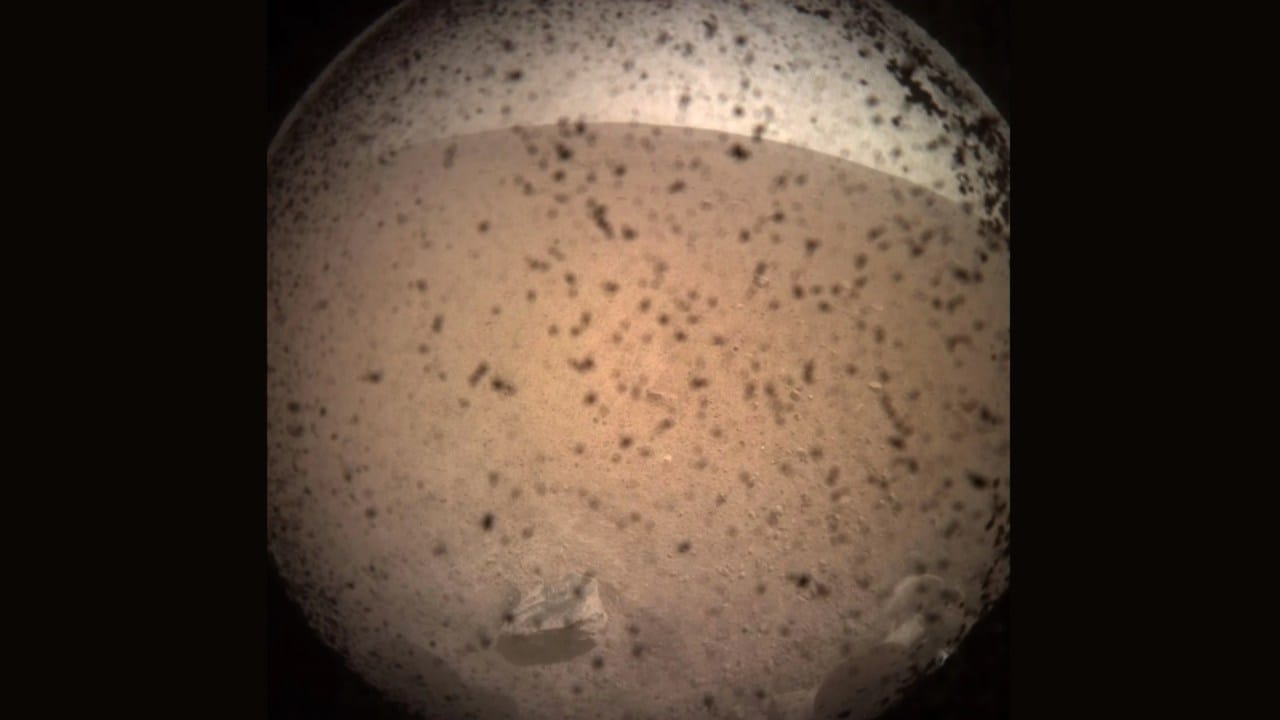 The first image of Mars taken by NASA's InSight Mars lander after its successful landing on the 'aprking lot'-like Elysium Planitia on 26 November, 2018. The dust seen in the image is a dust cover protecting its camera till InSight sends back a signal assuring the team it has landed in a safe spot. Image courtesy: NASA JPL[/caption]NASA is the only space agency to have made it, and is invested in these robotic missions as a way to prepare for the first Mars-bound human explorers in the 2030s."We never take Mars for granted. Mars is hard," Thomas Zurbuchen, NASA associate administrator for the science mission directorate, said on Sunday.The nail-biting entry, descent and landing phase began at 11.47 am (7 pm GMT) at NASA's Jet Propulsion Laboratory in Pasadena, California, home to mission control for Mars InSight, and ended one second before 7.53 pm GMT.A carefully orchestrated sequence — already fully preprogrammed on board the spacecraft — unfolded over the following several minutes, coined "six and a half minutes of terror."Speeding faster than a bullet at 12,300 miles (19,800 kilometers) an hour, the heat-shielded spacecraft encountered scorching friction as it entered the Mars atmosphere.The heat shield soared to a temperature of 2,700 Fahrenheit (about 1,500 Celsius) before it was discarded, the three landing legs deployed and the parachute popped out, easing InSight down to the Martian surface.[caption id="attachment_5622061" align="alignnone" width="1280"]
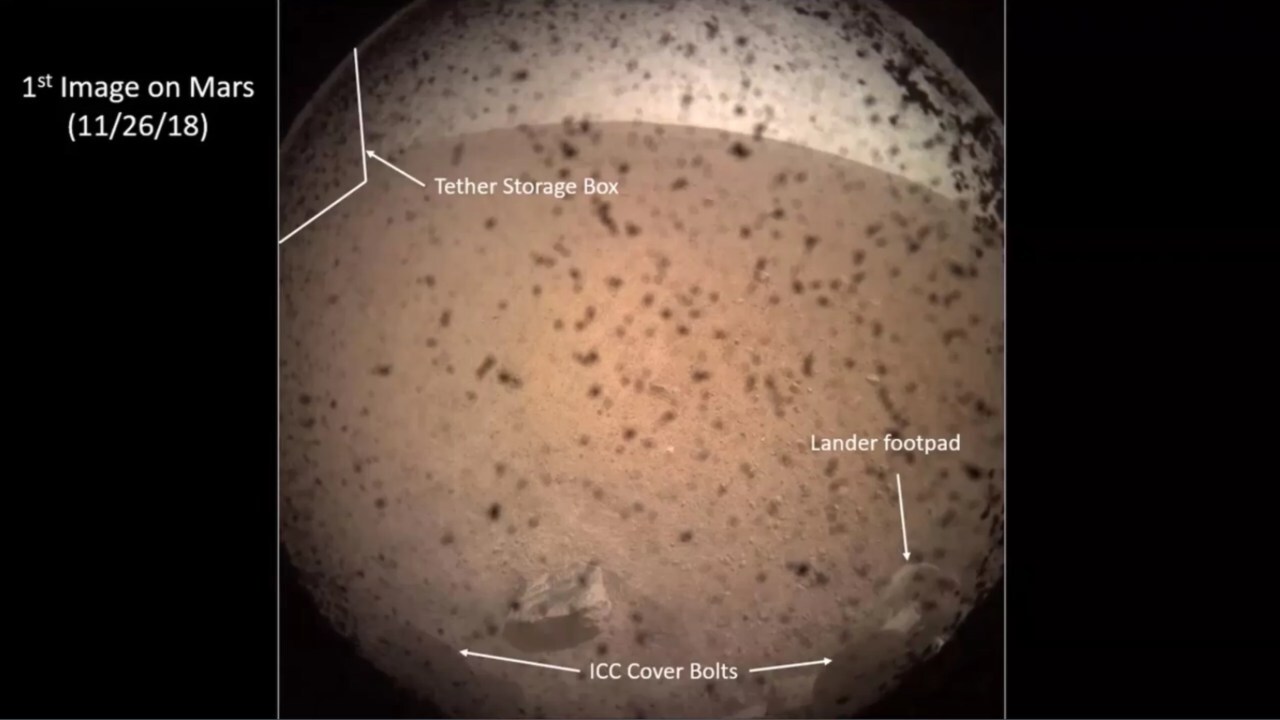 This image shows an annotated image from NASA's InSight lander showing key parts of the terrain and lander after successful touchdown. Image courtesy: NASA TV[/caption]Goal: 3D map of inner MarsInSight contains key instruments that were contributed by several European space agencies.France's Centre National d'Etudes Spatiales (CNES) made the Seismic Experiment for Interior Structure (SEIS) instrument, the key element for sensing quakes.The German Aerospace Center (DLR) provided a self-hammering mole that can burrow 16 feet (five meters) into the surface -- further than any instrument before -- to measure heat flow.Spain's Centro de Astrobiologia made the spacecraft's wind sensors.Three of InSight's seismic instruments were designed and built in Britain.Other significant contributions came from the Space Research Center of the Polish Academy of Sciences and Astronika and the Swiss Institute of Technology."It is wonderful news that the InSight spacecraft has landed safely on Mars," said Sue Horne, head of space exploration at the UK Space Agency.Together, the instruments will study geological processes, said Bruce Banerdt, InSight's principal investigator at the Jet Propulsion Laboratory.By listening for tremors on Mars, whether from quakes or meteor impacts or even volcanic activity, scientists can learn more about its interior and reveal how the planet formed.The goal is to map the inside of Mars in three dimensions, "so we understand the inside of Mars as well as we have come to understand the outside of Mars," Banerdt told reporters. With inputs from AFP
First Published:Nov 27, 2018, 08:00:52 IST
Advertisement
Advertisement

Careless Whispers: Scientists discover that plants can 'talk' to each other using smells
Japanese scientists have recorded a video that shows plants, in certain conditions, communicate with each other using mists that carry smells. The discovery, reveals that plants release a fine mist of airborne compounds, to warn nearby plants of potential dangers
Life on Mars? European Space Agency’s Orbiter discovers ice water deposits at equator
European Space Agency's Mars Express Orbiter has identified massive ice and ice water deposits beneath the surface of Mars. The Mars Express orbiter was also the first to confirmed the presence of ice on Mars in 2004
Microsoft briefly overtakes Apple as the most valuable company, Apple back on top again
At its peak during the session, Microsoft's value reached $2.903 trillion, with a 2% surge. As of writing this article, Apple closed at $2.89 trillion, whereas Microsoft closed at $2.86 trillion
Even NASA is facing a tough time, starts layoffs following major budget cuts
NASA is facing some massive budget cuts, because of which, it has been forced to postpone some upcoming missions. NASA's Jet Propulsion Laboratory has been hit hard by recent federal budget cuts, resulting in the layoff of 100 contractors last week
ISRO, NASA's NISAR satellite to get ready by Jan-end, will monitor Earth's snow-covered regions
The NISAR satellite which has been developed jointly ISRO and NASA, should be ready for launch by the end of January 2024. The collaboration between NASA and ISRO on NISAR is the first time the two agencies have cooperated on hardware development for an Earth-observing mission
Advertisement
Advertisement