
Advertisement


Sections
NASA has announced the 12 payloads that will help it prepare for the Artemis moon mission
The 12 payloads are a mix of old experiments from previous missions and new technologies.

It's been about 50 years since man last visited the moon. The National Aeronautics and Space Administration (NASA) has announced its intention of sending humans back to that orbiting rock and the mission has been dubbed Artemis. The learnings from the mission will help NASA plan for a future manned mission to Mars.In preparation for the Artemis mission, NASA is sending 12 payloads to study the moon and its surface. These 'investigations and demonstrations’ will be transferred to the moon via NASA's Commercial Lunar Payload Services (CLPS) project. Nine private companies have partnered with the US space agency to ensure that payloads that will further the development of technology and science can be quickly sent to the Moon.These new payloads are a mix of old equipment that has flown before and new hardware. Of the 12 selected, seven are new experiments that will study planets and heliophysics. The other five will demonstrate new technologies.[caption id="attachment_6649291" align="alignnone" width="1280"]![Artist’s concept of a future moon landing carried out under NASA's newly named Artemis program. Image: NASA]() Artist’s concept of a future moon landing carried out under NASA's newly named Artemis program. Image: NASA[/caption]"The selected lunar payloads represent cutting-edge innovations, and will take advantage of early flights through our commercial services project,” said Thomas Zurbuchen, associate administrator of the agency's Science Mission Directorate in Washington in a press release. "Each demonstrates either a new science instrument or a technological innovation that supports scientific and human exploration objectives, and many have broader applications for Mars and beyond.”The 12 selections are as follows:
Artist’s concept of a future moon landing carried out under NASA's newly named Artemis program. Image: NASA[/caption]"The selected lunar payloads represent cutting-edge innovations, and will take advantage of early flights through our commercial services project,” said Thomas Zurbuchen, associate administrator of the agency's Science Mission Directorate in Washington in a press release. "Each demonstrates either a new science instrument or a technological innovation that supports scientific and human exploration objectives, and many have broader applications for Mars and beyond.”The 12 selections are as follows:![Artemis on the Moon. Image credit: NASA]() Artemis on the Moon. Image credit: NASA[/caption]
Artemis on the Moon. Image credit: NASA[/caption]
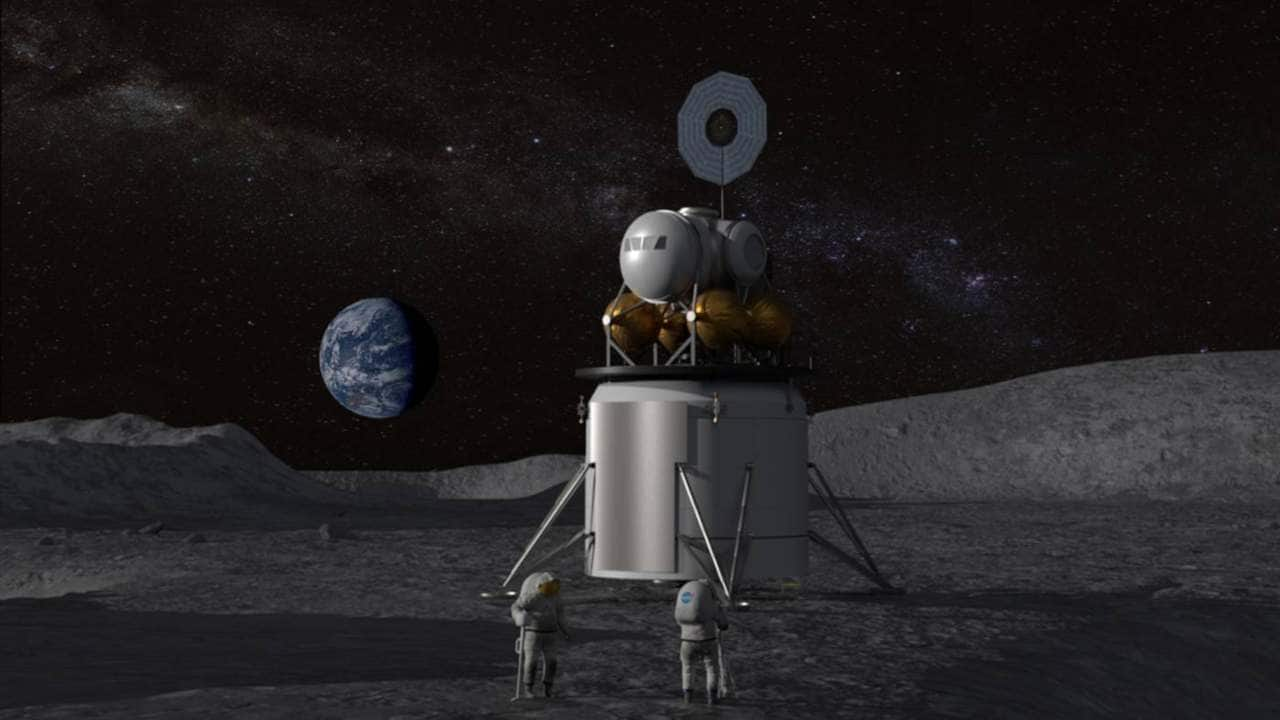 Artist’s concept of a future moon landing carried out under NASA's newly named Artemis program. Image: NASA[/caption]"The selected lunar payloads represent cutting-edge innovations, and will take advantage of early flights through our commercial services project,” said Thomas Zurbuchen, associate administrator of the agency's Science Mission Directorate in Washington in a press release. "Each demonstrates either a new science instrument or a technological innovation that supports scientific and human exploration objectives, and many have broader applications for Mars and beyond.”The 12 selections are as follows:
- MoonRanger is a fast-moving rover that can move beyond the communication range of its lander upto one km. It will map the surface of the Moon.
- Heimdall is a camera system that will study the Moon’s regolith (upper surface) as well look into potential landing sites for the mission.
- The Lunar Demonstration of a Reconfigurable, Radiation Tolerant Computer System, as its name suggests, will demonstrate radiation tolerant technology and will study the radiation effects on the lunar surface.
- The Regolith Adherence Characterization (RAC) Payload will determine how lunar regolith sticks to a range of materials exposed to the Moon's environment at different phases of flight. Components of this experiment were derived from a commercial payload facility called Materials International Space Station Experiment (MISSE) currently on the International Space Station.
- The Lunar Magnetotelluric Sounder is designed to characterize the structure and composition of the Moon’s mantle by studying electric and magnetic fields. The investigation will make use of a flight-spare magnetometer, a device that measures magnetic fields, originally made for the MAVEN spacecraft, which is currently orbiting Mars.
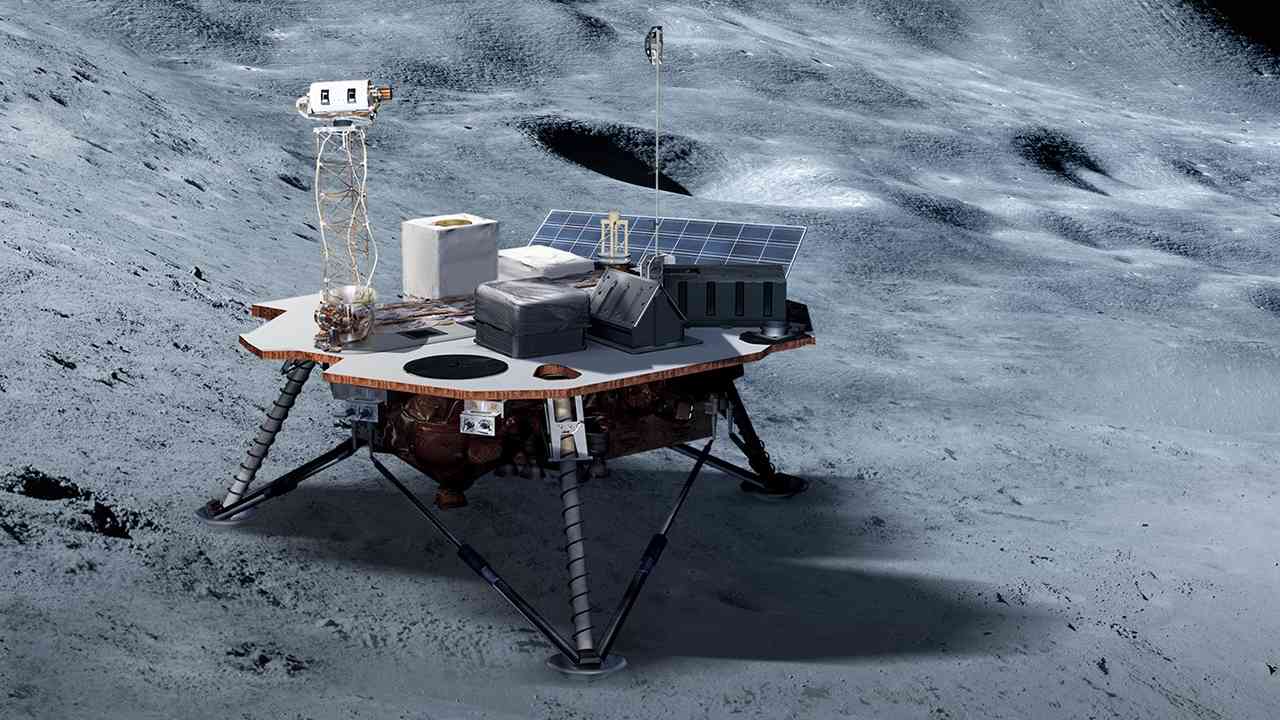 Artemis on the Moon. Image credit: NASA[/caption]
- The Lunar Surface Electromagnetics Experiment (LuSEE) will use hardware from the Parker Solar Probe FIELDS experiment, the STEREO/Waves instrument, and the MAVEN mission to make comprehensive measurements of electromagnetic phenomena on the surface of the Moon.
- The Lunar Environment heliospheric X-ray Imager (LEXI) will capture images of the interaction of Earth's magnetosphere with the flow of charged particles from the Sun, called the solar wind.
- The Next Generation Lunar Retroreflectors (NGLR) will serve as a target for lasers on Earth to precisely measure the Earth-Moon distance.
- The Lunar Compact InfraRed Imaging System (L-CIRiS) will deploy a radiometer, a device that measures infrared wavelengths of light, to explore the Moon's surface composition, map its surface temperature distribution, and demonstrate the instrument's feasibility for future lunar resource utilization activities.
- The Lunar Instrumentation for Subsurface Thermal Exploration with Rapidity (LISTER) is an instrument designed to measure heat flow from the interior of the Moon.
- PlanetVac is a technology for acquiring and transferring lunar regolith from the surface to other instruments that would analyze the material, or put it in a container that another spacecraft could return to Earth.
- The Sample Acquisition, Morphology Filtering, and Probing of Lunar Regolith (SAMPLR) is another sample acquisition technology that will make use of a robotic arm that is a flight-spare from the Mars Exploration Rover mission.
First Published:Jul 02, 2019, 15:29:49 IST
Advertisement
Advertisement

Careless Whispers: Scientists discover that plants can 'talk' to each other using smells
Japanese scientists have recorded a video that shows plants, in certain conditions, communicate with each other using mists that carry smells. The discovery, reveals that plants release a fine mist of airborne compounds, to warn nearby plants of potential dangers
Life on Mars? European Space Agency’s Orbiter discovers ice water deposits at equator
European Space Agency's Mars Express Orbiter has identified massive ice and ice water deposits beneath the surface of Mars. The Mars Express orbiter was also the first to confirmed the presence of ice on Mars in 2004
Microsoft briefly overtakes Apple as the most valuable company, Apple back on top again
At its peak during the session, Microsoft's value reached $2.903 trillion, with a 2% surge. As of writing this article, Apple closed at $2.89 trillion, whereas Microsoft closed at $2.86 trillion
Even NASA is facing a tough time, starts layoffs following major budget cuts
NASA is facing some massive budget cuts, because of which, it has been forced to postpone some upcoming missions. NASA's Jet Propulsion Laboratory has been hit hard by recent federal budget cuts, resulting in the layoff of 100 contractors last week
ISRO, NASA's NISAR satellite to get ready by Jan-end, will monitor Earth's snow-covered regions
The NISAR satellite which has been developed jointly ISRO and NASA, should be ready for launch by the end of January 2024. The collaboration between NASA and ISRO on NISAR is the first time the two agencies have cooperated on hardware development for an Earth-observing mission
Advertisement
Advertisement